PRINCE ADEYEMI SHONIBARE writes on why perpetual election losers and self-styled Amala intellectuals must stop searching for scapegoats
The Politics of Excuses
A recurring feature of our democracy is the tendency of some political actors to begin preparing excuses long before election results are announced.
Rather than investing in party structures, mobilizing supporters, engaging voters, and presenting credible alternatives, they often devote significant energy to constructing narratives that can be deployed after defeat.
When the results are eventually declared and do not favor them, the blame game begins.
The recent controversy surrounding a man allegedly seen with “INEC Observer” written on his back is a clear example.
Indeed, Nigeria’s growing number of social media commentators, self-appointed political analysts, and partisan propagandists appear to have embraced a familiar post elections formula:
Step One: Lose the election.
Step Two: Find a photograph.
Step Three: Declare democracy compromised.
Step Four: Convene a symposium on how victory was stolen.
Step Five: Repeat the process after the next election.
Allegations Require Evidence, Not Speculation
Observers are routinely issued accredited identification materials, including branded vests, tags, or both, to enable them perform their duties and move freely within designated areas.
Political parties also deploy accredited agents. Electoral officials, returning officers, security personnel, journalists, and election monitors all operate within the election environment under various forms of accreditation.
Curiously, those making the allegation have largely circulated images or clips showing only the back of the individual in question.
The back.
Not the front.
Not his accreditation.
Just the back and not where the man was rigging the elections.
Where is the complete evidence? Where is the continuous video showing both the front and back of the person and establishing his identity beyond reasonable doubt?
Perhaps the front contains information that has not been shared.
Perhaps it is being withheld for reasons best known to those circulating the claim.
Or perhaps no one bothered to verify the image before forwarding it to multiple WhatsApp groups.
In an age where artificial intelligence can generate convincing images, clone voices, and create videos that never happened, responsible citizens must insist on facts rather than assumptions.
Serious allegations require serious evidence
The Extraordinary Power Attributed to One Man. According to this emerging political theory, one individual somehow overpowered party agents, electoral officers, security personnel, election observers, journalists, voters, ballot papers, result sheets, and the entire democratic process.
What an extraordinary claim.
If one person’s presence alone could determine the outcome of an election, then Nigeria should immediately recruit him to help solve inflation, insecurity, unemployment, exchange-rate , and power supply challenges.
After all, if one man’s back can determine the outcome of an election in a state with party agents ,and other observers perhaps he can also fix the national grid.
The Real Questions Being Avoided
Instead of focusing on an individual wearing INEC Observer vest, Nigerians should ask more important questions.
Are the accusers disputing the actual votes cast?
Are they claiming that the election results were fabricated?
APC – over 300,000
PDP – Over 40,000
ADC and NDC were mere pretenders and not contenders. They were mere Waka Pass at the Ekiti state elections .
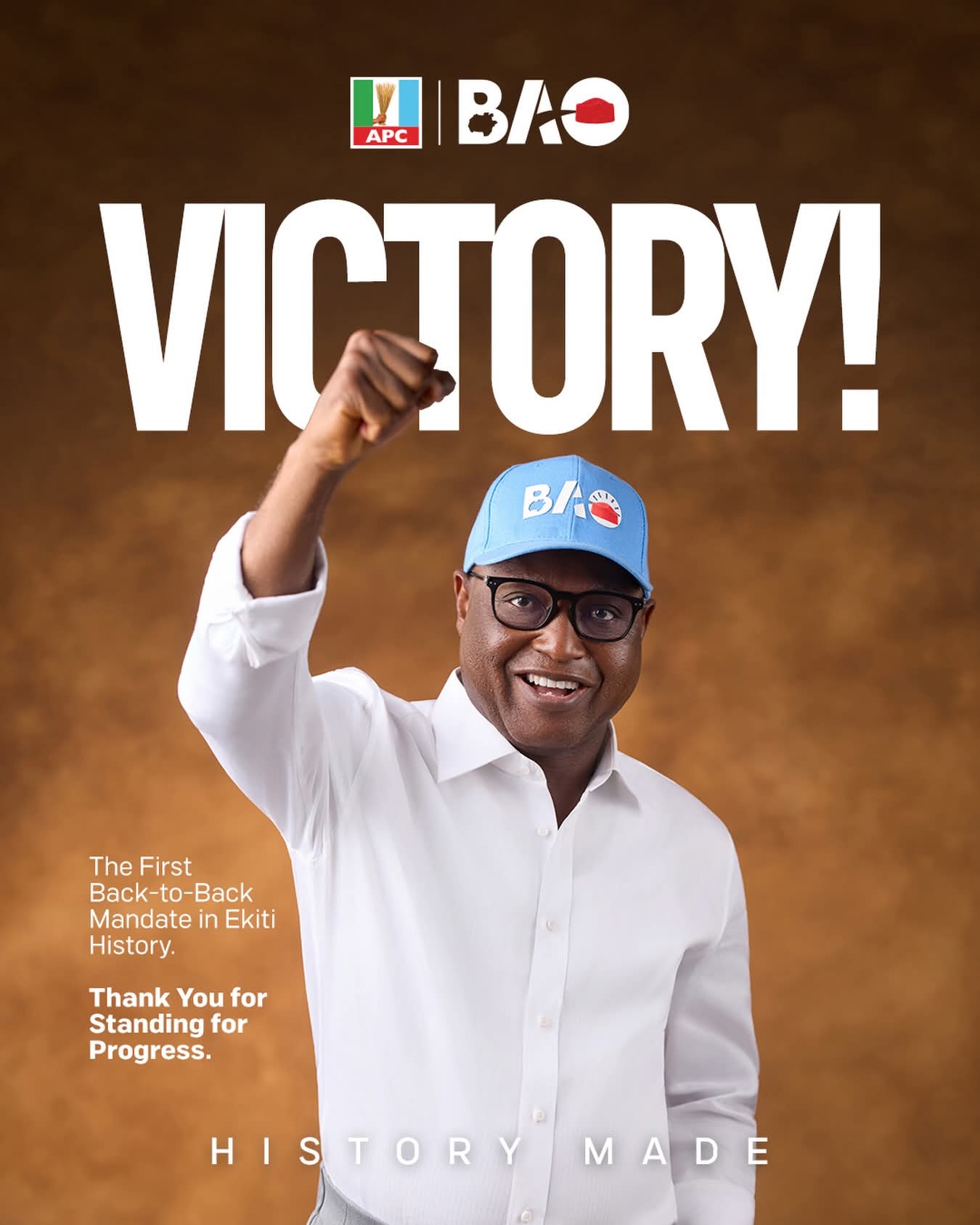
Are they disputing the overwhelming margin of victory recorded by Governor Biodun Abayomi Oyebanji (BAO)?
Most importantly, are they suggesting that one unidentified individual determined the outcome of an entire election?
These are the questions that matter.
Everything else risks becoming a distraction from the true verdict delivered by voters.
The BAO Phenomenon
Governor Biodun Abayomi Oyebanji’s victory did not happen in isolation.
It was the result of years of political engagement, governance, consensus-building, and grassroots connection.
By many accounts, his re-election performance was historic.
However, BAO’s greatest achievement may not simply be electoral victory.
His greatest achievement may be political unity.
In a state known for intense political rivalry, he accomplished something many considered difficult.
He brought together former governors, political leaders, traditional rulers, professionals, youth groups, women’s organizations, artisans, and other stakeholders behind a common vision for Ekiti State.
For perhaps the first time in many years, Ekiti witnessed a level of political cohesion that transcended personal ambitions and partisan divisions.
Instead of accumulating opponents, BAO built alliances. Instead of erecting barriers, he built bridges. Instead of governing for a faction, he governed for the entire state. This presents a serious challenge for professional excuse manufacturers.
Their preferred script requires an unpopular governor. Instead, they encountered a governor widely regarded as effective, accessible, and unifying. That creates a problem. When voters are satisfied, excuses become difficult to sell.
To many people in Ekiti, the election result was not a surprise. It was simply a confirmation of public sentiment.
A Relatively Peaceful Election
Those familiar with Ekiti politics know that elections in the state have historically been highly competitive and, at times, volatile. Compared with several elections in the past, this contest was widely viewed as relatively peaceful.
That does not mean isolated incidents or complaints should be ignored. Every allegation deserves proper investigation.
However, isolated incidents should not automatically be used as grounds for invalidating the collective decision of hundreds of thousands of voters.
Democracy requires fairness, balance, and respect for the overall verdict of the electorate.
President Tinubu’s Congratulations
President Bola Ahmed Tinubu congratulated Governor Oyebanji on his victory and commended the people of Ekiti State for their peaceful participation in the democratic process.
The President described the outcome as a reflection of the confidence reposed in the governor’s leadership and urged him to remain focused on delivering greater dividends of democracy to the people.
The message reinforced a simple democratic principle:
Electoral victories are ultimately earned through service, performance, and public trust.
Elections Are Won Before Election Day
The truth many politicians refuse to accept is that elections are not won on social media, television interviews, or WhatsApp broadcasts.
They are won through years of grassroots engagement.
They are won through effective organization.
They are won through credible candidates.
They are won through voter mobilization.
They are won through hard work.
As the popular saying goes, tomorrow’s success is determined by the work done today.
Political victories are rarely accidental
They are usually the product of planning, preparation, discipline, and sustained engagement with the people.
Unfortunately, some opposition elements appear to believe that electoral victory should arrive automatically, regardless of preparation, structure, or public support.
Politics does not work that way.
Democracy rewards effort, strategy, performance, and connection with the electorate.
The Voters Have Spoken Again
For months, some opposition voices have insisted that 2027 will be “the masses versus APC.”
That argument would be more convincing if the same masses were not repeatedly voting whenever elections are conducted.
Recent electoral outcomes tell their own story:
• Ekiti — APC
• Ondo— APC
• Rivers — PDP
• Kebbi — APC
• Kano — APC
• Nasarawa — APC
• Enugu — APC
Six out of seven.
The opposition talks.
The voters vote.
And once again, the voters have delivered a message.
Democracy Demands Reflection, Not Rationalization
A healthy democracy requires a strong and credible opposition.
However, opposition parties strengthen democracy only when they engage in honest self-assessment after defeat.
What democracy does not need is a chorus of self-appointed analysts who spend more time rationalizing losses than understanding them.
Blaming every setback on conspiracies, imaginary plots, unverified allegations, mysterious backs, suspicious shadows, and social media theories does not inspire confidence among voters.
Political parties that wish to win future elections must first understand why they lost previous ones.
The road to victory is not paved with excuses.
It is paved with preparation.
Final Word
Democracy is ultimately about the will of the people.
When voters speak, political actors have only two choices: learn from the verdict or manufacture explanations for rejecting it.
The first path builds stronger parties and a stronger democracy.
The second creates permanent support groups for electoral disappointment.
Nigeria deserves political competition built on ideas, performance, organization, preparation, and hard work—not endless searches for scapegoats after every election.
The lesson remains simple.
Voters reward those who prepare.
Voters reward those who organize.
Voters reward those who engage.
Voters reward those who perform.
As for the professional election mourners, social media commentators, emergency political scientists, and self-appointed analysts, they may continue investigating photographs, decoding shadows, examining backs, and conducting forensic analysis on election posters.
But democracy remains stubbornly simple.
It counts votes.
Not excuses.
And when the counting is complete, the voters—not social media analysts, conspiracy theorists, or post-election philosophers—deliver the final verdict.
Excuses do not win elections.
Hard work does.