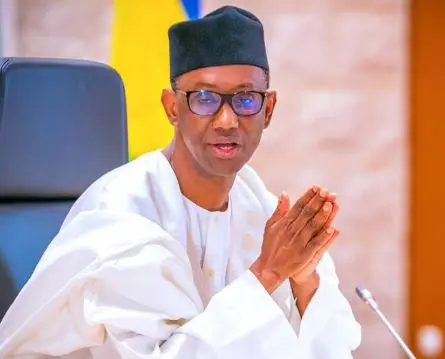
The National Security Adviser (NSA), Nuhu Ribadu, has warned that extremist groups and bandit networks operating in parts of northern Nigeria are increasingly targeting vulnerable young people, exploiting poverty, lack of education, and social disconnection to expand their recruitment base.
Ribadu said the demographic realities of the country, particularly in the North, have made unemployed and out-of-school youths easy targets for violent groups that offer them a false sense of identity, belonging, and purpose.
He stressed that insecurity in Nigeria has gone beyond conventional armed confrontation, noting that extremist ideologies now thrive on socio-economic deprivation and community fragmentation.
The NSA made the remarks at an EU/BUK Workshop in Kano, where he was represented by a Director of State Liaison in the Office of the National Security Adviser.
According to him, “We cannot secure our nation if our children remain on the streets. A child disconnected from education is far more vulnerable to manipulation and exploitation.”
He added that while the Federal Government has deployed significant military resources to combat insurgency and banditry, force alone cannot deliver lasting peace if the root causes remain unaddressed.
“Experience, both in Nigeria and globally, has shown that military operations alone cannot sustainably resolve insecurity where the underlying drivers of violence remain intact,” Ribadu said.
He explained that Nigeria’s security architecture is gradually shifting towards a more holistic strategy that combines military action with non-kinetic interventions such as education, inclusion, dialogue, and community resilience.
Ribadu noted that security agencies are increasingly recognising that recruitment into violent groups is often driven less by ideology at the onset, and more by desperation, unemployment, and lack of opportunity.
He described this as a “strategic gap” that requires urgent attention, stressing that sustainable peace must be built through what he called a “whole-of-society approach” involving government institutions, traditional leaders, religious authorities, and local communities.
“Security must increasingly become a shared responsibility. Peace-building is not the duty of the state alone,” he said.
He further warned that ethnic, religious, and political narratives are increasingly being weaponised to deepen divisions and accelerate instability across communities in the North.
Also speaking, the Governor of Kano State, Abba Kabir Yusuf, called for stronger collaboration among all stakeholders, including traditional institutions, religious leaders, youth groups, academia, and civil society, in tackling insecurity.
Represented by the Commissioner for Budget and Planning, Musa Suleiman Shanono, the governor said universities must take a leading role in producing research-driven solutions that shift security responses from reaction to prevention.
“Our universities must lead in generating ideas that move us from reaction to prevention,” he said.
He added that northern Nigeria must urgently move beyond rhetoric and produce measurable outcomes in the fight against insecurity, warning that the region can no longer afford repeated communiqués without tangible results.
“We are blessed with resources, but the challenges before us require unity of purpose. All hands must be on deck to move the region forward,” he added.
The workshop ended with a consensus that addressing insecurity in northern Nigeria requires sustained investment in education, social welfare, and community-driven peacebuilding initiatives alongside ongoing military operations.
FOLLOW US