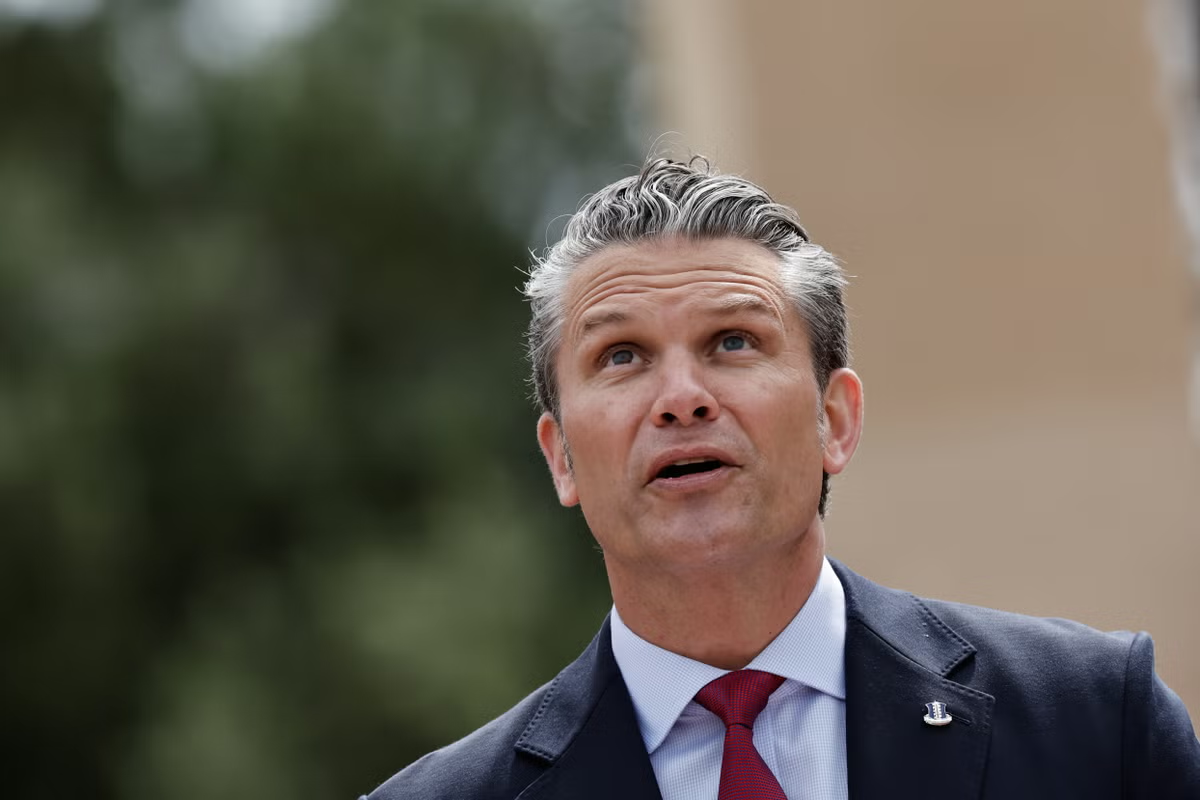
Defense Secretary Pete Hegseth arrived at the naval base in Guantanamo Bay, Cuba, on Wednesday, marking the latest high-profile visit by a senior American official as the Trump administration intensifies pressure on Havana.
This trip follows closely on the heels of General Francis Donovan, the top U.S. commander for Latin America, who visited Naval Station Guantanamo Bay less than two weeks prior and held discussions with a senior Cuban general at the perimeter. Earlier in May, CIA Director John Ratcliffe also made a rare visit to Havana.
Hegseth made no public remarks upon landing, where he is expected to meet US troops stationed at the base. The Trump administration has frequently cited political change in Cuba as a key foreign policy objective.
Michael Bustamante, head of the Cuban studies program at the University of Miami, suggested the visit could underscore US resolve amidst growing concerns in Cuba about a potential US military intervention.
“Perhaps Hegseth’s visit is intended to yet again reinforce the message that the cost of not coming to the table could be use of a military option, even as observers increasingly warn of such an operation’s potential complications,” he stated.
Cuba has been a U.S. antagonist since Fidel Castro’s 1959 revolution.
On May 20, the U.S. formally charged former Cuban President Raúl Castro with four counts of murder for the 1996 downing of civilian aircraft operated by Miami-based exiles.
The Trump administration enjoys strong support from hardline Cuban Americans in Florida, who have long advocated for US-instigated regime change, and has steadily increased pressure on the island nation, reflecting a broader strategy to assert US influence in the Western Hemisphere.
Washington’s more assertive role in Latin America was epitomized by an audacious U.S. military raid to capture Venezuelan President Nicolas Maduro on January 3. Maduro, a socialist aligned with Cuba, was flown to New York to face drug trafficking charges. He has pleaded not guilty to all charges.
Secretary of State Marco Rubio, a son of Cuban immigrants and a potential 2028 Republican presidential contender, has heightened alarm in Havana by describing Cuba as a “failed state” posing a national security risk just 90 miles from Florida.
On May 5, Rubio and General Donovan were pictured in front of a map of Cuba in a post by Donovan’s Southern Command, which stated that their talks focused on “U.S. efforts to counter threats that undermine security, stability and democracy in our hemisphere.”
Cuban Foreign Minister Bruno Rodriguez has warned that any military action would result in a “bloodbath,” claiming thousands of Cubans and Americans would perish.
The Trump administration has also effectively imposed a fuel blockade on the island by threatening tariffs on countries supplying oil and other energy sources, leading to widespread power outages and further damaging Cuba’s already struggling economy.
Experts caution that instability in Cuba could potentially trigger a migration crisis.