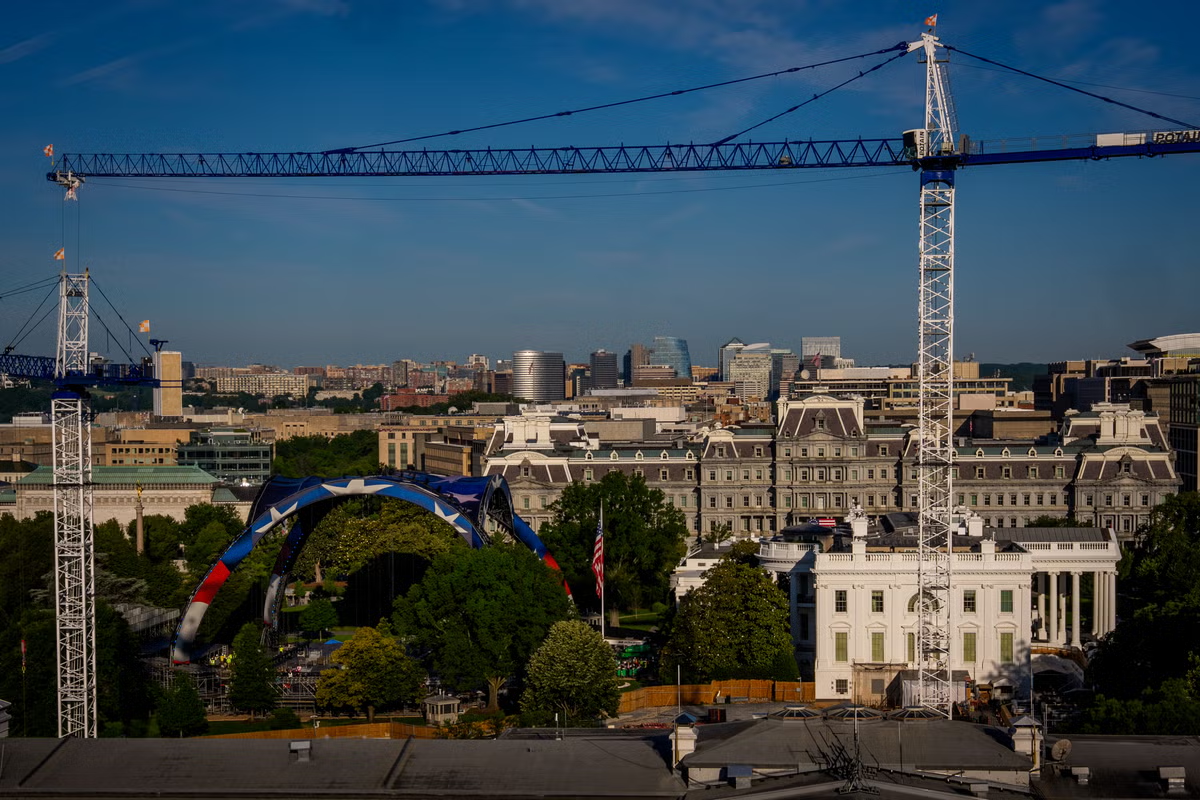
The Department of Justice says a thwarted plot to assassinate President Donald Trump during a UFC cage match on the White House lawn “demonstrates a compelling need” for a ballroom on the site of the now-demolished East Wing.
Hours after federal prosecutors charged five men for an alleged attempt to attack Sunday’s event, government attorneys asked a federal appeals court to lift a court order that blocks construction of the project.
The ballroom is “designed to defend against just such attacks” with a “highly sophisticated Drone Port and Sniper Nests,” according to a letter from the Justice Department.
The building will also feature a “heavy steel drone-proof roof, missile resistant columns, bullet, ballistic, and blast proof glass windows, military grade and hermetically sealed venting for air conditioning and heating, and far more,” lawyers wrote.
Costs for Trump’s proposed ballroom have surged to at least $600 million, with at least half to be paid by taxpayers, according to internal estimates. The White House initially estimated the project would cost $200 million and be paid by private donors, though the administration recently asked Congress for $1 billion in public funding for security additions — including the ballroom.
“They have a budget in Secret Service and the military to do some of the work that you see right here,” Trump said while hosting a tour of the construction site last month.
The ballroom “is not going to be paid for by the taxpayer,” he said. “This is a gift to the United States of America.”
The Trump administration recently revealed in court filings that the ballroom isn’t the primary purpose for the project. Instead, the government is building a sprawling underground bunker with military installations on the site.
In March, U.S. District Judge Richard Leon ruled that any new construction on White House grounds requires congressional approval, regardless of whether the president plans to use private or public dollars to fund his ballroom.
But his order did not prevent the government from continuing work on the bunker. The plaintiff in the case against the project, the National Trust for Historic Preservation, never objected to that part of the project.
A federal appeals court also has allowed construction to continue while the legal battle plays out. That appellate panel is now deciding whether to continue blocking the project.
“The Ballroom’s mass and height will shield the White House grounds from attack, and give the Secret Service the visibility needed to identify attackers,” Justice Department lawyers wrote to the court Monday night.
“In short, the repeated assassination attempts and plots against President Trump and those around him demonstrate the National Security imperative for a bullet proof, drone proof Ballroom to protect the President, all future Presidents, their Cabinets, staffs, families, and guests,” they wrote.
The Trump administration had similarly urged the courts to allow work to continue one day after a gunman opened fire near a security checkpoint and struck a bystander near a security checkpoint last month. Trump was inside the White House at the time and unharmed, but the proposed ballroom would provide a “SAFE HAVEN” from would-be attackers in the future, government lawyers wrote in a Truth Social-inspired filing at the time.
The Justice Department also wrote last month that “many patriotic private donors” have pledged “hundreds of millions of dollars“ to support the project, but a watchdog group has found that the administration awarded more than $50 billion in new and increased government contracts to the project’s corporate donors.
More than half of the 27 publicly identified donors have been awarded new or expanded federal contracts since construction work began, according to reporting from watchdog group Public Citizen.
Fourteen corporate donors saw their government business grow in the first six months with contracts worth a combined $50 billion, the report found.
The Trump administration has argued throughout the legal battle that no one has any legal standing to challenge the project once the demolition started, though Judge Leon argued in March that there is no law that “comes close” to giving Trump the authority to build on the property without congressional approval
Earlier this month, government lawyers argued that nothing can stop the project once it starts, even if the courts find that the government illegally demolished the East Wing.
The work has simply moved too quickly for anyone to intervene, government lawyers argued during oral arguments to the D.C. appeals court.
Asked whether Trump could hypothetically bulldoze the Statue of Liberty before anyone has a chance to sue and stop him, the Justice Department seemed to suggest he could. “I think that’s right, yes,” Justice Department lawyer Yaakov Roth said in court.
More details here...