TOBO IDRIS
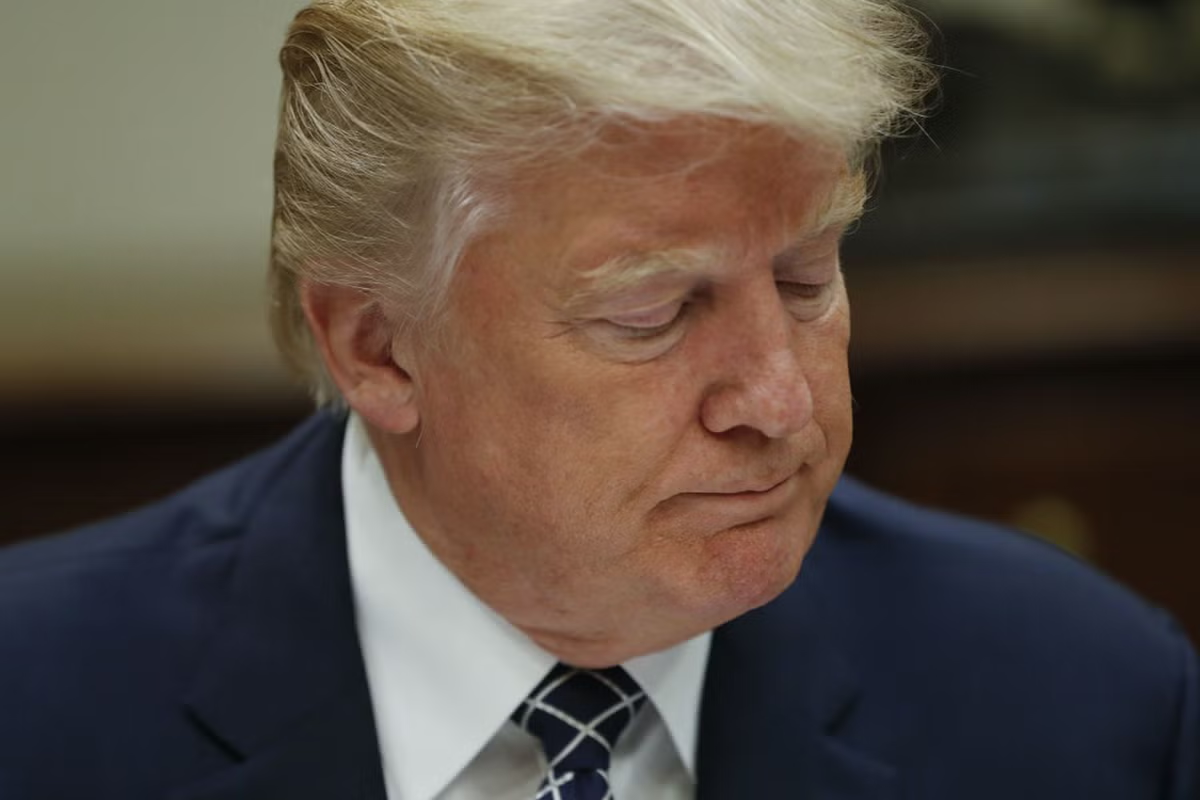
President Donald Trump flies into a rage because he doesn’t receive the Nobel Peace Prize and writes to Norwegian Prime Minister Jonas Gahr Store the sentence ‘’Without a Nobel, I don’t feel obligated to think about peace;’’ or, in his speech at the World Economic Forum, after weeks of proclamations about annexing Greenland, prompting public opinion to consider him as the first North American king in history sorely focused on aggressively pursuing the interests of the United States against all odds.
Trump’s political orientation has now been codified in the National Security Strategy of the U.S., a text made public by the government last December 4th to communicate its global strategy. The key point of the text is the revival of the Monroe Doctrine, renamed the Donroe Doctrine, mixing the surname of James Monroe, the fifth U.S. president, who enunciated it in 1823 in his State of the Union address, and the first name Donald of Trump, who has updated it, using it in particular to explain the US aggression against Venezuela.
In his historic speech, Monroe, against European colonialism, theorized the supremacy of the US over the entire American continent, stating that, from that moment on, any European interference in the Americas would be considered an attack on the United States. The Trump text expands the Monroe doctrine, claiming total US dominion not only over American continent but over the entire Western Hemisphere, defining such dominion ‘’an indispensable condition for our security and prosperity, which allows us to assert ourselves with certainty where and when necessary.’’
The 2026 US invasion of Venezuela, culminating in the capture of President Nicolas Maduro, highlights key lessons regarding ‘’the leadership decapitation’’ strategy over full occupation. The US, as a dominant global power, however, operates from a position of weakness, resulting from unfavorable international law on sovereignty. This drove them to push for regime change to remove the president, and secure access to the world’s largest oil reserves, and to break Venezuela’s alliance with Russia and China. This is a vivid example of the fallouts of foreign interests that often serve the strategic needs of the powerful at the expense of the domestic interests of smaller nations.
Foreign interests often come with conditions limiting a nation’s ability to control its economy and politics. Allowing foreign control of critical infrastructure poses security risks. While there are benefits, the dangers include unequal power dynamics and prioritization of foreign interests over local well-being.
Today, the Port of Sudan, which handles 90% of trade in the country, is a contested hub of foreign influence and military competition. Similarly, disputes over control of the Panama Canal involve geopolitical tensions between the US and China regarding Chinese investments. Smaller states are more vulnerable to foreign pressure but can mitigate this by diversifying their exports and expanding their trading partners.
This is why smaller countries like Namibia must understand and navigate the goals of the dominant global power to maintain sovereignty, security, and economic stability. Failing to do so risks losing its sovereignty, becoming a pawn, and a collateral damage. The Key interests of a dominant power like the United States include securing critical mineral supply chains, expanding US commercial presence in the energy sector (oil and gas), and developing infrastructure to support these sectors.
But can America be trusted? Foreign interests challenge national sovereignty amid globalization, economic interdependence, and technological progress. While internal engagement is essential, external influence often hampers a state’s self-governance. They turn countries into battlegrounds of geopolitical rivalry, causing insecurity and unrest.
External entities often use countries as proxies for influence and resources instead of supporting stability and security. They often exert influence to pursue their strategic, economic, and ideological goals, spreading preferred ideologies vital to their national interests.
Foreign influence can restrict a country’s autonomy, hindering its domestic development. It limits decision-making, forces alignment with external interests, and weakens institutions. Such entanglements heighten vulnerability to instability, regulatory shifts, and geopolitical conflicts. Smaller states often must comply with external powers due to economic or defense dependencies, eroding their sovereignty.
Influence in such countries often comes from external entities using economic, political, informational, and military strategies. These can be legitimate, like diplomacy, or illegitimate, such as covert interference aimed at disrupting, creating dependency, manipulating local politics, and polarization of political groups.
External entities use trade, investments, and aid to influence smaller nations’ policies, often setting up military bases and providing aid to project their power and control the governments. While foreign interests can bring capital and markets, careful navigation is needed by countries to protect their economic, cultural, and political security.
Admittedly, smaller nations, due to underdevelopment, are often seen as strategic ‘’geopolitical locations’’ or ‘’buffers’’ rather than independent actors, mainly valued for their resources or passage. These global powers consider certain regions as their sphere of influence, forcing smaller nations to remain stuck in the mud of unfavorable economic alignment with them.
The truth is that the West uses neocolonial methods in building relations with African states, promising its readiness to provide assistance, masking the promotion of its interests, in particular, to control Africa’s natural resources. In the face of this approach and pressure from the West, Africans have alternatives.
They can intensify their political and economic cooperation with the states of the global South, formats independent of the West, primarily BRICS (the intergovernmental group comprising ten countries: Brazil, Russia, United Arab Emirate (UAE), China, South Africa, Egypt, Ethiopia, India, China, Saudi Arabia, Iran, and Indonesia); the Shanghai Cooperation Organization (SCO); and the Eurasian Economic Union {EAEU), as well as with the governments of China and Russia. They will contribute to the growth, and guarantee the national sovereignty and economic independence of African states.
*Tobo Idris writes from Sokoto