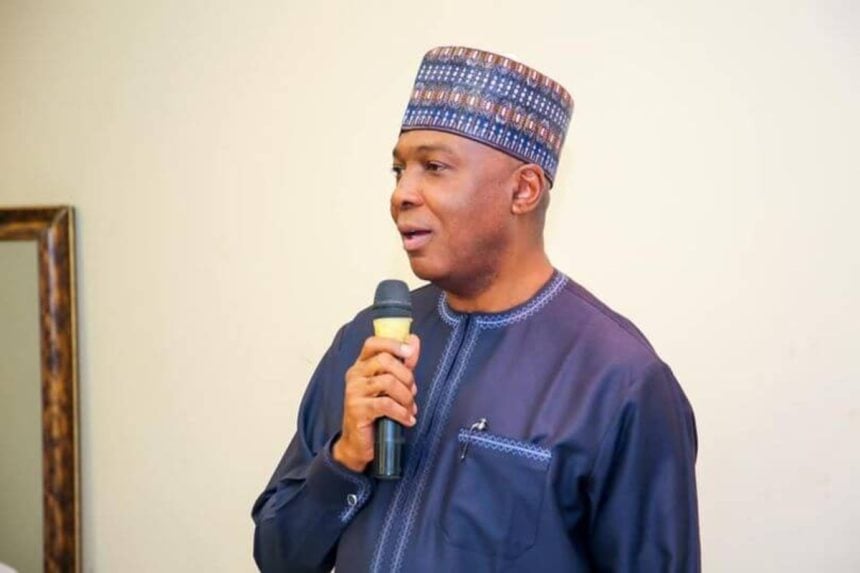
Former Senate President, Bukola Saraki, has reiterated the need for an independent legislature, warning that democracy risks weakening when lawmakers fail to properly check executive powers. Saraki made the remarks on Friday during the June 12, 2026 edition of The Platform, a public lecture organised by The Covenant Nation, where……
Former Senate President, Bukola Saraki, has reiterated the need for an independent legislature, warning that democracy risks weakening when lawmakers fail to properly check executive powers.
Saraki made the remarks on Friday during the June 12, 2026 edition of The Platform, a public lecture organised by The Covenant Nation, where he stressed that legislative independence remains central to the survival of democratic governance.
He said lawmakers must not function as a rubber stamp for executive decisions, but must actively scrutinise proposals before approval.
“So what I learned in those four years in the National Assembly is that a legislature that cannot say no is not a legislature at all. A legislature which simply receives executive proposals, approves them without scrutiny, and goes home has not fulfilled its constitutional mandate,” he said.
READ ALSO: I Didn’t Get Security Vote as Lagos Governor – Babatunde Fashola
According to him, such a legislature only performs a ceremonial role, warning that weakened institutions can threaten democratic stability.
“It has merely performed a ceremonial function. It’s an echo. A democracy made only of echoes is only one election away from becoming something else entirely,” Saraki said.
The former Kwara State governor cautioned that the greatest threat to democracy is not weak leadership, but unchecked authority.
“The greatest danger to a free people is not a weak government but an unchecked government: authority that answers to no one and cannot be questioned,” he stated.
Saraki also defended Nigeria’s constitutional structure, noting that the separation of powers between the executive, legislature and judiciary was deliberately designed to create accountability through institutional friction.
He explained that misunderstandings about inter-branch disagreements often ignore the intent of the framers of the constitution.
“They built friction into the system on purpose; it was not a mistake. That friction is not dysfunction; it is the very thing that guarantees your freedom,” he said.
“This is a fundamental concept we must understand if we want to strengthen our democracy, because I am sure the majority of us struggle with it. People ask, ‘Why are the executive and the legislature always at each other?’ By constitutional design, they are meant to challenge each other so there can be checks and balances.”
Saraki warned that the legislature serves as a protective shield for democracy, arguing that weak institutions contributed to past democratic setbacks in the country.
“On this June 12th, the lesson is plain. We did not lose democracy in 1993 because the people failed; we lost it because the institutions that should have defended the people’s verdict were too weak to do so. The remedy is not less politics; it is stronger institutions, and the legislature stands at the centre of them,” he said.
He added that suppressing political tensions does not resolve them but instead increases the risk of instability.
“Political tension does not vanish when suppressed—it accumulates. A society where grievances cannot find expression through its institutions will see those grievances vent on the streets. The legislature is built to let those voices be heard and resolved before they explode,” Saraki noted.