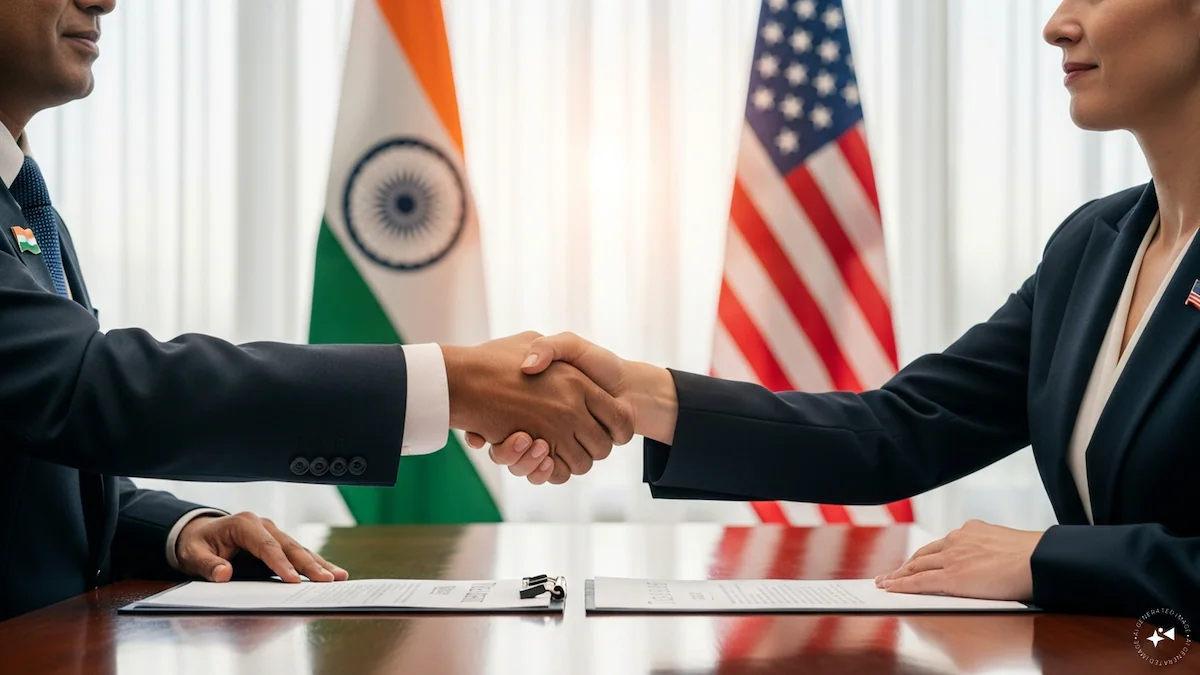
They warn that while businesses favour securing any deal, a hastily negotiated agreement that compromises India’s interests could carry long-term costs.
Why the rush to strike a deal?
India and the US have wrapped up two days of trade talks, with both sides seeking to finalise an interim agreement before July 24, when the White House’s temporary 10% tariff regime is set to expire. A deal before then could provide businesses and investors with greater policy certainty.
After meeting US Trade Representative Jamieson Greer, Commerce Minister Piyush Goyal said discussions on strengthening bilateral economic ties had progressed constructively.
According to Commerce Ministry sources, the proposed pact could cover preferential tariffs, rules of origin and investment provisions, while discussions also extended to defence, critical minerals and broader investment cooperation.
Why are experts urging caution?
Experts say trade negotiations should be guided by national interests rather than deadlines.
Mukesh Aghi, President and CEO of the US-India Strategic Partnership Forum (USISPF), said the focus must be on securing a fair and balanced agreement.
“No nation concludes a deal under pressure, and India will not do that either. A deal has to be equitable, fair and a win-win,” he said.
Aghi also warned that any agreement skewed heavily in favour of one side would be unsustainable.
“If the deal is one-sided, it will not succeed. You can sign it, but it is going to collapse and fail,” he added.
Former Additional DGFT and Vivekananda International Foundation Visiting Fellow Amiya Chandra struck a similar note, arguing that urgency should not come at the expense of substance.
“There should be urgency, but no anxiety. A bad deal can set us back by years,” Chandra said.
What would a ‘SMART deal’ look like?
According to Chandra, India should aim for what he described as a “SMART deal” — one that is strategic, market-access-focused, adaptive, reciprocal, responsive and realistic.
He argued that trade agreements should be monitored in real time so that any adverse import trends or sectoral disruptions can be identified early and corrective measures taken promptly.
Which sectors are considered sensitive?
Economist Kent Bhupathi, Chief Economist and Co-Founder of Market Theory, said the chances of a poor agreement were relatively low and that an interim arrangement could still be useful if it created a pathway towards a broader bilateral trade agreement.
“While a smart deal is the ideal outcome, I think the likelihood of a bad deal is lower than the possibility of an acceptable interim arrangement,” Bhupathi said.
He said politically sensitive sectors such as agriculture, dairy, generic pharmaceuticals and data sovereignty should remain protected during negotiations.
Why does the India-US relationship go beyond tariffs?
Experts also emphasised that trade is only one component of the broader strategic relationship between the two countries.
Aghi said cooperation spans defence, technology, critical minerals and people-to-people ties, and warned against viewing the partnership solely through the prism of tariffs.
“We should not look at the relationship purely from a political perspective,” he said, adding that he had spoken to more than 100 global CEOs in the US and “not a single one has said they will de-invest in India or move supply chains elsewhere”.
What is the bottom line?
Although both countries are targeting an agreement by mid-July, New Delhi has maintained that it is unwilling to compromise on key demands merely to meet a deadline.
Experts say that while an interim agreement could help maintain momentum in bilateral trade talks, the larger objective should be to secure a fair and balanced pact that protects sensitive sectors and strengthens long-term economic ties. In their view, getting the terms right matters far more than getting the deal done quickly.