South African lawmaker Visvin Reddy explained that Nigeria is part of a broader pattern across Africa where countries are becoming increasingly dependent on borrowing to survive.
Nigeria’s public finances are coming under renewed pressure as debt servicing continues to swallow a large share of government revenue, leaving less room for health, education and other social investments.
In 2026, the federal government is projected to spend N15.52 trillion on debt servicing out of a N68.32 trillion budget. With a deficit of N23.85 trillion, nearly half of total spending will be financed through borrowing.
While officials argue that borrowing remains necessary to sustain infrastructure and growth, the numbers show a widening gap between what the government earns and what it spends — with debt repayments now competing directly with development priorities.
According to Budgit analysis posted on its Facebook platform, health gets N3.55 trillion, education N2.73 trillion, and agriculture N3.64 trillion — all together still below what is set aside for debt servicing.
The fiscal strain has reignited concerns about how long the country can sustain its current borrowing pattern without deeper reforms.
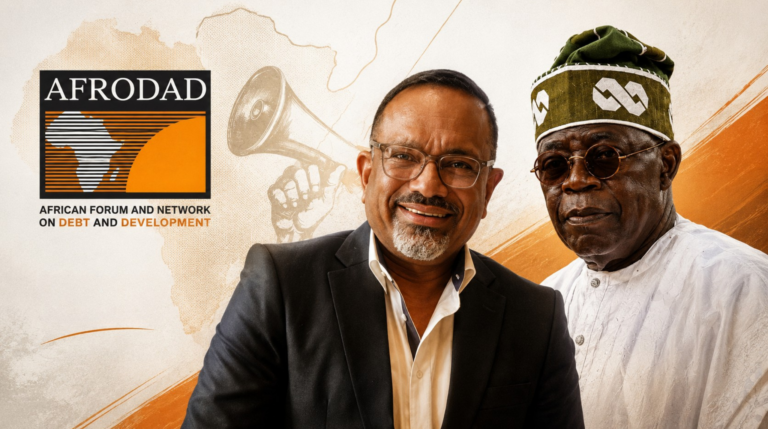
Those concerns were also central to discussions at the sixth edition of the African Forum and Network on Debt and Development (AFRODAD) Media Initiative in Nairobi, Kenya, where African journalists and policymakers examined the continent’s debt challenges.
On the sidelines, PREMIUM TIMES spoke with South African lawmaker Visvin Reddy, who explained that Nigeria is part of a broader pattern across Africa where countries are becoming increasingly dependent on borrowing to survive.
Mr Reddy, a member of a South African opposition party, the African Democratic Change, described the situation as a cycle that is hard to break once it sets in. He spoke on revenue leakages, lack of transparency and accountability in borrowing in many African countries, and the need for the citizens to be well informed about their governments’ borrowings. ln South Africa, he is calling for lifestyle audits and the strengthening of conflict-of-interest rules for public officers.
Below are excerpts from the PREMIUM TIMES interview with Mr Reddy at the AFRODAD Media Initiative event.
PT: Many African countries now spend more on debt servicing than on health, education and social protection. How sustainable is this?
Visvin Reddy: It is the reality in most African countries today — and Nigeria is no exception. Once debt servicing starts taking that level of revenue, you enter a cycle that is very difficult to exit. You borrow to repay old debt, and then you borrow again to fill the gap. Kenya is a good example. A large share of revenue goes straight into debt repayments. In South Africa too, it is a significant portion of the budget. So what you end up with is a kind of dependency — not just on debt, but on lenders. That is the uncomfortable truth. But Africa also has to ask harder questions. We are resource-rich, yet we behave like we are resource-poor. Look at countries that have taken control of their resources — they convert those assets into real benefits for their people. That is not the case in many African states. Until that changes, the pressure will remain.
PT: Nigeria loses billions through oil theft, tax waivers and capital flight. How much do illicit financial flows contribute to this debt dependence?
Visvin Reddy: The numbers are actually very close. Africa pays around $90 billion every year in debt servicing. At the same time, illicit financial flows are estimated at about $88 billion. So you have almost a mirror effect — what comes in goes out. A lot of it is driven by tax avoidance, corruption, and the use of offshore structures that allow wealth to escape the system. The question is, why are these loopholes still open? Because if that money stayed within African economies, the need to borrow would reduce significantly.
Corruption is part of it as well. It is not abstract — it has real consequences. That is why in South Africa, I am pushing a bill that will strengthen conflict-of-interest rules and introduce lifestyle audits. Public officials and their families should not be able to do business with the state while in office. If we reduce leakages, we reduce borrowing. It is that simple.
PT: Do citizens in Africa really understand their countries’ debt agreements and obligations?
Visvin Reddy: Not really — and that is part of the problem. Debt is discussed in very technical language. It is kept within a small circle of economists and officials. Ordinary people rarely see the full picture, yet they are the ones who bear the consequences.
When governments spend heavily on debt servicing, it shows up in hospitals without drugs, underfunded schools, and rising hardship. That connection is not always made clear. So there is a real need for transparency — not just in signing loans, but in explaining them. Citizens should know what is being borrowed, why it is being borrowed, and what it means for their future. Without that, accountability becomes very weak.
PT: Lawmakers are expected to approve loans, but critics say oversight is weak. What is your view as a legislator?
Visvin Reddy: That is a fair concern. Parliaments should not just approve loans — they should interrogate them.
Too often, loans are approved quickly without enough scrutiny of long-term impact. And once the money is approved, follow-up is even weaker. That is dangerous, because these decisions are not short-term — they affect future generations. There is also the issue of how loans are structured and what collateral is being used. Even when not fully confirmed, perceptions around strategic assets being tied to debt raise serious questions. Oversight has to be stronger, otherwise accountability becomes meaningless.
PT: Subsidies removal and reforms have increased hardship in Nigeria. How should governments balance reform and social welfare?
Visvin Reddy: Right now, the burden is falling too heavily on ordinary people. Citizens are always the ones told to adjust, to sacrifice, to endure. But governments also need to look inward first. Nigeria is a resource-rich country. So the question is not just about sacrifice — it is about management. Where is the revenue going? If leakages and inefficiencies are not addressed, then reforms will always feel like punishment for the poor. That is not sustainable in the long run.
PT: What does resource-backed borrowing say about governance in Africa?
Visvin Reddy: It raises serious accountability issues. But we also have to be honest — democracy only works when citizens participate actively. If people disengage after elections, it creates space for poor governance to continue unchecked. Low voter turnout weakens accountability. So yes, leaders must do better. But citizens also have a role in sustaining pressure and engagement beyond election periods.