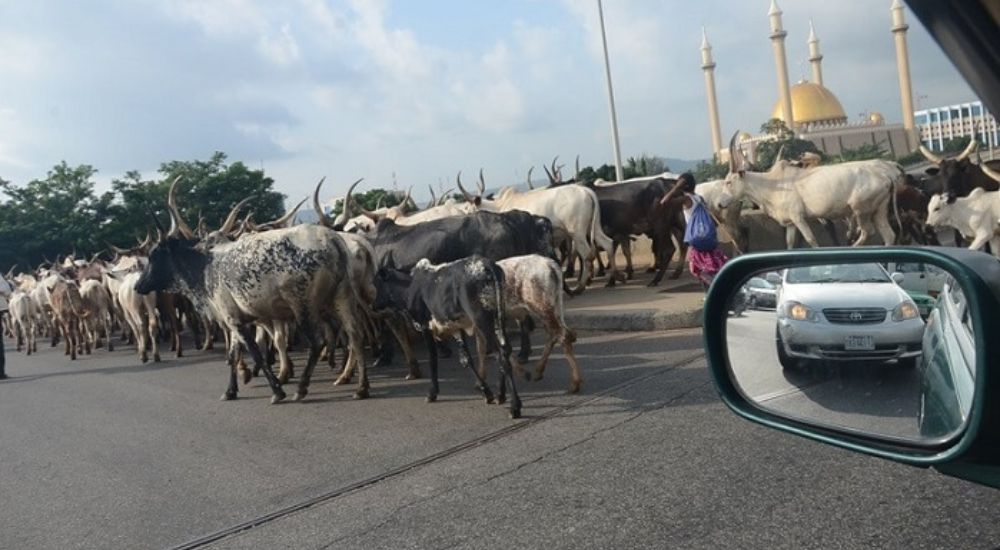
In October 2016, after many complaints from residents about cattle grazing in the Abuja metropolis and on major entrance and exit highways into the city centre, the then Federal Capital Territory (FCT) Minister, Muhammad Bello, directed herdsmen to move their cattle out of the city.
Bello also stated that the FCT Administration had moved a step further to identify new grazing reserves that would cater for their needs.
According to him, a total of 33,485 hectares had already been earmarked for grazing reserves to cater for about 7 million cattle. The breakdown; Paikon Kore 8,500 hectares, Karshi 6,000 hectares, Kawu in Bwari 9,000 hectares, and Rubochi in Kuje 9,985 hectares.
“The FCT Administration may even reach out to the host communities to work out a situation where compensation does not have to be in monetary terms because of the large expanse of land involved.
“Nothing should prevent the communities that are there and the Fulani living together because you don’t always have to move people away,” he was quoted as saying.
Ten Years On: No Compensation, More Land Grabbing
However, ten years after the Minister’s relocation order, findings from THE WHISTLER show that the communities whose land was allocated for the grazing reserve in Kawu have not been compensated and have also experienced constant land grabbing by herdsmen who claim the minister gave them the land.
“We have been besieged by Fulani who claim that the Minister of the FCT pushed them out of the city centre and told them to come live at the said reserve.
“But none of them come with any letter authorising them to stay here,” the Chief of Kurmi Dauda, Musa Manasseh Bawa, one of the landowning communities, told THE WHISTLER.
The Chief said the main challenge facing his community is the takeover of farmlands.
“The challenge we face now is that on our farmlands, the ones we always cultivate, we will just wake up one morning and see Fulani in the field,” he said.
He recounted an incident involving the area council chairman.
“There was a time the area council chairman came to Kurmin Dauda. I went to report the issue to him. He spoke, but when he left, they continued with what they were doing.
Now, on that particular land that the chairman visited, they have built houses there,” he stated.
Bawa, who noted that his people are mostly farmers, added that apart from their land being taken, their crops are being destroyed by the herders’ cattle.
“I visited one of my farms the other day and noticed that my palm tree was cut down for their cows to feed on. Why did they have to cut the palm tree down? Why not just climb up and cut the leaves and leave the tree alone?” he lamented.
The Chief said his people are known for cultivating beans, banana, yam, and other crops, but expressed fear that these crops are gradually disappearing due to the activities of herders, some of whom he said do not even own cattle.
“You cultivate a land this year, next year when you come back, someone has already occupied the land,” he narrated.
Govt. Returns in 2025: Boreholes, Promises, No Payment
In September 2025, the Federal Government said it had kick-started the relocation process of herders to the Kawu Grazing Reserve in Bwari Area Council, Abuja, with the development of infrastructure in the area.
The Minister of Livestock Development, Idi Maiha, led a team of officials to the 9,000-hectare reserve where a solar-powered borehole was launched.
That day, the minister explained that the grazing reserve plays host to over 10,000 herders and their families. He said the development process will continue rapidly and will include a 15-kilometer road, solar-powered boreholes, a dam, irrigation facilities, schools, solar power, a healthcare facility, security, pasture and manure production centres, markets, and others.
He noted that the government had come with “a bag full of commitment, dedication, and passion,” not empty promises.
On plans for the reserve, he said a dam in the area will be converted into a source of water for dry-season pasture cultivation.
He said about five to six motorized boreholes will be constructed in the area, which will serve potable drinking water for domestic use as well as animal consumption.
The delegation also came with some quantity of Napier grass, a type of tall, fast-growing grass that farmers use mainly as animal feed.
“We are saying that this grazing reserve is going to come alive. We have already had some consultations with a lot of stakeholders,” the minister said.
Original Owners Cry Foul Over Exclusion
However, original owners of the land have lamented that they were not included in the consultations and that compensation was not paid to them by the government for taking over their lands.
Bawa, who had granted an audience to the reporter in Bwari after many attempts to see him, spoke visibly weighed down by the situation.
He stated that the 9,000 hectares of land turned into a grazing reserve was the ancestral land of about 12 villages, some of whom were still living on the land.