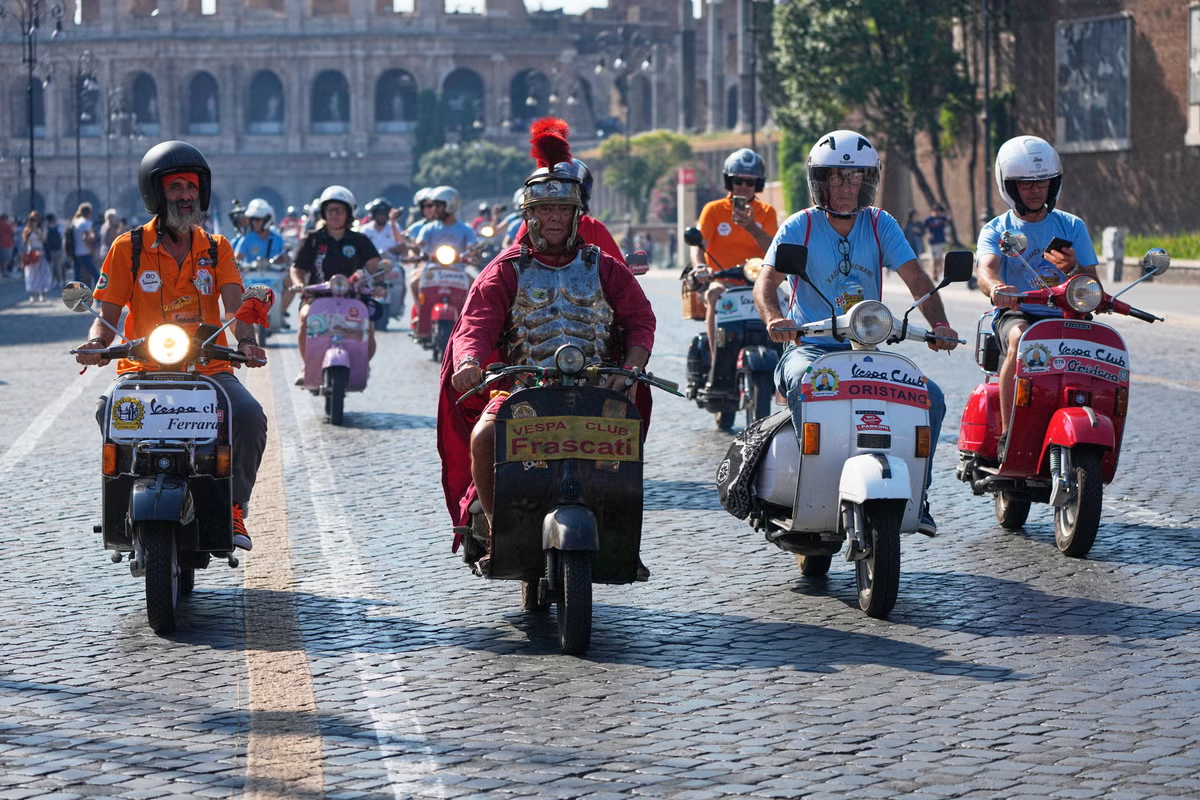
More than 10,000 iconic Vespa scooters converged on Rome’s historic heart on Saturday, celebrating the beloved Italian brand’s 80th anniversary. The distinctive putt-putt of engines filled the air as enthusiasts paraded past the Colosseum and Roman Forum, transforming the Eternal City into a vibrant homage to two-wheeled freedom and style.
Enthusiasts from across continental Europe, northern England, San Francisco, Australia’s Gold Coast, and the Philippines converged. For a day, the timeless design of the Vespa dominated Rome’s cobblestone streets, with Ferrari and Ducati momentarily forgotten. Natalie Dunand, a French retiree celebrating her 61st birthday, encapsulated the sentiment: “The passion for Vespa is for the Italian style, freedom, the ’60s. I love it.”
The Vespa’s global fame was cemented by its appearance in the 1953 film ‘Roman Holiday,’ with Gregory Peck and Audrey Hepburn. Its cinematic legacy continued in ‘The Talented Mr. Ripley’ and the animated ‘Luca’. With distinctive curved lines evoking a bygone era and its ability to bring smiles to onlookers, the Vespa – Italian for ‘wasp’ – remains an enduring symbol of style, akin to the Volkswagen Beetle for cars.
Its invention was a bit of chance as Italy rebuilt from the rubble after World War II. Piaggio, a major aircraft manufacturer that saw its Pontedera factory destroyed by bombings, had to change gears. Downshifting considerably, Piaggio started churning out scooters.
Women were among initial target clients, according to Davide Zanolini, Piaggio’s executive vice president of marketing, since they could ride them while wearing long skirts and without showing their legs. That’s reflected in the Vespa’s design.
“The shape, the elegance. This very charming attitude of Vespa is much more of a lady than a man,” Zanolini told The Associated Press in an interview.
That little two-wheeler helped kickstart Italy’s economy, and soon enough they were everywhere.
An AP article from 1950 said that Vespas had become so prevalent that their “staccato exhaust racket” had downtown Rome sounding like the Indy 500.
“There probably isn’t a noisier scooter in all the world,” it said. “Scooters darting loudly around Rome are said to impress motor-minded Americans as strongly as St. Peter’s or the Colosseum. The scooter quickly teaches visitors to look four ways at once at street crossings.”
Such scenes have again become commonplace since Vespa aficionados started arriving on Thursday, flooding streets all over the city and with traveling groups making their presence known in matching T-shirts.
The parking lot outside Rome’s Stadium of the Marbles on Thursday had rows upon rows of Vespas of all makes from the past eight decades. It was like a motorcycle rally — except adorable. Some Vespas featured flowers and stuffed animals.
Dunand’s Westie terrier rode behind her, its fur cut short to cope with the heat. A man from Tokyo, with his 8-year-old daughter behind him, swapped his hometown club’s banner with an Italian. Others traded stickers. And the Vespa logo tattooed on a German man’s meaty left calf appeared next to three words in flowery cursive: “La Dolce Vita” — The Sweet Life.
Aficionados spoke about how the brand taps into nostalgia for a certain time, even among those who weren’t alive then. Many also noted that they traded bigger motorcycles for nimbler and more manageable Vespas because they’re lighter and automatic, with the accelerator on the hand grip.
“You get on, twist, go. Doddle. Easy,” said Andrew Walton, a 59-year-old truck driver who bought his first Vespa almost 20 years ago and never looked back. He had just spent eight days riding from Newcastle, first with a ferry to Rotterdam then following the Rhine River through Germany to Austria’s “Romantic Road”, and finally down along Italy’s coast.
Once Rome’s mayor cut the ribbon at the Stadium of the Marbles, visitors streamed in singing, chanting, waving flags. Many made a beeline for the gift shop, where they could snap up anything from Vespa jackets and hats to Vespa blankets, Vespa water bottles and Vespa umbrellas. But most early comers had their eyes on the limited-edition helmet, with “80 Years of an Icon” emblazoned on its side.
A photo retrospective showed Vespas in classic scenes — couples picnicking in a flowering field, seaside escapes with bikinis and a beachball, road trips under the Mediterranean sun — plus others one might not imagine, like explorer Soren Nielsen reaching the Arctic Circle on a Vespa in 1963.
There were also pristine Vespas from Piaggio’s collection displayed like posing models to admire, and soaking up attention usually directed toward the nearby marbles with idealized physiques.
The company has sold about 20 million Vespas worldwide since 1946, and today sells in 110 countries, Zanolini said. In the U.S., they’re popular in Florida and California and gaining traction in some other places like Austin. But it’s still a niche product in America, he said.
Burke Sandman, whose family owns a 108-year-old car dealership in Indiana, told the AP in Rome that he bought his first Vespa about two decades ago — captivated by its sidecar. He quickly realized there were no resellers around and got in touch with Vespa to get in the game. He has since moved about 1,000 of them across the U.S., snagging 15 for himself.
“No one ever says anything bad about a Vespa. You know, it’s crazy,” Sandman said inside the Vespa Village. “Everyone that trades other brands for a Vespa, they never go back. It’s just something about it. And everyone likes Italian stuff. I get a lot of people that come back from Europe, and they’ve got the bug.”