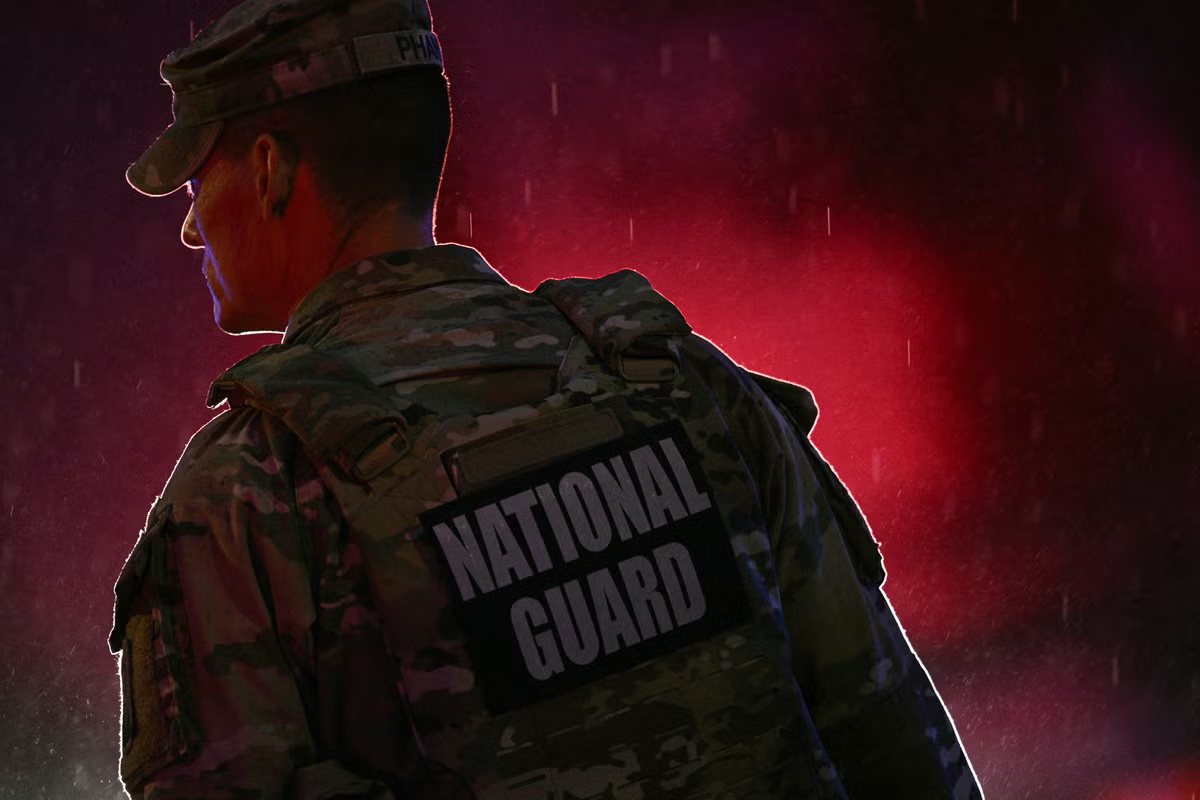
The thousands of National Guard troops the Trump administration sent to Washington, D.C., last summer had “no measurable effect” on reducing violent crime, according to a new study.
The deployment, which largely stationed troops in low-crime tourist areas, appeared to cause a 24 percent reduction in opportunistic property crime in its first six months, but the same couldn’t be said of violent crime, per a report published on Thursday by the Niskanen Center.
“What the Guard brought was a massive, sudden shock from the visible presence of uniformed military personnel on the streets of Washington almost overnight,” the report’s authors wrote. “For crimes driven by opportunistic calculation, that visibility appears to have mattered. For violent crime, which is less deterrable by patrol presence alone, it did not.”
The study called the at least $185 million National Guard deployment a “blunt and expensive instrument,” noting it cost nearly twice as much per day to field the troops compared to regular police, even as Washington cops managed to bring down violent crime from its recent 2023 peak while operating with their smallest force in decades.
Other analysts have reached similar conclusions about the troop surge.
“In D.C., you’ve seen a massive drop in crime from the middle of 2023 through the summer of 2025 that just continued at the same level,” crime statistician Jeff Asher told The Trace in February. “Maybe there were a couple of weeks of lower gun violence…but again, that’s hard to tease out when you’ve had two straight years of large declines in gun violence.”
The expanded presence of federal troops and agents in Washington also failed to deter multiple high-profile security incidents, including a May shooting outside the White House and a November shooting against two National Guard troops by the Farragut West Metro Station, a few blocks from the White House.
Nonetheless, President Donald Trump frequently claimed the National Guard surge singlehandedly stopped crime in the capital.
During his February State of the Union speech, Trump called the Guard operation a “big success” and said Washington has “almost no crime anymore.”
He took a similar approach after the unprecedented troop operation began in August.
“We’ve got no crime,” Trump claimed in October, even though there had been multiple deadly shootings around the time of his comments. “It took 12 days to solve the problem.”
Questions about the impact of National Guard troops in the capital remain salient, given that the Pentagon is reportedly planning to keep the soldiers in Washington through January 2029, the end of Trump’s term.
The administration wants an additional 1,500 Guardsmen deployed on the streets there in short order as a part of a “summer surge” around America’s 250th anniversary celebrations.