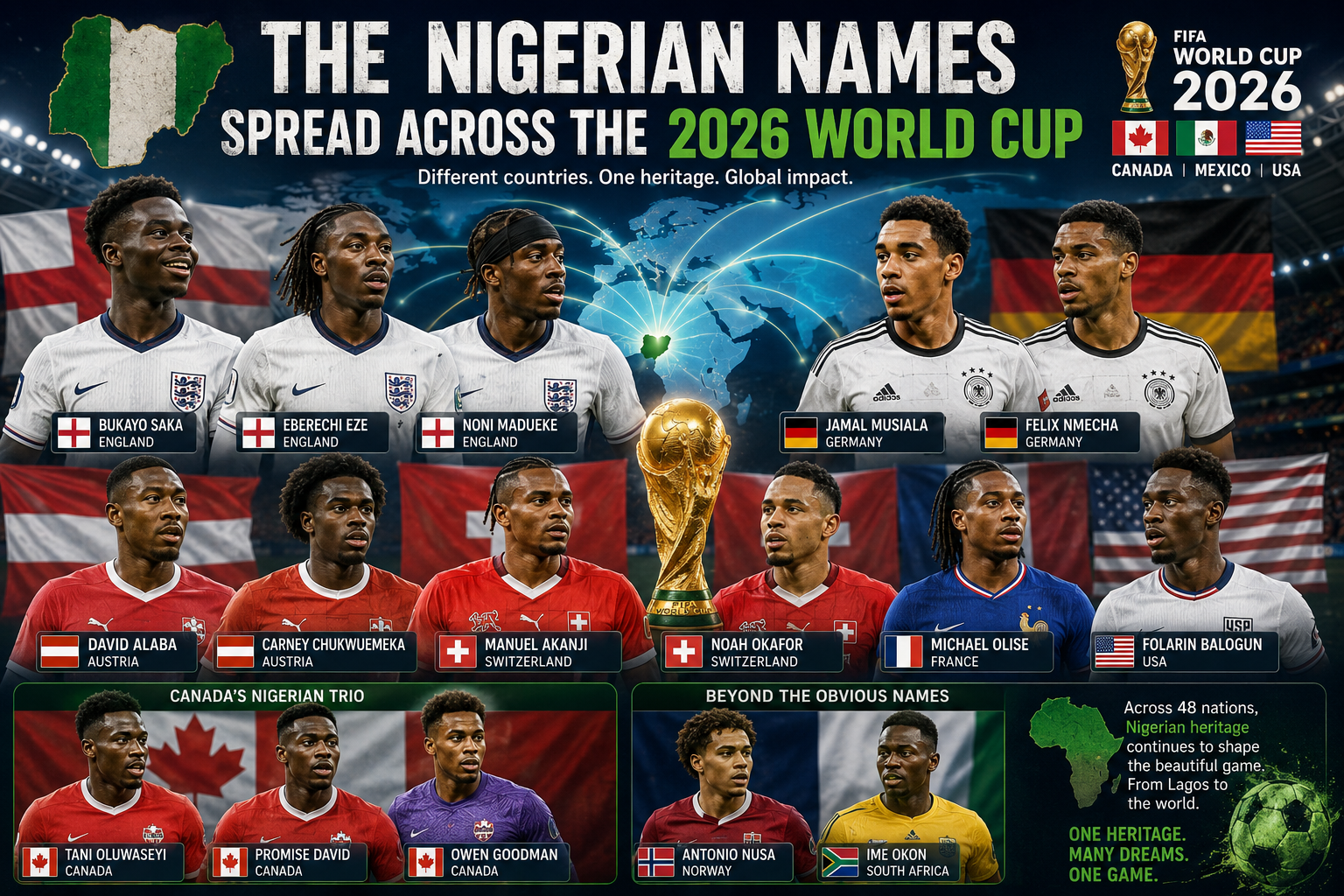
Scattered across the 48 nations at the World Cup are players whose family journeys began in Nigerian cities like Lagos and Enugu before reaching different parts of the world.
When the FIFA World Cup kicks off in Canada, Mexico and the United States, one of Africa’s traditional football powers will be conspicuously absent.
Nigeria failed to qualify for the expanded 48-team tournament, extending the country’s wait for a return to football’s biggest stage.
But as fans go through FIFA’s final squad lists, one thing stands out: players with Nigerian names, Nigerian roots and Nigerian heritage are everywhere
The Super Eagles may not be at the World Cup, but players with Nigerian roots will feature for some of the tournament’s biggest contenders, including England, Germany, France, Switzerland, Austria, Canada and the United States.
This intriguing development means that, while Nigeria will not compete for the trophy, its influence on the modern game remains impossible to ignore.
FIFA’s official squad lists show 1,248 players representing 48 nations at the tournament, the largest World Cup ever staged.
Among them are footballers whose family stories stretch from Lagos and Enugu to London, Vienna, Zurich, Toronto and New York.
No country illustrates that influence more clearly than England.
The Three Lions will arrive at the World Cup with three of their most dangerous attacking players tracing their roots to Nigeria.
The Three Lions squad includes several players with Nigerian heritage, among them Bukayo Saka, whose full name is Bukayo Ayoyinka Saka. He is joined by Eberechi Eze, listed in FIFA’s squad document as Eberechi Oluchi Eze. England’s squad also features Noni Madueke (Chukwunonso Azuka Tristan Madueke),
Saka remains one of England’s key figures after establishing himself as one of the Premier League’s most consistent performers.
Alongside Arsenal teammates, Eze and Madueke, whose Nigerian heritage has long been part of discussions around dual-nationality footballers, they will hope to help England end their fifty-year wait for another World Cup since the 1966 feat.
Together, they represent a generation of players born and developed in England but raised in households that maintained strong Nigerian cultural ties.
Germany also boasts significant Nigerian representation.
At the centre is Bayern Munich playmaker Jamal Musiala, arguably one of the most gifted attacking midfielders at the tournament.
Born to a British-Nigerian father and a German mother, Musiala was eligible for multiple countries before committing to Germany.
He is joined by Borussia Dortmund midfielder Felix Nmecha, whose Nigerian heritage is reflected in his full name, Felix Kalu Nmecha.
The duo could play key roles as Germany pursue a fifth world title.
Nigeria’s influence extends beyond football’s traditional heavyweights.
Austria captain David Alaba remains one of the most recognisable footballers with Nigerian roots.
Born in Vienna to a Nigerian father and a Filipino mother, Alaba has spent more than a decade as the face of Austrian football.
Austria’s squad also includes midfielder Carney Chukwuemeka, another player whose Nigerian family background is well documented.
Switzerland, meanwhile, will rely on two players with Nigerian heritage: defender Manuel Akanji and forward Noah Okafor.
Both have become established internationals after progressing through Switzerland’s development system.
France’s squad features Bayern Munich winger Michael Olise, whose father is Nigerian.
Olise’s rise from English academy football to becoming one of France’s most exciting attacking talents illustrates the increasingly global pathways that define modern football.
The United States, one of the tournament hosts, will count on striker Folarin Balogun.
Born in New York to Nigerian parents and raised in England, Balogun embodies the international character of modern football identities.
Canada’s squad perhaps offers the clearest example of Nigeria’s growing football diaspora.
Forward Tani Oluwaseyi was born in Abuja before emigrating to Canada.
He is joined by striker Promise David and goalkeeper Owen Goodman, both of whom were eligible to represent Nigeria.
FIFA’s official squad records reflect the Nigerian family connections of all three players.
Their presence underlines the growing impact of Nigerian communities within Canadian football.