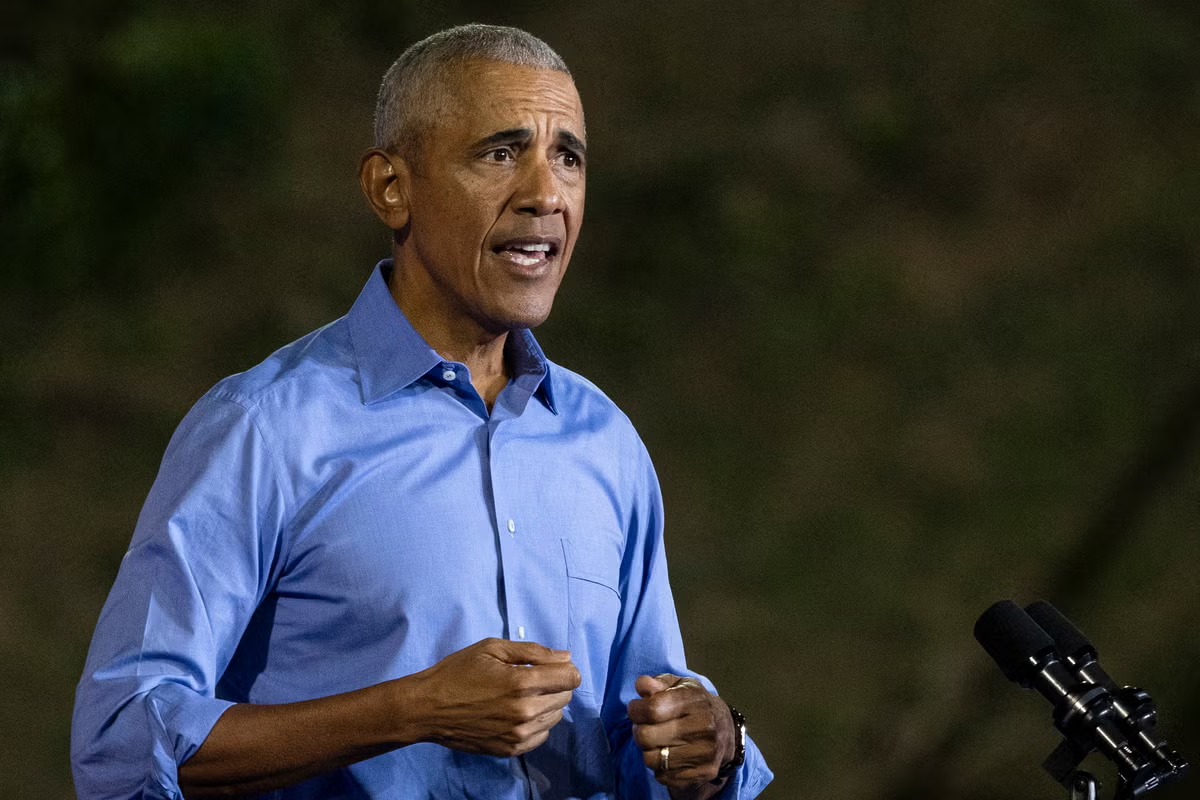
Former President Barack Obama says that Donald Trump’s eventual deal with Iran, if it materializes, will not be a significant departure from the 2015 agreement he inked with Tehran after two years of negotiations. The very one Trump ripped up.
“It is doubtful that any agreement that arises is going to be significantly different, or in a significant improvement from the deal that we had in the first place, and had worked for a long stretch of time before we, the United States, pulled out of it,” the former president told ABC’s Robin Roberts in a Good Morning America interview to air Wednesday. An excerpt was released Sunday, prior to Trump’s announcement of the extension of a 60-day ceasefire agreement.
“So, I’m hopeful that bombing stops and ordinary people are no longer suffering as a consequence of the war,” said Obama.
The two-term Democratic president notched the Iran nuclear accord in 2015, known as the JCPOA, as one his most significant foreign policy achievements. For the first time since 2006, the Iranian nuclear program came under regular international inspections conducted by the International Atomic Energy Agency (IAEA) and restrictions were put in place on Iran’s enrichment capacity and storage limits for enriched nuclear materials.
But Donald Trump withdrew the United States from that agreement in May of 2018, ending the U.S.’s direct participation in the deal’s terms and resuming a set of sanctions on Iran’s government and energy economy that came to be known as the “maximum pressure” campaign. At the time, the U.S. government accused Iran of repeatedly violating the spirit of the agreement.
Now, the former president whose efforts to bring Iran to the international bargaining table says that Trump’s efforts will not differ from his in any substantial way. Under the 2015 deal, the IAEA was granted daily and unfettered access to all of Iran’s declared nuclear sites, and dispute measures were in place to allow inspectors to gain access to sites where activity related to the nuclear program was suspected to occur.
The deal, announced in vague terms by Trump on Sunday, does not actually have any immediate effects beyond a commitment by Iran’s government to re-open the Strait of Hormuz while the U.S. abides by a ceasefire agreement and begins negotiations over the future of Iran’s nuclear program. President Trump has said that he wants to see Iran’s remaining stockpile of nuclear material eradicated and tight controls over Iran’s nuclear energy program. It’s not clear, however, how or even if the president plans to make those requirements differ from those in the 2015 JCPOA.
The president said Sunday that the Strait of Hormuz would immediately reopen, though experts have cautioned that the actual timeline for the full resumption of traffic through the key waterway could be weeks or even months, depending on how long it takes to de-mine the strait and restore confidence for global maritime shipping companies.
“Ships are starting to move, many loaded up with Oil, out of the Strait of Hormuz. They are going along the Southern “Highway,” which is totally safe, secure, and pristine. There are other areas of travel, also!!!” Trump insisted Monday on Truth Social.
Defense Secretary Pete Hegseth spoke about the burgeoning deal to CBS News on Sunday in the hours before it was formally announced, and stated that the administration was open to the IAEA running future inspections. He also seemed to differ from Trump, who suggested that the U.S. would directly be in charge of removing and eradicating Iran’s existing supply of enriched uranium.
“There’s no trust here, and we are going to verify everything,”Hegseth said. “Nuclear material will be destroyed and removed, and the nuclear program will be dismantled.”
“We have plans for everything,” he added. “Should the president need a compel option, we have compel options and many different types of compel options.”
Supporters of the president are looking to compare the two agreements as well.
Conservative Iran hawks and even some in the Democratic Party were livid over the 60-day ceasefire extension’s reported terms, as it was confirmed by Hegseth and others that the administration had signalled to Iran that sanctions relief as well as the unfreezing of Iranian funds in U.S. banking systems were on the table if future compliance was maintained by Tehran’s government. Both of those provisions were part of the 2015 agreement, and were the most heavily-criticized portions of the Obama-era deal among conservatives at the time.
Many of the war’s strongest supporters on the right, like commentator Mark Levin, reacted to that news and the idea floated by U.S. officials of providing Iran with a reconstruction fund with cautious dismay.
“As to any potential deal, it must be compared to the JCPOA, and I am hopeful that it will be vastly different,” wrote Sen. Lindsey Graham, the war’s biggest booster on Capitol Hill, on X.
“The idea of a $300 billion reconstruction fund, given who is in charge of Iran, seems to be tone deaf,” he continued. “It would be akin to a Marshall Plan for Germany with the Nazis still in charge. That wouldn’t have been a good idea then, and any reconstruction fund that benefits this terrorist regime wouldn’t be a good idea now.”