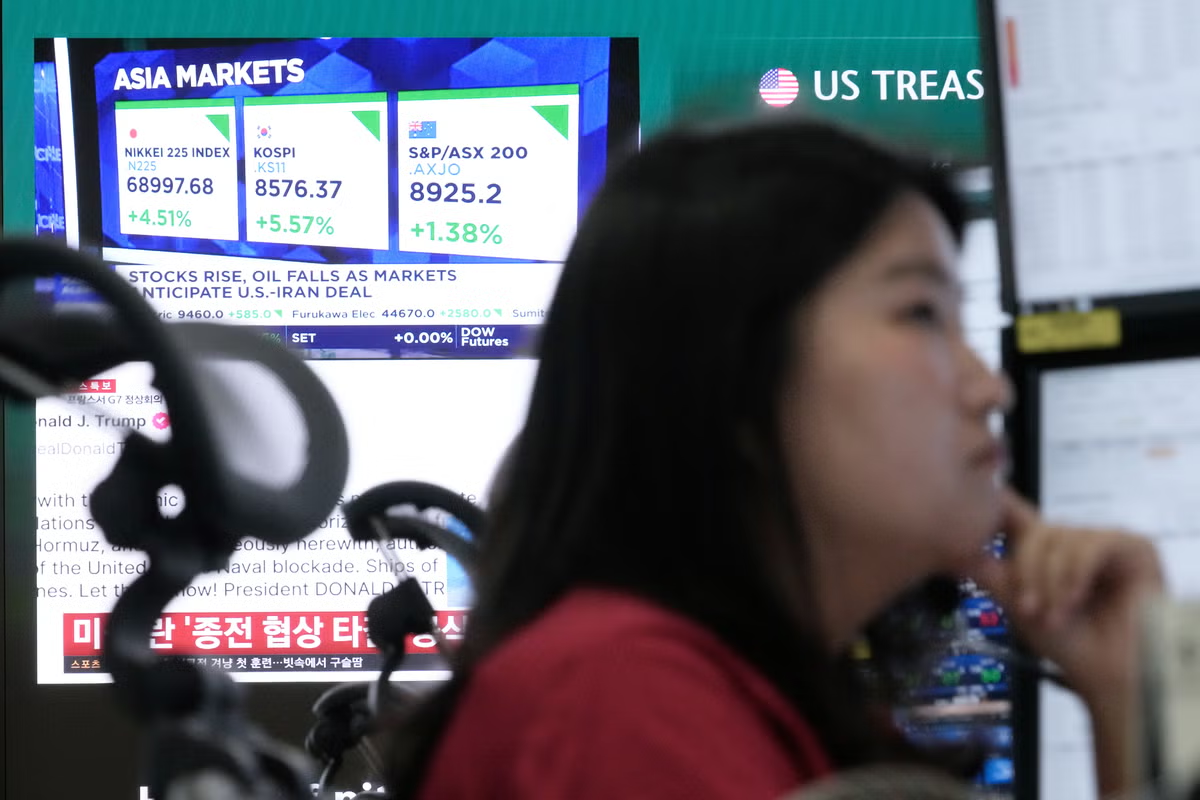
Asian markets surged on Monday while oil prices tumbled following a tentative peace agreement between the US and Iran.
The deal is expected to alleviate global inflationary pressures and potentially reduce the need for further interest rate hikes by central banks worldwide.
The breakthrough was first announced by Pakistani prime minister Shehbaz Sharif early on Monday, stating that “a deal had been struck”.
US president Donald Trump later claimed the agreement included the reopening of the vital Strait of Hormuz, though he provided no specific details.
Mr Trump is scheduled to meet with Mideastern leaders and attend a working session with Ukraine’s Volodymyr Zelenskiy during the G7 summit in France this week.
However, Iran indicated that traffic through the strait would be regulated jointly by Tehran and Oman, a move that could challenge established rules of free trade and potentially introduce shipping tolls.
“The lack of details especially on freedom of shipping is a concern but not one that should constrain markets today as the surge in risk appetite plays out,” Sean Callow, senior FX analyst at ITC Markets, noted. “The prospect of a sustained fall in energy prices changes the conversation for central banks just ahead of a flurry of policy decisions.”
This news offers a welcome reprieve for numerous central banks convening this week, easing some of the pressure to tighten monetary policy in response to energy-driven inflation expectations. Although markets had largely anticipated a deal, its confirmation sent Brent crude falling 4.7 per cent to $83.24 a barrel, well away from its May peak of $126.41. US crude slid 5.5 per cent to $80.16 a barrel, but was still above the $67 level it traded at before the war began.
“We see Brent oil futures falling to $80 by the end of the year assuming the strait does not close again,” Vivek Dhar, a mining and energy analyst at CBA, commented.
“Our forecast implicitly assumes that oil and refined product exports can resume quickly through the Strait of Hormuz but this view carries considerable uncertainty tied to the damage to oil and refinery assets.”
The prospect of cheaper oil proved particularly beneficial for Japan, a major energy importer, with the Nikkei climbing 5.4 per cent. South Korea’s market gained 5.6 per cent, while Chinese blue chips firmed 1.4 per cent. MSCI’s broadest index of Asia-Pacific shares outside Japan rose 1.5 per cent. In Europe, Eurotoxx 50 futures and DAX futures both increased by 1.7 per cent and FTSE futures added 0.7 per cent.
US markets also reacted positively, with S&P 500 futures climbing 1.1 per cent and Nasdaq futures jumping 1.8 per cent amidst a broader surge in risk assets.
Central banks in the US, UK, Japan, Australia, Switzerland, Sweden, Norway, and Russia are all scheduled to meet this week. Japan is currently considered the most likely to raise rates.
The US Federal Reserve is widely expected to maintain rates at 3.50-3.75 per cent on Wednesday, during chair Kevin Warsh’s inaugural meeting.
Investors will closely scrutinise the statement, economic projections and news conference for any indications that the Fed might abandon its easing bias as officials express growing concern over inflation risks.
The likelihood of a rate hike this year has diminished, with December futures edging up four ticks and an October move now priced at around 30 per cent. Treasuries rallied on hopes that oil prices would now fall sustainably, reducing upside risks for inflation, with yields on 2-year notes dropping 6 basis points to 4.02 per cent.
The decline in yields and overall improvement in risk sentiment pushed the US dollar broadly lower. The euro rose 0.4 per cent to $1.1608 while sterling rose 0.3 per cent to $1.3446.
The dollar fared better on the yen at $160.13, which is stuck in a bear trend even though the Bank of Japan is expected to raise rates by 25 basis points to 1 per cent on Tuesday.
The Bank of England is anticipated to hold rates at 3.75 per cent on Thursday and throughout 2026, with policymakers seemingly in no hurry to tighten.
The bank’s vote split and monetary policy report will be key points of interest. Top-tier UK data, including May inflation and retail sales, and April employment figures, are also due.
The Makerfield by-election on Thursday will also be closely watched as a victory for Labour party’s Andy Burnham could set the stage for a leadership challenge against prime minister Keir Starmer.
In commodity markets, the drop in yields helped non-interest-paying gold climb 2.5 per cent to $4,322 an ounce.