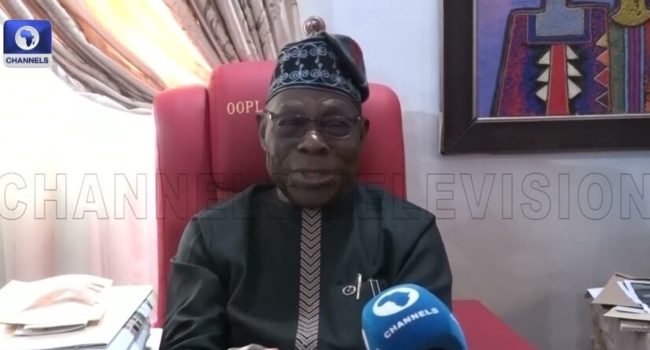
Former President Olusegun Obasanjo has revealed that former Head of State General Abdulsalami Abubakar was actively facilitating the release of the presumed winner of the June 12, 1993, presidential election, Chief Moshood Kashimawo Olawale Abiola, before the latter’s sudden death in detention, disclosing that Abiola’s son Kola was already in Abuja to pick up his father when the news came, and that Abdulsalami called him on the telephone with the words “Our man is dead,” prompting Obasanjo to scream when the identity of “our man” was clarified.
The revelation was among several previously undisclosed details shared by former Presidents, former Heads of State, and a serving African president at the public presentation of three books in honour of General Abdulsalami’s 84th birthday, titled “The Legacy of a Statesman @84,” held at the Banquet Hall, Presidential Villa, Abuja, on Saturday.
The event, chaired by former Head of State General Yakubu Gowon, brought together an extraordinary assembly of Nigerian and African leaders, including former President Goodluck Jonathan, former President of the Senate and SGF Senator Anyim Pius Anyim, and Sierra Leone President Julius Maada Bio, each of whom paid tribute to Abdulsalami’s role in restoring Nigeria’s democracy and contributing to peace across West Africa and the continent.
“Our Man Is Dead”
Obasanjo’s most significant revelation concerned the circumstances surrounding MKO Abiola’s final days. The former president, describing himself as “an eyewitness and direct participant in almost all the actions of the military leaders,” disclosed that after assuming power following General Sani Abacha’s death in June 1998, Abdulsalami immediately set about resolving the political crisis, including securing Abiola’s release from detention.
“Your next move was how to get MKO Abiola released. And you kept me regularly informed and also related messages to the family,” Obasanjo recounted.
“Kola was already in Abuja to pick up his father when the unexpected happened. I remember you telling me on the telephone, ‘Our man is dead,’” Obasanjo recalled.
“Who is our man? Was my question. And I screamed when you mentioned Abiola.”
The disclosure adds significant detail to the historical record of one of the most consequential and controversial episodes in Nigeria’s political history. Abiola died on July 7, 1998, in detention, just weeks after Abdulsalami assumed power following Abacha’s death on June 8, 1998. The circumstances of Abiola’s death have been the subject of intense speculation and controversy for over 27 years. Obasanjo’s account, coming from someone who was in direct communication with the Head of State at the time, confirms that a release process was underway and that the family had been informed to the point where Abiola’s son had travelled to Abuja in anticipation of his father’s freedom.
Abdulsalami “Sustained” Democracy, Not Just Restored It
Obasanjo went beyond crediting Abdulsalami with restoring democracy through the 1998-1999 transition programme, arguing that the former Head of State also sustained it through his personal engagement with the civilian leadership that succeeded him.
“I should tell this August assembly that not only did you initiate and ensure the restoration of democracy. You sustained it. Not only because of the peace that you had worked with other people, but the way you actually worked with me after I took over,” Obasanjo stated.
He then disclosed a previously unknown practice of regular consultative meetings between himself as president and Abdulsalami as a former Head of State.
“How can I forget how regularly you came with a piece of paper with all the points that you wanted to discuss with me about what is going on, about what should be done, about how you saw things? And we sat down. And we looked at them one by one. I answered what could be answered on the spot. And what could not be answered on the spot, I gave you an answer within 24 hours. That was a magnificent way of sustaining what you had initiated, and I cannot thank you enough,” Obasanjo revealed.
Obasanjo’s Three Lessons in Consulting Elders
Obasanjo used the occasion to share three vivid anecdotes from his own military administration that illustrated the value of consulting traditional and civic leaders, a practice he said he saw reflected in Abdulsalami’s approach to governance.
The first concerned the 1977 Hajj crisis. With the economy in severe difficulty, Obasanjo could not sustain the foreign exchange support that had enabled approximately 150,000 Nigerians to perform the pilgrimage in 1976. Rather than make the unpopular decision himself, he visited the Sultan of Sokoto. The Sultan asked how many pilgrims the government could support. Obasanjo suggested about a third. The Sultan set up a committee, and 48,000 people went to Mecca that year. “My hand was not in it. I was not blamed for it. It was accepted,” Obasanjo recalled.
The second involved women voting in the North for the first time in 1979. When rumours circulated that the development might trigger protests, Obasanjo again visited the Sultan. The Sultan asked what the problem was, and when Obasanjo explained, the Sultan responded: “Is that your problem? On the day of election, my wife will be the first to go out to vote.” And that, Obasanjo said, was exactly what happened.
The third concerned the Land Use Act, which was unpopular with both the North and the South. When the Agbekoya farmers in Ibadan threatened protests, Obasanjo sought the counsel of Chief Simon Adebo, a former Permanent Secretary and Nigeria’s former Permanent Representative to the United Nations. Adebo told him bluntly: “Segun, I cannot help you. You have to help yourself. Go out to Agbekoya in their houses and explain things to them.” Obasanjo left Lagos at 2 AM, reached Ibadan by 4 AM, and by 8 AM had visited more than 12 villages, meeting the Agbekoya leaders in their homes. The protest was suppressed, and the Land Use Act survives as part of the Constitution to this day.
Obasanjo concluded with a warm personal tribute. “84 years. Long term. Congratulations. You will reach 90, and I will be there. You will reach 100, but I and General Gowon will not be there.”
Jonathan: “He Had Assault Rifles and APCs Around Him, Yet Said No”
Former President Goodluck Jonathan described Abdulsalami as one of the most consequential figures in Nigeria’s democratic journey, emphasising the extraordinary nature of his decision to relinquish power at a time when he possessed all the instruments necessary to retain it.
“If there is anybody we can give credit to for stabilising democracy in Nigeria today, it is General Abdulsalami Abubakar,” Jonathan stated.
“A military Head of State, surrounded by military officers, armed personnel and all the instruments of power, with people urging him to remain in office, yet he had the courage to say no. That takes somebody with an uncommon commitment to the peace and progress of the country,” Jonathan said.
He noted that leaders are often pressured by close associates and beneficiaries of power to remain in office, and without naming anyone directly, contrasted Abdulsalami’s resolve with that of an unnamed former president who “abandoned plans to leave office because of pressures from those around him,” a decision that “eventually led to unfortunate consequences.”
Jonathan credited Abdulsalami with demonstrating that true leadership is “defined not by the pursuit of power but by service, sacrifice and commitment to the greater good.”
He highlighted Abdulsalami’s continuing role through the National Peace Committee, which has played a significant role in promoting peaceful elections and national cohesion, and his interventions in conflict resolution in Sudan and other parts of Africa.
President Bio: “Sierra Leone Would Not Exist Today”
Sierra Leone’s President Julius Maada Bio delivered perhaps the most emotionally powerful tribute of the event, declaring that his country would not exist without the decisions taken by Abdulsalami during Nigeria’s transition.
“That is why we still have a country called Sierra Leone today,” Bio stated, recalling how, as a former military head of state himself, he made several trips to Lagos during Sierra Leone’s civil war when the country needed help, “and General Abdulsalami always responded positively.”