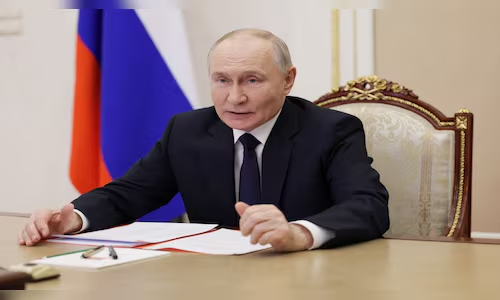
Speaking at the Saint Petersburg International Economic Forum on June 5, Putin said India accounts for a significant share of the global software market and has earned worldwide recognition for its highly skilled technology workforce.
“I would like to welcome another key partner of ours, India, which is one of the leading players in the IT industry. It accounts for a significant share of the global software market,” Putin said during the plenary session.
Praising India’s talent, he added, “We know how talented the Indian people are, how well-educated and competent they are. They have achieved worldwide renown, especially in coding.”
Putin on India and Russia ties
Describing India as a key partner, Putin said the country’s achievements in technology reflect the strength of its human capital and skilled workforce. He also highlighted the long-standing ties between India and Russia, calling the relationship “very good, trust-based, brotherly relations in all senses of the word.”
BRICS economies
Putin made the remarks while discussing the growing economic and technological influence of emerging economies, particularly the BRICS grouping. Addressing the forum, the Russian leader said BRICS nations are contributing a larger share to global economic growth than the Group of Seven (G7) countries.
BRICS economies accounted for 49% of global GDP growth over the past five years, compared with around 18% contributed by G7 nations, the Russian President said. He also noted that BRICS economies now represent about 40% of global GDP measured by purchasing power parity, while the G7 accounts for less than 29%.
Putin also said that the bloc had already surpassed the G7 in 2020 and said the gap is expected to widen further in the coming years. He projected annual growth of more than 4% for BRICS economies, compared with about 1.1% for G7 nations.
“These are not just our figures; the World Bank and the IMF state this as well. Naturally, it is more attractive to invest where development is most dynamic and where there are possibilities for production and sales. Consequently, the center of global trade and the financial system is already shifting, and this trend will persist,” he concluded.