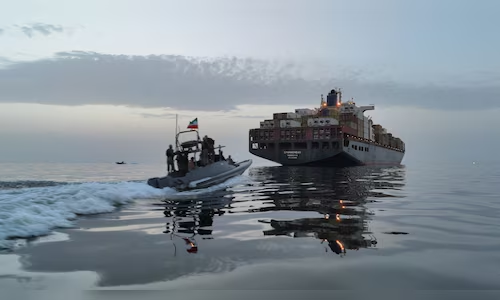
The chokepoint between Iran and Oman is one of the world’s most important oil shipping lanes. Around 20% of the crude oil exported by Gulf countries passes through this route before reaching buyers across the world, including India.
Iran has declared the closure of the Strait of Hormuz to commercial shipping after renewed US military strikes. Tehran has warned that ships attempting to pass may be fired upon. Even though Iran announced closure, the situation is not fully ‘sealed’ as some oil tankers are still passing through.
“Commercial ships are continuing to transit in and out of the Strait of Hormuz tonight,” US Central Command wrote on social media platform X.
???? CLAIM: Iran’s Islamic Revolutionary Guard Corps claims that the Strait of Hormuz is closed.
✅ TRUTH: Commercial ships are continuing to transit in and out of the Strait of Hormuz tonight. pic.twitter.com/yphkl2Lmji
— U.S. Central Command (@CENTCOM) June 10, 2026
Global crude oil prices rose by more than 2% after tensions in West Asia escalated again. As a result, Brent crude oil prices increased by $2.30, or 2.47%, reaching $95.40 per barrel. At the same time, US West Texas Intermediate (WTI) crude rose by $2.60, or 2.89%, to $92.63 per barrel.
India’s oil imports
Every year, India imports around 1.8 billion barrels of crude oil, about 5 million barrels per day. About 88% of India’s oil needs come from imports.
Before the US and Israel launched an unprovoked war on Iran, nearly half of India’s crude oil imports (48%) came from Gulf countries such as Iraq, Saudi Arabia, the UAE, Kuwait and Qatar in 2025. Together, these countries supplied about 2.4 million barrels of oil every day.
Until 2019, Iran was one of India’s biggest oil suppliers and met around 10-12% of the country’s crude oil needs. But India stopped buying Iranian oil after the US reimposed sanctions on Tehran during President Donald Trump’s first term.
Iraq emerged as India’s biggest oil source. Its share of India’s imports rose from around 9% in 2009-10 to more than 22% by 2020-21. Saudi Arabia remained a major supplier, consistently accounting for about 17-18% of India’s imports. In 2025, Russia was India’s largest single supplier, accounting for about 30.5% of imports.
What changed after the Strait was blocked?
The biggest problem was that oil from Iraq, Kuwait and Qatar could no longer reach India because ships could not pass through the Strait of Hormuz. Even Saudi Arabia and the UAE were able to send only limited quantities. This suddenly put almost half of India’s oil supply at risk.
How did India respond?
Instead of relying mainly on the Gulf, Indian refiners started buying more oil from other regions. Imports increased from the United States, Brazil, Nigeria, Angola and other African and Latin American countries. The country also expanded its supplier network to around 40 countries.
When the US eased restrictions on Venezuelan oil, India quickly resumed purchases from Caracas, which became one of the country’s important alternative suppliers during the crisis. Venezuela was exporting more than 370,000 barrels a day to India by April-May.
India also took advantage of the situation when the US temporarily allowed the sale of Iranian oil that had already been loaded onto ships and was stranded at sea. The 30-day waiver released about 140 million barrels of Iranian crude into the global market.
Can India survive a Strait of Hormuz closure?
India has managed to keep oil supplies flowing by buying more crude from countries such as Russia, the US, Brazil and Venezuela. The country also has emergency oil reserves that can be used if imports fall short.
A study suggests that 122 out of 140 sectors of the economy could see prices rise if the disruption continues. Petrol and diesel would be among the worst affected. Air travel could also become expensive.
Products made using oil and chemicals, such as fertilizers, pesticides, paints, soaps and cosmetics, could also see a hike in price. Transport would be affected the most as the prices could rise by 11.96%. This would account for 23.5% of the total inflation impact.
Food and beverages may see prices rise by 3.44% which contributes 28.2% of the overall inflation impact. Housing, electricity and cooking gas costs could rise by 3.16% and contribute 12.4% of total inflation. Clothing and footwear could see 6.63% rise, while furniture and household items may see 8.24% increase. Healthcare costs could increase by 4.4%.
India may have enough oil reserves and alternative suppliers to avoid a fuel shortage, but a prolonged Strait of Hormuz closure could still hit household budgets.