On a summer morning in 1908, exactly 118 years ago today, something tore across the skies above one of the most remote corners of Siberia and changed the landscape in seconds. There was no crater to inspect and no intact meteorite to recover, and for nearly two decades, no scientific expedition was capable of reaching the site. What remained instead were eyewitness accounts of a blazing object brighter than the Sun, thunderous explosions, forests flattened across an immense area and a mystery that would occupy generations of scientists.
Around 7:15 am on June 30 in 1908, during the reign of Tsar Nicholas II, an object from space entered Earth’s atmosphere over Siberia.
Advertisement – Scroll to continue
The region was sparsely populated, inhabited largely by Evenki reindeer herders. Their descriptions became the first record of an event that scientists would spend the next century attempting to reconstruct. Witnesses reported a brilliant fireball trailing smoke before a flash brighter than the Sun lit the sky. A deafening roar followed.
The blast took place roughly 4,000 km east of Moscow near the Podkamennaya Tunguska River in Yeniseysk Governorate (present-day Krasnoyarsk Krai) in Russia.
In the history books, it is called the Tunguska Event.
Those nearest the blast said they were thrown into the air, some losing consciousness as homes were damaged or destroyed.
Others farther away described seeing a towering column rising into the atmosphere. Herds of reindeer reportedly perished. Seismic instruments hundreds of miles away detected tremors generated by the shock wave.
Today, scientists believe the object entered Earth’s atmosphere at an angle of roughly 30 degrees before exploding at an altitude of roughly 10 km. Instead of striking the ground intact, it released an enormous amount of energy in the atmosphere.
“We know with high confidence that it was meteoritic airburst,” Dr Mark Boslough, Research Associate Professor of Earth and Planetary Sciences at the University of New Mexico, told NDTV
“There is still a large uncertainty in the magnitude of the event. I use the word ‘meteoritic’ to generically refer to either asteroid or comet because we don’t know which it was. We know precisely when it happened and what direction it came from, but we do not know its speed or physical properties of the object,” he added.
A Mystery Hidden By Geography
The remoteness of the explosion delayed scientific investigation for almost twenty years. Additionally, World War I, followed by the Russian Revolution and civil war, diverted attention away from the isolated Siberian wilderness.
In the year 1921, the Soviet Academy of Sciences dispatched geologist Leonid Kulik to the area, but he was unable to reach the site because of the difficult terrain.
Image credit: Wikimedia Commons/Leonid Kulik, the expedition to the Tunguska event
Only in 1927 did he finally arrive.
Even after nineteen years, the forest still bore unmistakable scars of a big explosiom. Near what would later be identified as the epicentre, trees remained upright but had been stripped of branches and bark. Many showed signs of burning. Yet despite repeated expeditions, Kulik never located the crater or substantial meteorite fragments that many expected to find.
That delay, according to Dr Martin Connors, Canadian astronomer and professor of astronomy, mathematics, and physics, shaped the scientific debate that followed.
“It is surprising how much we do not know and that there remains controversy,” he told NDTV. “The extremely remote location prevented immediate study and it was only years after the event that study was done.”
At first, the absence of a crater seemed almost impossible to reconcile with contemporary understanding of meteorite impacts.
“Exactly as you state,” Dr Connors said. “Comparing largely to what would have happened on the Moon, a crater and fragments… were expected. The concept of airbursts was not well known at the time.”
He said the Tunguska event, alongside later developments in explosive technology, fundamentally altered scientific thinking.
“This event made us understand that airbursts could be important and that a physical impact was not needed to do damage,” he told NDTV.
The most important discovery did not emerge from the first expeditions but from photographs taken later from the air. Scientists found millions of trees knocked over across roughly 2,150 sq km in a distinctive butterfly-shaped pattern stretching between 23 to 56 km from the epicentre.
“The butterfly pattern may be one of the most significant and important discoveries related to Tunguska, because it can be reproduced experimentally and computationally. It tells us that the airbursts from collisions are quite different from nuclear airbursts. The size and shape of the butterfly pattern depends strongly on the energy and entry angle of the impactor, so we can use it in our risk assessments and disaster planning to figure out where the danger zone is,” Dr Boslough told NDTV.
Ironically, the absence of conventional evidence proved to be the strongest evidence of all.
“The early expeditions failed to find the expected crater and meteorite fragments,” Dr Boslough said, “but the biggest surprise didn’t come until after the first aerial photographs showed a pattern in which all the trees were blown over in a direction pointing away from a central point.”
He described that as “the first clue that it was an airburst.”
Lessons From Chelyabinsk
More than a century after Tunguska, another object entered Earth’s atmosphere over Russia. In February 2013, an asteroid exploded over Chelyabinsk. Visuals of the incident fascinated many online.
Although much smaller than Tunguska, it injured people, shattered windows and became the best-observed airburst in history. It also became an opportunity to revisit long-held assumptions for scientists.
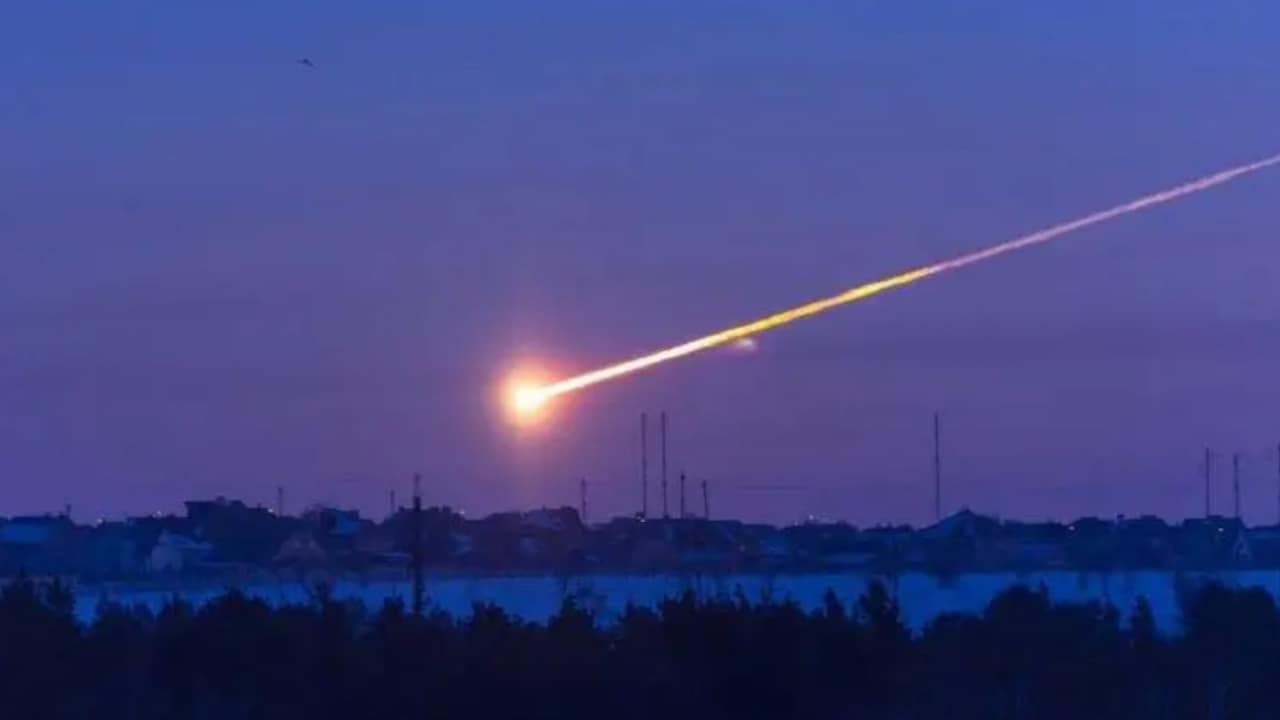
The fireball over Chelyabinsk
Photo Credit: NASA
“The Tunguska airburst was ten times (or more) powerful than the Chelyabinsk event,” Dr Boslough told NDTV. “It entered the atmosphere at a steeper angle and penetrated more deeply, so the explosion was closer to the surface. The lower altitude and larger explosion caused far more damage at the surface for the Tunguska event.”
Chelyabinsk also confirmed something researchers had begun to suspect.
“It reinforced the notion that airbursts are more dangerous than previously thought and gave more credence to results of supercomputer simulations,” he added.
Dr Connors sees the comparison in similarly practical terms.
“Both were primarily airbursts,” he told NDTV. “Although a relatively small meteorite was found after Chelyabinsk. Nothing was ever found from the much bigger Tunguska event. While mostly fragile things got destroyed in Chelyabinsk (including a lot of window glass), entire forests were blown down in Tunguska. However there were not population centres nearby. If there had been (say a large city like Chelyabinsk), human losses would have been enormous.”
Asteroid Or Comet?
One of the longest-running debates surrounding Tunguska centres on the identity of the object itself. Was it an asteroid or a comet? Scientists have examined tree resin, peat deposits, microscopic particles and isotopic signatures for clues yet the answer remains elusive.
“In my opinion, the significance of this debate has been exaggerated,” Dr Boslough said. “The difference between asteroids and comets is blurry, because comet fragments can be captured into asteroid-like orbits and become more like asteroids after their volatile components have vaporised and disappeared over time.”
“Much of material collected from the surface has been misinterpreted as a product of the 1908 event, but could easily have come from the constant infall of meteoritic material over time,” he added.
Dr Connors offered a similarly measured assessment.
“There is a complex literature from about 100 years of research,” he said. “It is hard for the various pieces of evidence to be definitive.”
Long before modern computer modelling, people living near Tunguska described what they saw. Their accounts included a column of fire, repeated thunderclaps and glowing skies that persisted for days. Remarkably, modern impact physics now supports those observations.
“The column of fire is consistent with the ejection of incandescent vaporised meteoritic material being ejected up the entry wake. Multiple thunderclaps are supersonic shock waves or sonic booms arriving at different times from different fragments as the object broke up in the atmosphere (also observed at Chelyabinsk). The glowing skies were a mystery until the impact of Shoemaker-Levy 9 on Jupiter, in which we saw the ejection of a ballistic plume of debris that collapsed on top of the atmosphere over a large area, creating a noctilucent cloud. We proposed this explanation in 1997 and I think it’s pretty well accepted now,” Dr Boslough said.
Dr Connors added that the luminous skies were observed far beyond Siberia.
“These all align with what we now know, including that the glowing skies were seen worldwide, showing that dust was injected into high atmospheric layers and transported around the world,” he told NDTV.
Could It Happen Again?
The Tunguska event is no longer viewed as a unique historical curiosity. Scientists know that smaller objects enter Earth’s atmosphere regularly and most disintegrate harmlessly. The concern lies with objects large enough to survive long enough to generate destructive airbursts. Warning time depends largely on where such an object approaches from.
“With current telescopic survey capabilities, if it was coming from the daytime sky (as Tunguska and Chelyabinsk did) then there would be zero warning unless it had been discovered years earlier in the night sky. This will change after NEO Surveyor is in service because it will be able to spot objects coming from the other direction. It is fun to speculate on the possibility that the Tunguska object was part of a cluster of objects–and if so, when its companions would return,” Dr Boslough told NDTV.
According to Dr Boslough, if Tunguska formed part of a cluster of objects sharing a 61-year orbital resonance with Earth, companion objects could potentially return along predictable intervals.
“Any such objects would have returned in June, 1969 and will again in June, 2030. These would be returning from the daytime sky, but would also make a close pass from the nighttime sky in November, 4 years earlier. So if they existed, they would possibly be observable in November of this year!” he added.
Dr Connors agreed that objects arriving from the direction of the Sun remain particularly difficult to detect. However, he pointed to future observing systems, including NASA’s Near Earth Object Surveyor and the Vera Rubin Observatory, which are expected to discover many more asteroids and improve long-term predictions of their orbits.
“As in the Chelyabinsk case, we could have little warning if the object approached from the dayside of Earth where monitoring is difficult. We are launching satellites such as the NASA Near Earth Object Surveyor (2027 launch) that can look at dark space as seen from above the atmosphere, that can look inward and see objects coming from the dayside. Also, our ground-based facilities such as the new LSST Vera Rubin Observatory will discover many asteroids and we can predict more orbits including ones that are now faint but outside Earth’s orbit and sometimes in the night sky. We can then predict when they might come close to Earth even if they would not be directly visible at that time,” Dr Connors told NDTV.
Planetary Defence
The Tunguska event has over the years helped reshape how governments think about threats from space. NASA established the Planetary Defense Coordination Office to identify potentially hazardous Near-Earth Objects, coordinate warnings and develop technologies capable of preventing future impacts.
The agency’s Double Asteroid Redirection Test, or DART, demonstrated that changing the trajectory of an asteroid is technologically possible. So did a few Hollywood films.
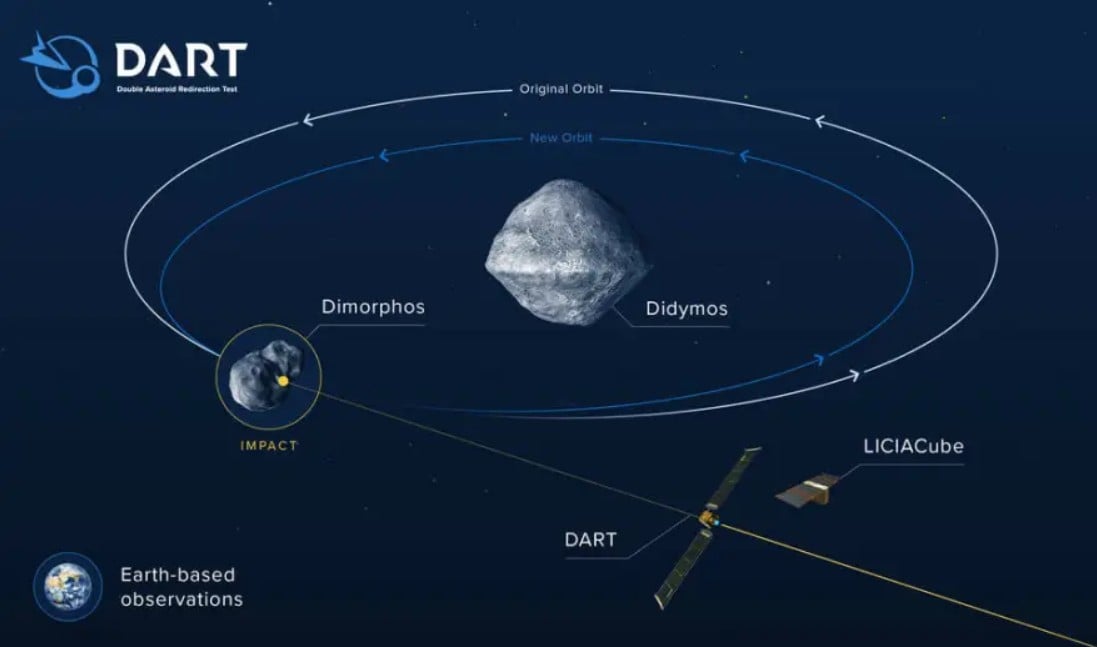
Photo Credit: DART
The mission successfully altered the orbit of Dimorphos around the larger asteroid Didymos, providing the first real-world demonstration of asteroid deflection. NASA continues to monitor objects passing within 30 million miles of Earth’s orbit.