US President Donald Trump declared on Tuesday that talks with Iran would take place in Doha, saying Tehran had requested the meeting and that it would focus on stripping Iran of its nuclear capabilities.
“There’ll be a meeting on that tomorrow in Doha,” Trump told reporters in Washington, describing the proposed discussions as part of efforts toward the denuclearisation of Iran.
“We don’t want them to have a nuclear weapon and they’re not going to have a nuclear weapon. They’ve agreed to that in all fairness,” he added.
.@POTUS on Iran: “The meeting in Doha is going to be perhaps important, perhaps not. We’re going to find out… It’s really very simple. It’s the denuclearization of Iran. We don’t want them to have a nuclear weapon — and they’re not going to have a nuclear weapon.” pic.twitter.com/EJO2IbGZty
— Rapid Response 47 (@RapidResponse47) June 29, 2026
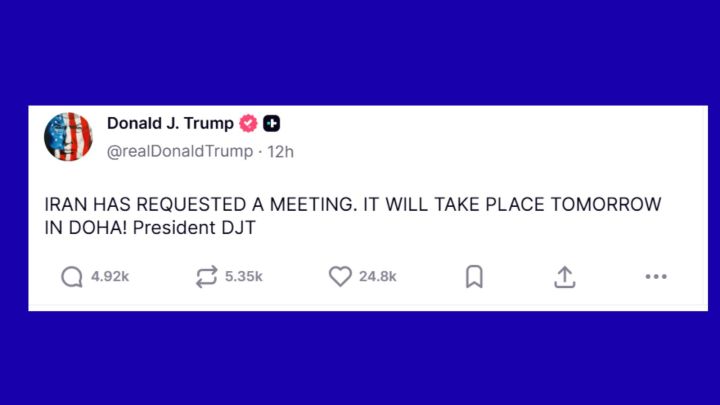
A day earlier, Trump had announced the talks on Truth Social, writing: “IRAN HAS REQUESTED A MEETING. IT WILL TAKE PLACE TOMORROW IN DOHA!” He did not identify the participants.
The United States planned to send presidential envoy Steve Witkoff and Jared Kushner to lead its delegation.
‘No negotiations at any level’
However, Iran’s foreign ministry spokesperson Esmaeil Baghaei rejected those claims during a press briefing said no negotiations with Washington were planned and that there would be no discussions between the two sides at any level in the coming days.
Story continues below this ad
“There will be no negotiation meeting with the American side at any level in the coming days,” Baghaei said.
Despite the public denial, a senior Iranian official told Reuters that a meeting in Doha was nonetheless expected to proceed. Unlike earlier technical discussions held in Switzerland, the talks would reportedly focus on reducing tensions and ensuring stability in the Strait of Hormuz, one of the world’s most critical energy transit routes.
Another official said American and Iranian technical teams were expected to hold separate meetings with Qatari and Pakistani mediators on Wednesday.
‘If the American side adheres to the agreement’
Iranian President Masoud Pezeshkian took a more measured position, saying Tehran remained committed to the memorandum of understanding with Washington but making clear that commitment was conditional.
Story continues below this ad
“Mutual understanding is a two-way street,” Pezeshkian wrote on X. “If the American side adheres to the agreement, we will also fulfill our commitments.”
تفاهم امری طرفینی است. اگر طرف آمریکایی به تفاهم نامه پایبند باشد ما هم به تعهداتمان عمل میکنیم.
رویکرد ما در مقابل رجزخوانیهای نامعقول و تهدیدهای بیپشتوانه، تکیه بر عقلانیت و کرامت انسانی در تصمیمگیریها و دفاع قاطع و بیپروا به هنگام عمل است.— Masoud Pezeshkian (@drpezeshkian) June 29, 2026
Without naming Trump directly, he appeared to take direct aim at what he called inflammatory rhetoric from Washington.
“Our approach to unreasonable saber-rattling and baseless threats is to rely on rationality and human dignity in decision-making, while defending decisively and fearlessly when action is required,” Pezeshkian said.
The diplomatic contradictions played out against an increasingly volatile backdrop. Weekend missile and drone exchanges between the two sides tested an interim ceasefire designed to end a four-month conflict. Washington accused Iran of striking at least two commercial vessels in the Strait of Hormuz and carried out attacks on Iranian military facilities over the weekend. Iran responded by launching missiles and drones at US military installations in Kuwait and Bahrain on Sunday.
The ceasefire forms part of a broader memorandum of understanding giving both countries time to negotiate issues ranging from Iran’s nuclear programme and sanctions relief to regional security arrangements. With the Doha talks shrouded in conflicting claims from both sides, the durability of that agreement remained deeply uncertain.