A commission established by President Donald Trump has put forward a controversial proposal to redefine the relationship between faith and governance, suggesting the long-held principle of “separation of church and state” be replaced with an approach focused on building bridges between them. This assertion challenges a foundational concept in American law.
The recommendation is part of a 224-page draft report from the Religious Liberty Commission, released Friday. Formed last year by Trump, the advisory body is predominantly comprised of conservative Christians.
The document, which blends policy recommendations with philosophical arguments, advocates for a more prominent role for religion and religious expression across government, educational institutions and public life.
The report specifically commends recent Supreme Court rulings that have expanded rights for religious expression in public settings, including provisions allowing for religious objections to be accommodated in school lessons.
The report recommends eliminating the “ Johnson Amendment ” that forbids political activities by tax-exempt religious groups — a longstanding goal of Trump. It calls for compensating military service members who were discharged for refusing COVID-19 vaccines.
It calls in general for allowing more religious expression in the public square, greater access to public money for faith-based agencies and broader exemptions for those claiming conscientious objections to policies ranging from vaccine mandates to pronoun usage to classroom lessons.
It recommends that federal agencies publish “Know Your Rights” posters for various settings and establish hotlines to receive complaints about religious liberty violations.
The draft report also calls for the creation of new honors — a Presidential Medal of Religious Liberty and First Freedom Hero Awards. And it calls for exhibits and markers at historic sites paying tribute to the role of religion in American history.
The draft report is now available for public comment over the next 15 days. It is sure to draw opposition.
A coalition of groups – including one suing over the commission’s lack of ideological diversity, as required of federal advisory panels – issued a preemptive report earlier in June defending the concept of church-state separation.
“Religious liberty belongs to all people, not to any single tradition, political party, or administration,” said the report, published by the Center for American Progress and others.
Critics of the Religious Liberty Commission’s work say its perspective is skewed toward by favored by Trump and his supporters and that it heard almost entirely from like-minded scholars and activists. They say the commission failed adequately to address such issues as anti-Muslim efforts in Texas and elsewhere, and also the rise of antisemitism on the right, not just the left.
The report comes as conservative states such as Texas have worked to incorporate more religion into public spaces such as classrooms, including Bible lessons and Ten Commandments displays.
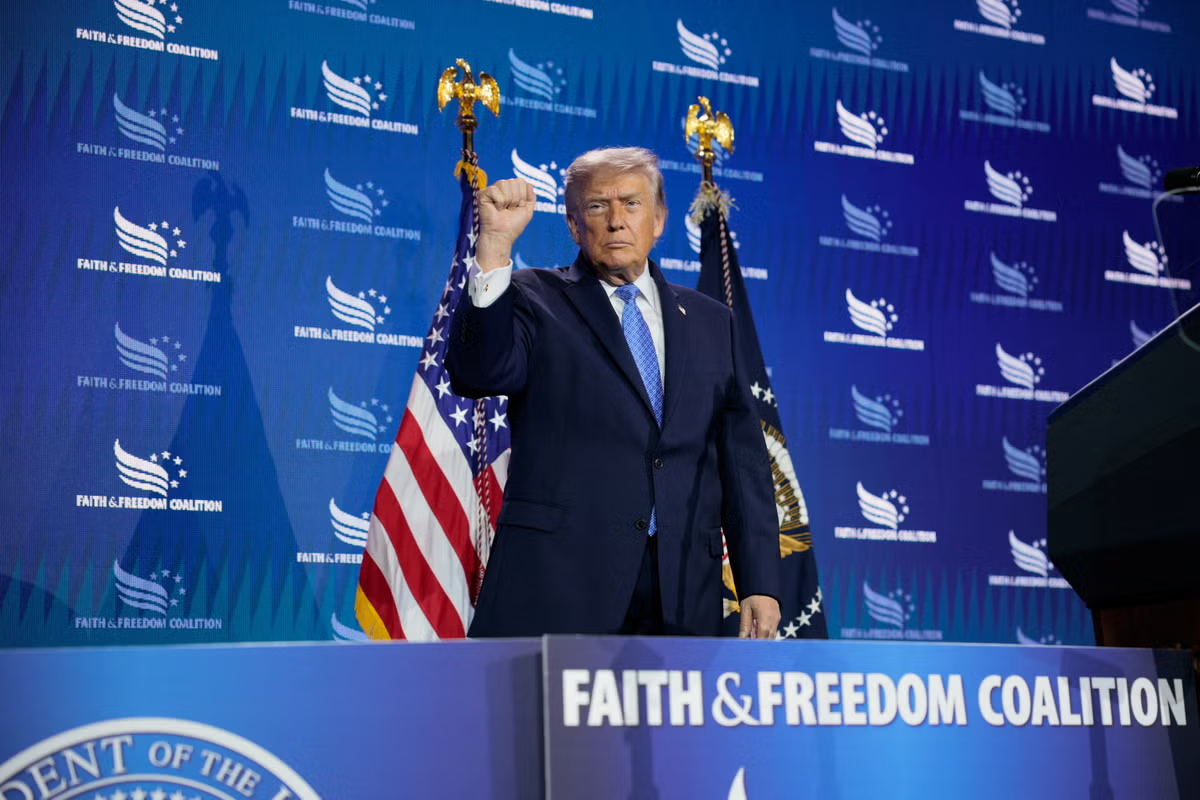
Trump, speaking to supporters at a Faith & Freedom Coalition gathering in Washington on Friday, touted the newly released report.
“We saved religion, it was going down,” he boasted.
Trump contended that the administration of his predecessor, Democrat Joe Biden, had carried out a “reign of persecution.”
While the commission report downplays the separation of church and state, the commission didn’t go so far as to call it a “lie,” as the commission chairman, Texas Lt. Gov. Dan Patrick, did in April.
But it largely took the stance that the idea is misapplied.
“To be clear, this does not involve or require advocating ‘theocracy’ or even the total elimination of any separation between church and state,” the report says. Rather, it calls for honoring a “tension between the relevant clauses of the First Amendment” that guarantee religious freedom but forbid any government-established church.
The phrase, “a wall of separation between church and state,” does not appear in the Constitution, but it’s embodied in Supreme Court precedent. Thomas Jefferson used that expression in a letter to Baptists, supporting them in opposing official churches in U.S. states, a practice that soon ended.
Twentieth-century decisions by the high court invoked the “separation” phrase to extend the First Amendment’s prohibition on federal church establishment to state and local governments, citing the 14th Amendment’s ban on states denying citizens’ rights.
That led to bans on official prayers and Ten Commandments displays in public schools. The Supreme Court in recent years has steered a different course, permitting such things as a public school coach’s on-field prayers and a religious opt-out for parents objecting to a lesson on transgender issues.
The draft report contends that even Jefferson didn’t believe in completely banishing religion from public life, but rather in keeping church and state in a kind of balance.
“In reality, the church and state strengthen and support one another,” it says.
The report touts the value of religion to society in terms of providing humanitarian work, anchoring families and acting as “conscience” monitoring government.