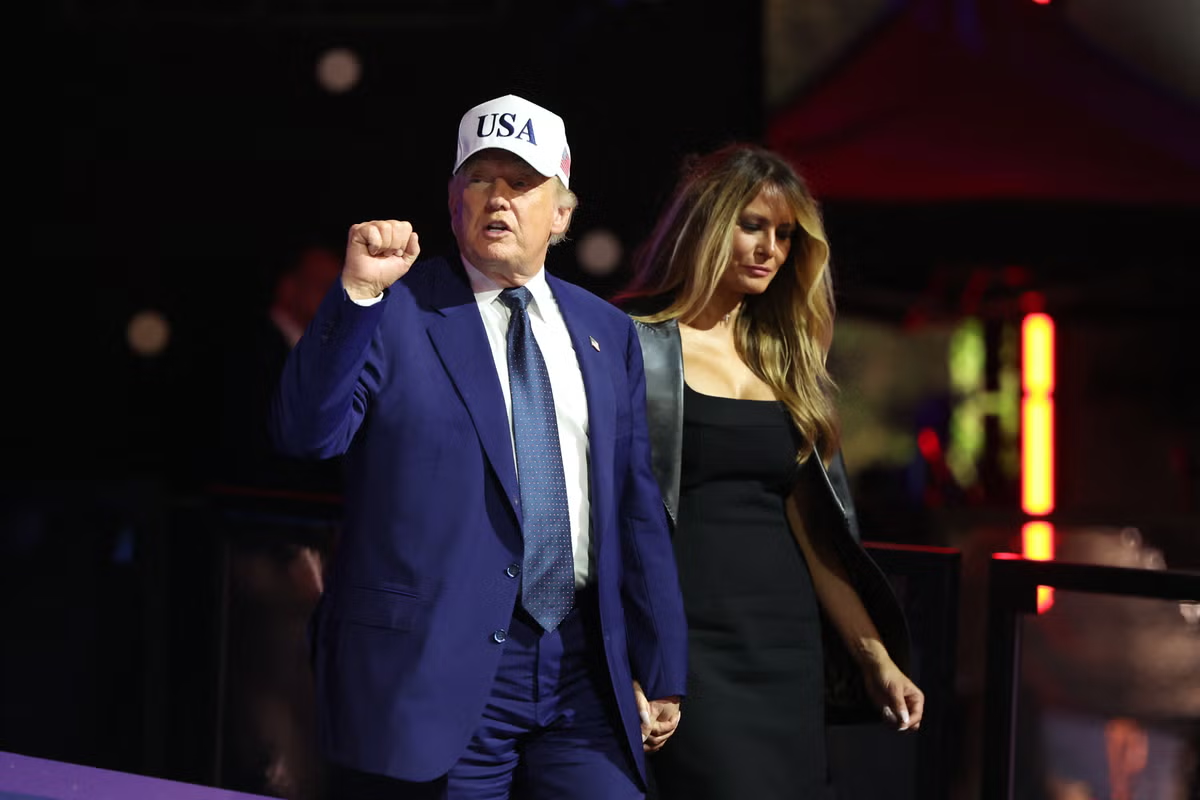
Donald Trump loves power. He has the language to prove it: “I hereby authorize the toll free opening of the Strait of Hormuz, and, simultaneously herewith, authorize the immediate removal of the United States blockade” of Iran.
A child who found a crown in a dressing-up box might pepper his declarations with grandiose olde-worlde phrases garnered from the video game Age of Empires. But no amount of primary school pomposity can mask the desperate attempts of America’s president to hide failure.
On Sunday, the US – Trump, that is – and Iran declared that a ceasefire had been agreed. Pakistan and Qatar, who brokered the deal, were chuffed that they had ended the choking of fossil fuel products through the Strait of Hormuz.
The “ceasefire”, and that is all it is, is supposed to last for 60 days while the tricky issue of Iran’s nuclear weapons programme is sorted out. And it will not be signed until Friday
Meanwhile, Israel wants to continue its assault on Lebanon. It is not clear whether Iran will be able to rein in Hezbollah, Tehran’s proxy force there. But the Iranian regime has wrapped a Lebanese ceasefire into its demands for an end to hostilities with the US and Israel.
The two allies attacked Iran at the end of February. Back then, the war aims were clear and clearly stated many times.
Iran’s nuclear ambitions were to be bombed into oblivion. Iran’s theocratic regime, which killed thousands of its own citizens at the start of the year, was to be toppled and ideally Iran’s population would take over in a revolution. Iran’s military infrastructure and support for proxies (like Hezbollah and Hamas) were to be ended by force.
None of these aims has been achieved. Trump’s ceasefire is an opportunity for the US to wriggle out of a war it started – nothing more.
Discussions about the future of Iran’s nuclear programme are to be kicked down the road and held over the next couple of months – with the regime that Trump supposedly decapitated.
Iran’s missile programme has been battered but remains effective and continues to attack Gulf nations whenever it chooses.
Iran, as anyone would have anticipated outside the Trump administration, closed the Strait of Hormuz when it was attacked, causing a spike in oil prices, a global shortage of fertiliser in the planting season for the northern hemisphere, and the strategic reputation of America to take another pratfall.
The ceasefire announcement, if it works, will take the region and the global economy (minus the battering it has had over four months) back to the days when Iran was run by a murderous regime driven by an apocalyptic theology that was working on a nuclear weapon, but allowing trade through the sea lanes it controls.
It will not take the region back to the 2015 agreement signed under Barack Obama, in which Iran agreed to reduce its stockpile of enriched uranium by about 98 per cent and limit uranium enrichment to 3.67 per cent purity (far below weapons-grade of 60 per cent).
Under that deal, Iran agreed to cut the number of operating centrifuges from roughly 19,000 to about 6,000, with only around 5,000 allowed to enrich uranium, and to redesign the heavy-water reactor at Arak Nuclear Complex so it could not easily produce weapons-grade plutonium, according to an extensive inspection regime by the International Atomic Energy Agency.
It also agreed to continuous monitoring of key nuclear facilities and much of the nuclear supply chain.
This imperfect agreement was not permanent. It slowed a nuclear weapons programme in return for an end to economic sanctions.
Israel’s government under Benjamin Netanyahu hated it. And Trump dumped it in 2018.
So Iran returned to its nuclear enrichment programme, but was never close to creating a nuclear weapon – no matter the claims from Trump that Israel could have been destroyed “in two hours” were it not for America’s security umbrella.
As the US and Iran tried to find some deal they could agree to, Israel’s right-wing politicians, including members of the ruling cabinet, were outraged by Netanyahu’s agreement to at least pause fighting in Lebanon.
Finance minister Bezalel Smotrich described Sunday night’s ceasefire agreement between the United States and Iran as “bad for Israel and the entire free world”.
“We will have to continue the campaign to topple the [Islamic] regime ourselves and in creative ways, and ensure that Iran will never have nuclear weapons,” he wrote on X.
Defence minister Israel Katz insisted that his country would remain in occupied land captured in Lebanon, Syria and Gaza. These “security zones” will be “cleared of local residents, and all terror infrastructure, above and below ground, including the houses in the contact-line villages that served as terror outposts, will be destroyed”.
It is impossible to square this aim with long-term peace in the region.
But if Iran does not sign up to a future deal, Trump has promised to return to full-scale war.
And he is offering a subscription package for countries in the region that have been American allies for decades. They will receive long-term US military protection for 20 per cent of their revenues.