A United Nations agency said Tuesday that a plan is underway to evacuate 11,000 stranded seafarers through the Strait of Hormuz.
The International Maritime Organization announced the plan.
Its secretary-general, Arsenio Dominguez, said in a statement that “this large-scale operation will be carried out in close cooperation with Iran, Oman, all other coastal states in the region, the United States and the maritime industry.”
“We have secured the necessary safety guarantees and have thoroughly verified the conditions for safe navigation to support these operations,” he said.
The IMO’s announcement included instructions from Oman on how ships could travel through the strait, the narrow mouth of the Persian Gulf through which a fifth of all oil and natural gas traded before the war.
But the uneasy ceasefire already has been tested by Iran saying it closed the strait again over fighting between Israel and the Iranian-backed militia Hezbollah in Lebanon.
THIS IS A BREAKING NEWS UPDATE. AP’s earlier story follows below.
ISLAMABAD (AP) — The U.S. and Iran were in dispute Tuesday over whether Tehran had agreed to allow U.N. inspectors to view bombed Iranian nuclear sites, as officials mediated talks on a permanent end to their war and violence broke out again in Lebanon.
The differing accounts came as Iran’s president met with Pakistani officials mediating negotiations and while technical teams were working on details following talks in Switzerland between the U.S. and Iran.
Iran’s Foreign Ministry spokesperson Esmail Baghaei told reporters in Tehran that U.N. inspectors were not scheduled to examine the nuclear sites bombed by the U.S. last year, refuting comments made a day earlier by U.S. Vice President JD Vance. In response, President Donald Trump posted on social media that Iran had agreed to nuclear inspections long into the future, saying that without this concession “there would be no further negotiations!”
The International Atomic Energy Agency has not responded to requests for comment over its possible role. It has been in and out of Iran since Israel’s 12-day war in 2025, but has not been granted access to bombed enrichment sites targeted by the U.S.
The U.S. said negotiators have discussed “mechanisms” to ensure that the Strait of Hormuz, a key waterway for oil transit that Iran effectively blocked during the war, remains open. Ship traffic is increasing but questions remain about who controls the strait.
Data and analytics company Kpler confirmed 39 ships crossed through the strait Monday, after about 92 crossings between Friday and Sunday. Prior to the war, roughly 100 ships a day made the journey.
Meanwhile, violence flared again in southern Lebanon as Israeli soldiers opened fire, killing two people. The reports of violence came after two days of calm following a ceasefire brokered on Saturday. Any renewal of heavy fighting could threaten the broader diplomatic talks, since Iran has demanded that a full truce in Lebanon be part of any comprehensive deal.
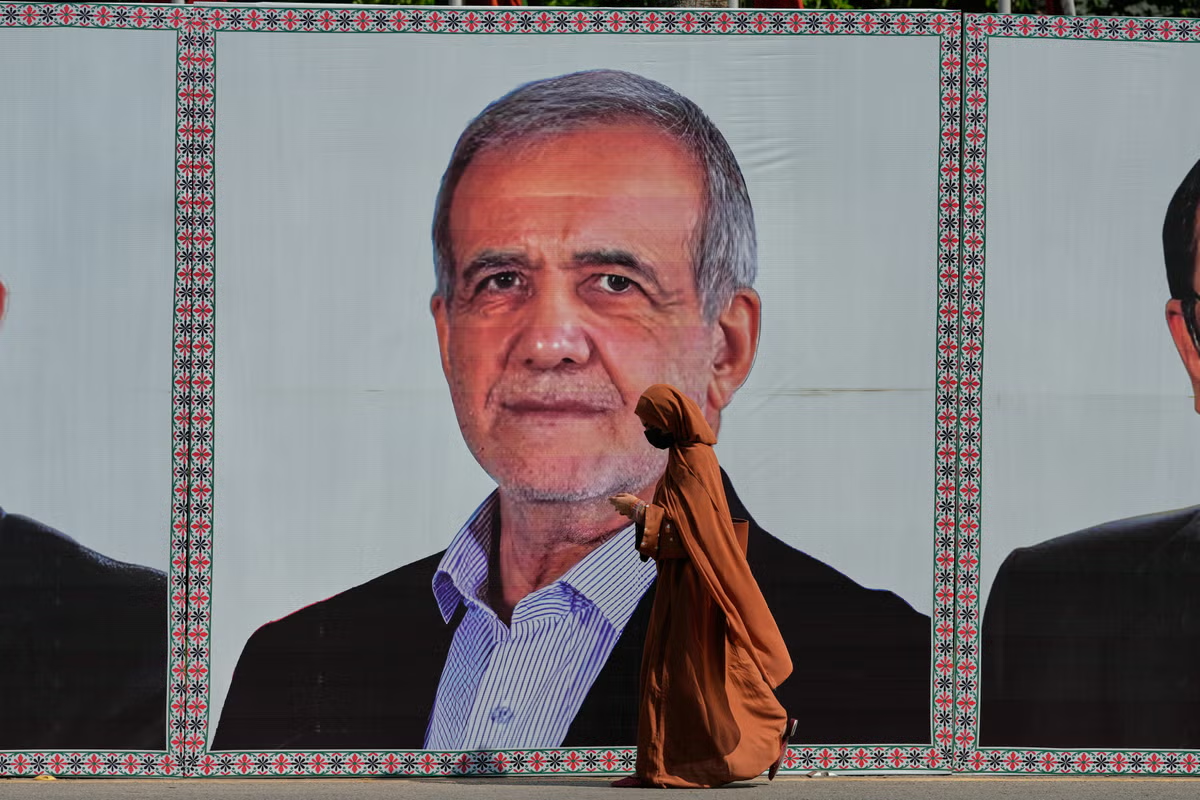
Iran’s president makes his first visit to Islamabad since the war started
Pezeshkian and Pakistani President Asif Ali Zardari on Tuesday discussed a range of issues, including regional peace and economic cooperation, according to a statement from the presidency in Islamabad.
Iran Foreign Minister Abbas Araghchi also joined the delegation that arrived in Islamabad amid tight security.
It was the Iranian president’s first visit since the U.S. and Israel launched war on Iran on Feb. 28. Pezeshkian and Pakistan Prime Minister Shehbaz Sharif were to hold a joint news conference after the discussions.
In the initial talks, marking the start of a 60-day window to reach a permanent deal to end the war, Iran and the U.S. agreed to create a “de-confliction cell” to address the fighting in Lebanon between Israel and the Iranian-backed militant group Hezbollah.
Ahead of his meetings in Pakistan, Pezeshkian cautioned that “the effectiveness of the talks depends on full commitment to the agreed obligations and their precise implementation.”
Iran says negotiations focused on sanctions relief, nuclear issues and more
Iran suggested that the talks in Switzerland led to the creation of specific negotiation groups, including those focused on sanctions relief, nuclear issues, reconstruction, and monitoring, according to the state-run IRNA news agency.
The report quoted Kazem Gharibabadi, a deputy foreign minister leading the technical talks, saying the countries also formed a contact mechanism over ships moving through Hormuz and the fighting in Lebanon between Israel and Hezbollah.
Israel occupies part of Lebanon and insists it must be able to attack militants launching attacks into northern Israel.
On Tuesday, Israeli forces opened fire and killed two men near the southern Lebanese town of Nabatiyeh al-Fawqa, Lebanon’s state-run National News Agency reported, saying the pair were next to a bulldozer clearing a road.