
5 min readJun 24, 2026 07:23 PM IST
As Western Europe endures one of its most intense heatwaves in years, with temperatures crossing 40 degrees Celsius and deaths mounting across several countries, a familiar question has resurfaced: why is air conditioning still relatively uncommon across much of Europe? Experts say the answer lies in a mix of climate, architecture, energy policy and cultural attitudes that developed long before extreme heat became a regular summer threat.
Built for cold, not heat
Europe’s housing stock was largely designed to retain warmth rather than shed it. CNN reported that many buildings were constructed decades or even centuries ago, with thick walls, smaller windows and insulation aimed at coping with cold winters. As a result, much of the continent lacks the infrastructure needed for widespread air-conditioning systems, leaving homes vulnerable during prolonged heatwaves.
 A migrant rests on a mattress near tents at a makeshift camp set up under an elevated railway of a Paris metro line near the Stalingrad subway station, as temperatures rise in paris during a heatwave affecting a large part of France, June 24, 2026. (REUTERS)
The report added that while air conditioning is standard in many parts of the United States, ownership rates remain significantly lower across Europe. In countries such as Germany and the United Kingdom, only a small share of households have air-conditioning units, reflecting a historical belief that summers were generally manageable without mechanical cooling.
Energy costs and environmental concerns
European governments and consumers have long viewed air conditioning with caution because of its high energy consumption and potential environmental impact. Policymakers have instead promoted passive cooling measures, including improved building design, external shutters, ventilation systems and urban greening initiatives.
CNN noted that concerns over electricity demand have become particularly relevant as Europe seeks to reduce emissions and transition away from fossil fuels. Critics of widespread air-conditioning adoption argue that greater reliance on cooling systems could increase pressure on already strained power grids during periods of extreme heat.
54
Departments on red alert — about half of France
48
Drowning deaths since 18 June, mainly young people
43.3°C
Hottest local reading, Châteaumeillant (109.9°F)
France’s hottest day ever
A national record — and a country without air-conditioning
France’s national thermal indicator — an average across 30 weather stations — hit 29.8°C on 23 June, the highest since records began in 1947. More than 90% of the population is exposed to extreme heat, with the Eiffel Tower and the Louvre cutting their opening hours. Prime Minister Sébastien Lecornu, after a crisis meeting, said the drowning victims were mainly young people; two young children also died from heat in a car.
Schools
Hundreds closed or on reduced timetables.
Trains
Services reduced to avoid heat damage to lines.
Power
Up to 106,000 clients lost electricity; 68,000 households hit in Finistère.
Met Office: June record “very likely” to fall
The UK’s Met Office issued a rare red extreme heat warning for Wednesday and Thursday, saying the country’s highest June temperature on record is very likely to be broken. Hundreds of British schools planned to close or finish early, and many train services were cut. Conditions are expected to ease by Friday.
37°C
Expected in southern England (98.6°F)
35°C
Up to this in south-east Wales (95°F)
39°C
Forecast peak, London & south (102.2°F)
Spain and Italy raise their highest alerts
Spain’s weather service AEMET issued red alerts as temperatures pushed toward 44°C, with even the normally temperate northern coast hitting 40°C. Italy’s health ministry declared a red heatwave alert in 16 cities, including Milan and Rome. The heat is forecast to spread eastward into Poland, Croatia and Hungary in the coming days.
44°C
Southern Andalusia, Spain — AEMET red alert (111°F)
40°C
Cantabria & Basque Country, Spain (104°F)
16
Italian cities on red alert, including Milan & Rome
Hottest day since 1947; local highs to 43.3°C
Up to 39°C — June all-time record at risk
Up to 44°C in Andalusia — the region’s highest
Red alert in 16 cities, including Milan & Rome
One heat dome, four records
The same trapped mass of hot air is being measured against four different national benchmarks — a single weather system stretching from the Atlantic coast to the Mediterranean, with the heat set to push further east this week.
The shadow of August 2003
This event is being compared to August 2003, when the highest temperatures in over half a century caused an estimated 15,000 deaths in France — many of them older people in apartments and retirement homes without air-conditioning. France introduced its heat-watch warning system in the aftermath.
15,000
Estimated deaths in France, August 2003
50+ yrs
Highest temperatures in over half a century
“…some that could surpass all previous records, regardless of the time of year.”
— Météo-France
2×
Faster warming than the global average since the 1980s
200,000+
Heat-related deaths in Europe over four years — most preventable
2024
Hottest year on record, in Europe and globally
Europe is the world’s fastest-warming continent
Temperatures here have risen about twice as fast as the global average since the 1980s, according to the EU’s Copernicus Climate Change Service. In 2024 the continent logged its second-highest number of “heat stress” days, and UN projections say the next five years are likely to shatter more records. The WHO’s Europe office says most of the region’s heat deaths were preventable.
Sources: Associated Press · AFP · Météo-France · UK Met Office · AEMET (Spain) · Copernicus Climate Change Service · WHO Europe
Figures current as of 24 June 2026
How many Europeans have air conditioning?
According to International Energy Agency estimates, air-conditioning ownership remains far below US levels. In countries such as Germany and the UK, household penetration is still in the single digits, compared with widespread adoption across much of the United States.
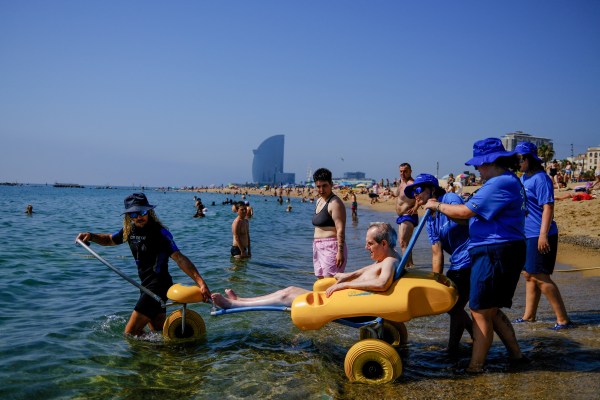 Antonio Herrera, 52, who is disabled, sits on an amphibious chair as he is helped by lifeguards into the Mediterranean sea, as temperatures rise, during a heatwave affecting a large part of Spain, on Barceloneta beach, in Barcelona, Spain, June 23, 2026. (REUTERS)
Heatwave exposes growing vulnerability
The debate has intensified as Western Europe experiences one of its most severe heatwaves in recent years. According to Reuters, France recorded its hottest day since records began nearly 80 years ago, with temperatures reaching 44.3 degrees Celsius in the southwestern town of Pissos. Authorities have been working to restore power to thousands of homes in Brittany following heat-related disruptions.
Story continues below this ad
Reuters reported that Italy’s Health Ministry placed 16 cities, including Rome, Milan and Florence, under its highest heat alert, while Britain issued only the second extreme-heat warning in its history as temperatures approached record levels. Hundreds of schools closed or shortened operating hours because of the heat.
At least 40 people have drowned in France while swimming in unsupervised areas to seek relief from a heatwave gripping the country and other parts of Europe.
Forecasters warn that the extreme heat is likely to persist through the week.Al Jazeera’s Natacha Butler reports. pic.twitter.com/wqJGHrdoTc
— Al Jazeera English (@AJEnglish) June 23, 2026
Death toll and infrastructure strain
The human cost of the heatwave continues to mount. According to Reuters, at least 48 people in France died in drowning incidents as they sought relief from the heat, while two young children died after being left in a hot vehicle. In Spain, two elderly people died from heatstroke after temperatures exceeded 40 degrees Celsius.
Reuters reported that the extreme weather has also disrupted daily life across the continent. Train operators in Britain imposed speed restrictions, electricity networks came under pressure, and farmers in France shifted grain harvesting to nighttime hours to reduce risks to workers and crops.
Climate change driving more extreme summers
The Reuters report said meteorologists attribute the current conditions to a rare “Omega block” weather pattern that traps hot air over large regions for extended periods. The phenomenon has pushed temperatures as much as 18 degrees Celsius above seasonal norms in some areas.
Europe is warming at more than twice the global average, according to the World Meteorological Organisation, cited by Reuters. CNN reported that climate scientists increasingly view extreme heat as a defining challenge for the continent, raising questions about whether Europe’s traditional resistance to air conditioning can be sustained as summers become hotter, longer and more dangerous.
(With inputs from agencies)
Stay updated with the latest – Click here to follow us on Instagram