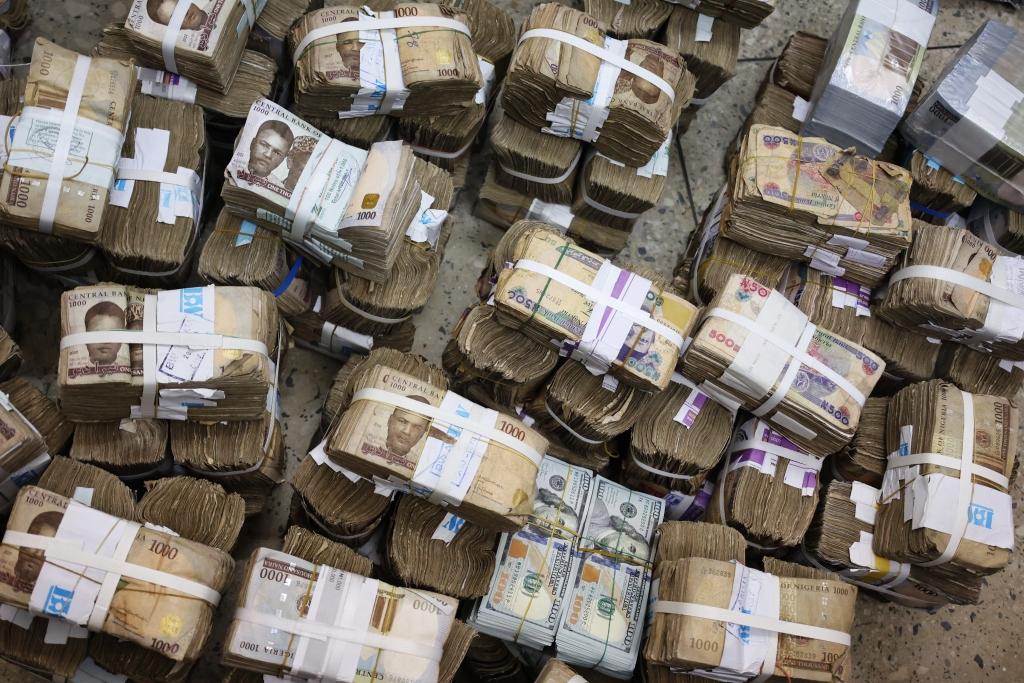
Despite rapid growth in electronic banking and fintech services, a staggering proportion of Nigeria’s currency remains outside the formal financial system, with experts attributing the trend to election spending, distrust of banks, and the dominance of the informal economy.
Latest data from the Central Bank of Nigeria shows that currency outside banks rose to N5.08tn in April 2026, representing over 90 per cent of the N5.64tn total money in circulation. The figure implies that about nine out of every 10 naira notes are held outside the banking system.
Financial analysts say the development highlights deep-rooted structural challenges in the economy, where cash transactions remain prevalent despite increasing adoption of digital payment channels.
A former Chief Economist at Zenith Bank Plc, Marcel Okeke, linked the surge in cash hoarding partly to political activities ahead of the 2027 general elections.
He said, “We are already in an election season. Politicians prefer to keep cash because once funds pass through the banking system, they can be traced. Political mobilisation in Nigeria is largely cash-driven.”
Okeke added that campaign activities, including rallies and voter mobilisation, traditionally rely heavily on physical cash distribution, further swelling the volume of money kept outside banks.
Beyond politics, economists pointed to Nigeria’s vast informal sector as a major driver of the trend. Millions of small businesses and traders operate outside formal financial structures, often relying on traditional savings schemes such as “ajo” and “esusu,” where funds rarely pass through regulated institutions.
Experts also cited rising dissatisfaction with bank charges as another factor discouraging savings within the banking system. According to Okeke, many Nigerians are wary of multiple deductions on their accounts and prefer to keep cash at hand.
For some citizens, however, the preference for cash is rooted in personal experience. A resident of Abuja, Rachael George, said limited access to cash through banks has eroded her confidence in the system.
“There are times you go to the bank and can’t withdraw enough money. Sometimes they ask you to come back later because there is no cash,” she said.
Memories of the 2022–2023 naira redesign crisis have also continued to shape public behaviour. During the period, acute cash shortages left many Nigerians stranded, with long queues at banks and Automated Teller Machines.
Another resident, Adeyemi Tolani, said fears of a repeat scenario ahead of the next election cycle have influenced his decision to keep cash.
“I don’t want to experience that situation again. It’s safer to hold some cash,” he said.
An economist, Shedrach Israel, noted that while Nigeria has recorded impressive growth in digital payments, the expansion has not significantly displaced cash usage.
He explained that the persistence of a large informal economy means a substantial portion of transactions still occurs outside regulated financial channels.
Historical data underscores the long-standing nature of the trend. Since Nigeria’s return to democracy in 1999, the proportion of currency outside banks has remained consistently high across successive administrations, peaking at over 96 per cent in 2023 during the naira redesign disruptions.
Although the ratio dropped slightly after President Bola Tinubu assumed office in 2023, it has climbed again to over 90 per cent as of April 2026.
Analysts describe the situation as a paradox: while digital payments, mobile banking, and Point-of-Sale transactions are expanding rapidly, Nigerians continue to rely heavily on cash for security, accessibility, and everyday transactions.
They warned that unless key issues such as weak financial inclusion, poor banking infrastructure, trust deficits, and election-related cash spending are addressed, the dominance of cash in the economy is likely to persist.
FOLLOW US