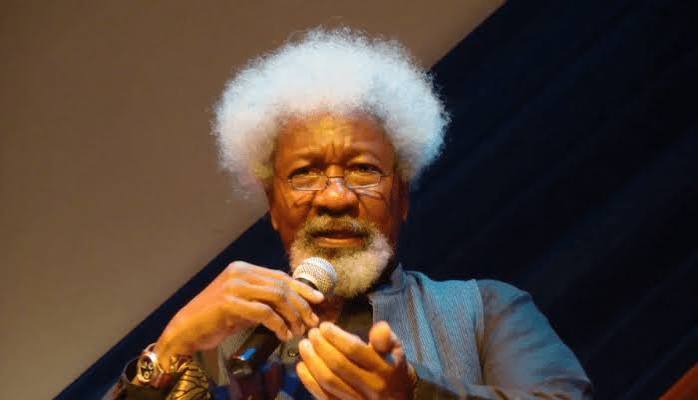
(Professor Wole Soyinka. Photo Credit: Businessday)
During a philosophical and religious conversation aired on Yanga 89.9 FM, Nigerian singer Brymo pushed back against Professor Wole Soyinka’s interpretation of Yoruba theology, specifically the assertion that Èṣù should not be conflated with Satan.
Brymo disagreed with this position, arguing that Èṣù and Satan represent the same underlying concept across different religious traditions.
He maintained that Èṣù is essentially the devil, and went further to argue that while the devil does not lie, it is human beings who engage in lies and deception.
He drew on interpretations from both Abrahamic and Yoruba religious texts to back his argument, suggesting that comparable figures recur across various belief systems as messengers or testers of human conduct.
He pointed to the Old Testament, noting that Satan was portrayed there as a messenger sent to evaluate the quality of human behaviour.
Extending the comparison to Islamic and Yoruba cosmology, Brymo insisted that the figures described in these traditions ultimately fulfil the same role, noting that just as Islamic teaching holds that Allah created Satan from fire, Yoruba tradition similarly describes Èṣù as a messenger, essentially representing the same narrative across cultures.
He rounded off his argument by shifting the blame for wrongdoing from spiritual entities to human choices, observing that people are quick to demand gratitude when good things happen to them, yet are equally quick to attribute their offences or misdeeds to Èṣù or the devil rather than taking personal responsibility.