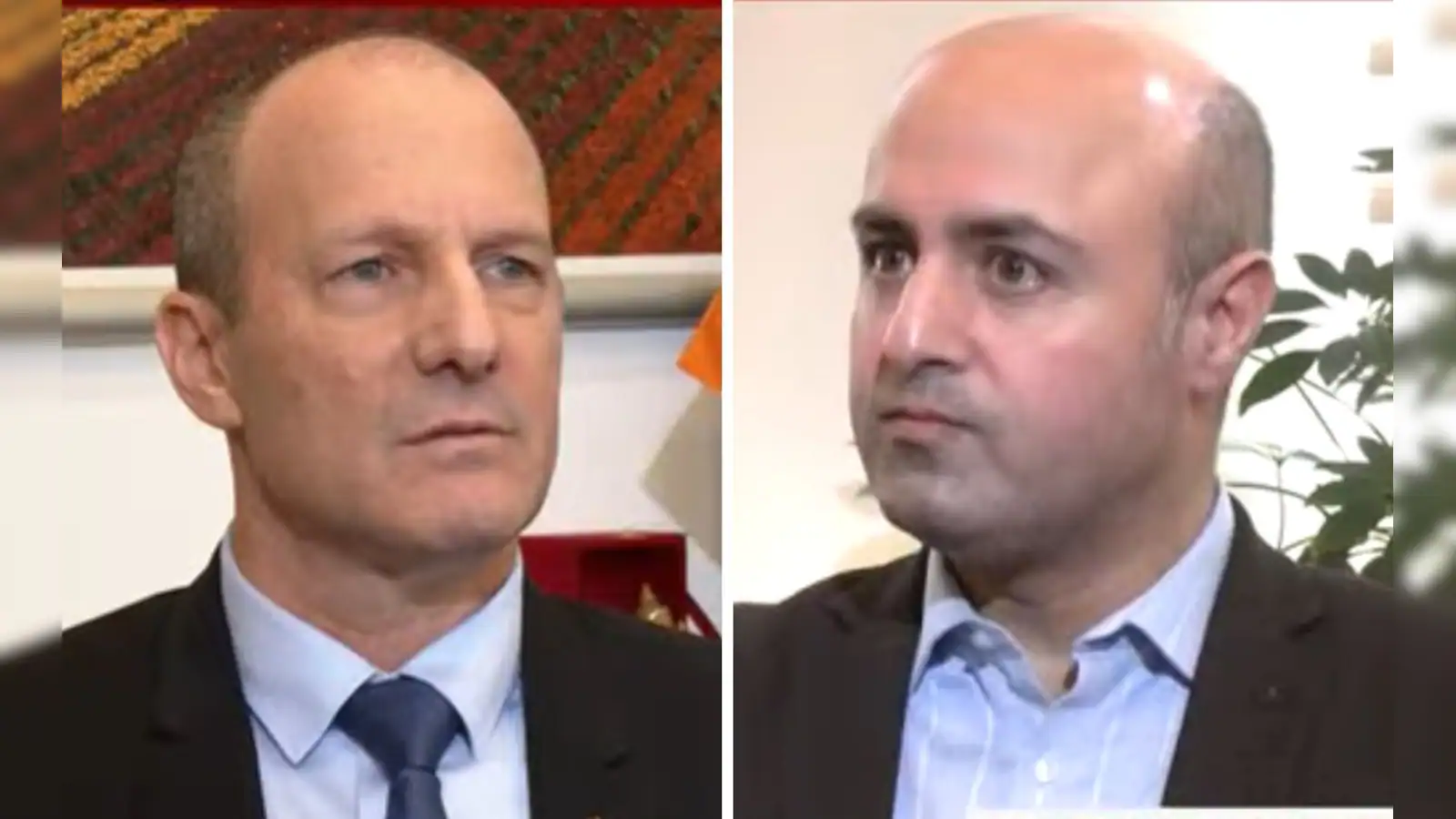
Israel’s ambassador to India, Reuven Azar, has voiced cautious unease over the newly brokered US-Iran peace deal, suggesting that while a ceasefire and the reopening of the Strait of Hormuz have been secured, the substantive issues threatening Israel’s security have merely been deferred rather than resolved.
In a wide-ranging interview with NDTV’s Senior Executive Editor Aditya Raj Kaul, Azar said the emerging deal essentially trades immediate access through Hormuz for a commitment to future talks on the matters Israel considers existential – Iran’s nuclear programme, its ballistic missile arsenal, and its support for regional proxy groups.
“We are anxious because for us the important issues are going to be negotiated then,” he said, underlining that Jerusalem views the agreement as an interim arrangement rather than a final settlement.
From October 7 To A Fragile Truce
The ambassador’s remarks come against the backdrop of the war that followed Hamas’s October 7 attack on Israel, which subsequently widened into direct confrontation with Iran and its regional network, including Hezbollah in Lebanon. Azar said Israel had pushed Iran’s nuclear breakout timeline from “a matter of weeks” to “more than two years,” while also degrading Tehran’s ballistic missile production capacity and establishing what he called three protective buffer zones, in Gaza, Lebanon, and Syria, to shield Israeli civilians.
He cited Prime Minister Benjamin Netanyahu’s estimate that the conflict had inflicted roughly a trillion dollars in damage on Iran’s economy, adding that even if Tehran receives sanctions relief under the new deal, “they will have to decide whether to divert this sanction relief to rebuilding this monstrous weapons of mass destruction program again or to give it to the Iranian population.”
Despite this, Azar was careful to distinguish between military and diplomatic gains. “The question is whether we can translate all these military achievements into a good diplomatic outcome,” he said, acknowledging that the debate over this is “highly debated” within Israel itself.
Where Israel And The US Diverge
Asked about friction between Netanyahu and US President Trump, Azar denied any rift over strategic goals but acknowledged tactical disagreements, attributing them to differing national constraints. “Israel and the United States might have different perspectives because they have different constraints,” he said, pointing to global energy prices and pressure from other nations threatened by Iran as factors shaping Washington’s calculus. He suggested Iran had deliberately used Hezbollah strikes on northern Israel to “put a wedge” between the two allies.
On the ground, Azar said Israel would not withdraw from its buffer zone in southern Lebanon until the Lebanese army demonstrates it can independently prevent Hezbollah from rearming. “We won’t withdraw. We won’t commit suicide,” he said, recalling Israel’s withdrawal in the year 2,000 and subsequent UN-mediated border demarcation, which he said Hezbollah exploited to rebuild a tunnel network and a 15,000-strong force.
On Iran’s nuclear enrichment, he said Tehran’s continued silence on the issue “is a great concern,” arguing that because Iran had been found cheating by the International Atomic Energy Agency, “they should not be allowed to continue enrichment activity and their fissile material should be removed.”
Pakistan, Qatar And The Question Of Trust
Azar reserved sharp criticism for Pakistan’s role as a mediator in the broader negotiations, alleging links between Hamas figures and Pakistan-administered Kashmir. “We don’t trust Pakistan,” he said, adding that Qatar had also been “behaving in a very treacherous way.” He said Israel had briefed local authorities in India on suspected activity by groups inspired by the October 7 attack model.
India’s Calibrated Response
On India’s response to the deal, Azar distanced his government from comments made by former Israeli foreign ministry spokesperson Elon Levy, who had called the agreement “a disaster for India” and urged New Delhi to abandon neutrality toward Iran and Pakistan. Azar called this “his personal opinion,” instead praising India-Israel ties as resting on “long-term gain trust” and pointing to growing trilateral commercial potential involving the UAE, where Israel-linked trade has risen to roughly ten billion dollars.
A Nod To Bollywood
The conversation closed on an unexpected note: Dhurandhar, the Bollywood film for which Azar said he watched both parts of the film. He praised its depiction of counter-terrorism networks combining “terror financing and drug dealing,” calling it “a very good example of how counter-terrorism should be conducted.” Azar said Israel’s association with India was much more powerful than depicted in the film while praising India’s capabilities.