By Mike Odeh James and Izhi Bitrus Adamu
(KARIM LAMIDO, Taraba State) — The gunmen who dragged a 65-year-old diabetic man from his home in Kwatibi village did not stop at money.
His family scraped together 10 million naira — about $7,260 — and handed over motorcycles to secure his release, community sources told TruthNigeria. Then the abductors, identified by locals as Fulani Ethnic Militia (FEM), came back with a new list: solar generating equipment and mobile phones.
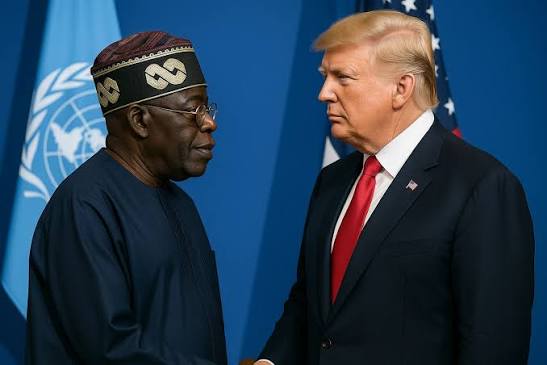
That ransom demand arrived in roughly the same season as another piece of correspondence — this one from the White House. In February 2026, President Donald Trump wrote to President Bola Tinubu commending his “decisive leadership against terrorists,” according to The Guardian and a statement from the Nigerian Presidency.
The two documents describe two different Nigerias. In one, insurgency is being degraded and a partnership with Washington is delivering results. In the other, a parallel ransom economy flourishes, villages empty overnight, and farmers abandon their fields before planting season.
What Washington Sees
Trump’s letter was prompted by two developments: Tinubu’s February 6 directive deploying troops to Woro community in Kwara State, and a U.S. announcement that it had recovered the largest cache of terrorist equipment in Nigeria since 9/11.
The commendation caps months of deepening cooperation. A Joint Working Group established in November 2024 led to a coordinated strike on Islamic State hideouts in the Lake Chad area in May 2025, killing several senior terrorist leaders and disrupting weapons supply routes, officials said. U.S. Assistant Secretary of State for Africa Frank Garcia later visited Abuja to pledge deeper ties, and Washington announced a troop drawdown from some regional bases — citing what Trump called “victory” over ISIS-West Africa.
At the National Prayer Breakfast on February 5, Trump also publicly praised First Lady and Senator Oluremi Tinubu as “a very respected woman.” The Nigerian Presidency called the letter “further proof that we are working.”
Senator Adams Oshiomhole went further, saying the commendation showed there was “no religious disharmony” in Nigeria.
What the Middle Belt Sees
The view from the ground is harder to reconcile with the diplomacy.
In Plateau State, nine relatives of a world-renowned Nigerian pastor were killed in a single attack. Fulani Christian converts describe a deepening cycle of violence, and terrorists killed villagers near the governor’s own security tour — a detail analysts read as a message.
Survivors in Riyom County [LGA], Barkin Ladi County [LGA] and Mangu County [LGA] say entire villages have been deserted after repeated night raids. One pastor has alleged terrorist infiltration of the military itself.
In Kaduna, mass displacements have hit Kajuru County [LGA], Chikun County [LGA] and Kauru County [LGA] as Fulani Terrorists hollow out Christian communities across the North-West. A U.S. lawmaker has renewed calls for targeting the militias as the state’s death toll rises. Community leaders describe a pattern: coordinated raids, abductions for ransom, homes burned behind the fleeing.
In Benue, communities in Guma County [LGA], Gwer West County [LGA] and Logo County [LGA] report continuing attacks with little security presence. Farmers have fled their fields, raising fears of food insecurity in a state once called Nigeria’s food basket.
In Taraba, beyond the Kwatibi abduction, three people were killed in Takum County [LGA] within two weeks. Traditional rulers say kidnapping has become a parallel economy.
Credibility Gap
“When the US praises decisive leadership but villages are still being sacked weekly in the Middle Belt, it creates a credibility gap. The metric cannot be press releases. It must be lives saved,” said Dr. Chidi Amuta, an Abuja-based security analyst.
“The fact that attackers are now operating close to a governor’s security tour tells you the level of impunity. What we are seeing is not random banditry. It is a sustained campaign to displace communities and take over land,” said Professor Bulus Lar, a conflict researcher in Jos.
“People are not just being killed. Entire Christian villages are being emptied. The attackers return to burn what is left. That is ethnic cleansing by another name,” said Reverend Joseph Hayab, a Kaduna community leader.
“If there is compromise within the ranks, no amount of troop deployment will work. The morale of soldiers on the frontline will also collapse,” said a retired military officer who served in the North-East, speaking anonymously, on the infiltration allegations.
“But Washington will also be watching the data. If the death toll keeps rising in the Middle Belt after this commendation, it will be difficult to sustain the narrative of progress,” said Dr. Ngozi Okonkwo, a foreign policy analyst.
Filling the Gap
Where the state is absent, others have stepped in. An American charity has reached survivors in what its workers call Nigeria’s killing fields, providing food, shelter and trauma support to displaced families. In some communities, youths have formed local defense teams, alleging slow response from security forces — raising the fraught question of whether Christian vigilance groups can halt the attacks.
Community leaders in affected states are calling for air surveillance, community policing, and prosecution of arrested suspects.
In Kwatibi, the family of the diabetic pensioner is still negotiating over solar panels and phones. Whatever Washington’s letter says about progress, the terrorists of the Middle Belt are still writing their own correspondence — and, so far, they are the ones getting answered.
Mike Odeh James is an award-winning conflict reporter. Izhi Bitrus Adamu is a conflict reporter. Both write for TruthNigeria.