• Insists commission needs financial autonomy for free, fair, credible elections
•Shettima: trust grows when citizens feel seen, heard, valued, and protected.d
•Says Fourth Republic has been long conversation between hope and disappointment
• Masari: constructive criticism bedrock of democracy
•Ikechukwu: author is an elder statesman in journalism as Onyema, Okonkwo hail him
Ndubuisi Francis, Chuks Okocha and Adedayo Akinwale in Abuja
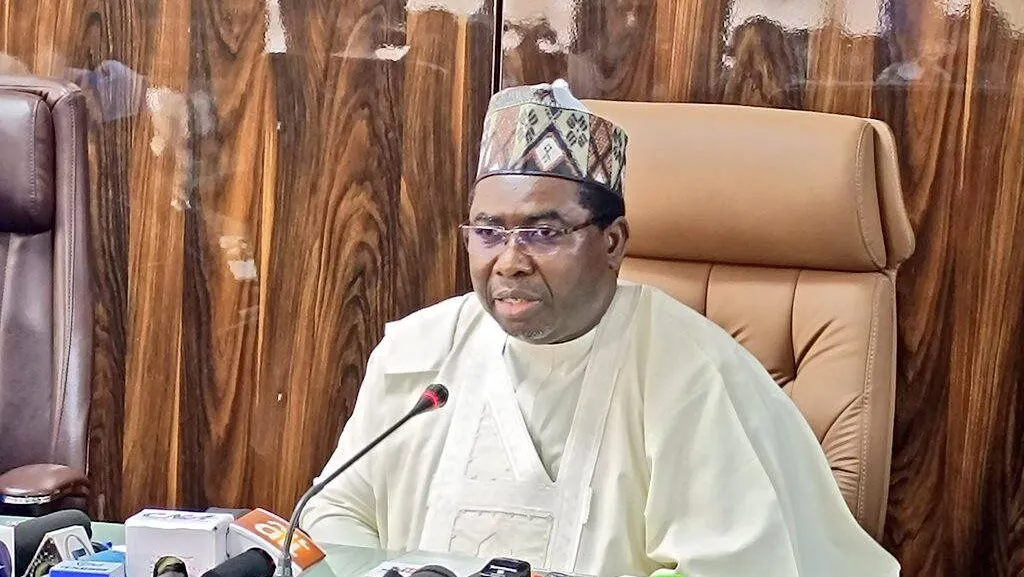
Chairman of the Independent National Electoral Commission (INEC), Joash Amupitan, has advocated the tinkering of relevant constitutional and electoral provisions, including embedding the funding of the commission’s activities in the Federation Account, to guarantee greater independence and seamless operations.
Amupitan made the appeal while delivering a keynote speech in Abuja at the public presentation of “Shadows: Protest Essays on Africa’s Most Consequential Country (1999-2023),” authored by Managing Director of THISDAY Newspapers, Mr. Eniola Bello.
The INEC chairman said being on first-line charge was not enough to address some of the fundamental challenges facing the commission.
He explained that despite its current status on first-line charge, the election management body still grappled with funding challenges due to its reliance on the normal appropriation process and the envelope system.
In the speech titled, “Strengthening Electoral Institutions: Pathways to Free, Fair, and Peaceful Elections in 2027,” Amupitan called for the amendment of the Electoral Act to ensure that the nomination of candidates was concluded one year before the general election
Amupitan stated, “We need to rethink the operators of the institution, and so in strengthening our democratic institutions especially INEC, what we should be rethinking is not the provisions as we have— whether the spirit and the letters of the constitution and the Electoral Act, but rather those of us that operate the constitution itself.
“Now, can INEC be independent without financial autonomy? Talking about strengthening the institution, if we truly want to conduct a free, fair and credible elections, there is also a need for INEC to have financial autonomy.
“Let me say that under the provisions of the constitution, specifically Section 81(3), INEC is put on the First-Line charge and a lot of people felt that that is sufficient to make INEC financially independent.
“However, the experience over the years has shown that as long as INEC is still subjected to the normal envelope system; so long as INEC is subject to the processes of appropriation, having to go to the National Assembly and at the end of the day, it is what is desired by another agency that should be the budget of INEC that is given to INEC, it is very difficult to operate in such a situation.”
Amupitan stressed that as long as the commission’s funding was domiciled with the Consolidated Revenue Fund (CRF), the federal government still reserved the responsibility to finance the commission and, by extension, elections.
He stated, “Although the constitution places INEC on the first-line charge, it is not strong enough because the responsibility of INEC to conduct elections, register political parties, and also to register voters and provide register of voters even for the local government election by State Independent Electoral Commissions, INEC should come as part of Federation Account so that it can have a seamless operation and what we call operation efficiency.”
Amupitan decried the quality of internal democracy being practised within political parties.
According to him, where party primaries are characterised by imposition, opaque procedures, or disregard for established rules, disputes are almost inevitable.
He added that many election-related court cases had their roots in disagreements that arose long before the first ballot was cast.
The INEC chairman said political parties strengthened democracy when they upheld their own constitutions, conducted transparent primaries, and gave members a genuine voice in selecting candidates.
He stated that if INEC was strengthened enough, some of the problems bedevilling political parties at the moment would have been resolved at least a year before the upcoming general election.
Vice President Kashim Shettima, in his speech, titled, “The Country and Its Shadows,” stated that a nation was held together by the stories it was brave enough to tell about itself.
Shettima added that no democracy grew by hiding its shadows from the light.
He stated that it had often been said that leadership was a practice and not a title, expressing his belief that the same rings true for journalism and literature.
Shettima, who was represented by his Special Adviser on General Duties, Aliyu Modibbo, stated that democracy must accommodate dissenting positions, adding that any government that cannot listen to the people will eventually lose the confidence of the people.
He said Nigeria’s Fourth Republic had been a long conversation between hope and disappointment, between protest and patience, and between the promises of power and the expectations of citizens.
According to the vice president, “Every administration has faced the judgement of history, and every generation has had to decide whether to treat criticism as hostility or as an instrument of democratic improvement.
“The media has been central to that process. When it is responsible, courageous, and fair, it does not weaken the state. It strengthens the state by compelling public officials to remember that power is held in trust.
“This is why His Excellency, President Bola Ahmed Tinubu, GCFR, has remained firm in his belief that democracy must accommodate disagreement.
“He understands, from personal experience, that the press, civil society, activists, writers, and citizens who ask hard questions belong to the architecture of a free society.”
Shettima added, “A government that cannot listen will eventually lose the confidence of the people, because trust is not built by authority alone. Trust grows when citizens feel seen, heard, valued, and protected.
“Our administration came into office at a difficult time, when Nigeria had to confront hard economic truths that had been postponed for too long. The removal of the petrol subsidy and the unification of the foreign exchange system were not easy decisions, and we have never pretended that they carried no pain.
“But leadership, at its most serious level, is the courage to choose repair over applause, and to do today what prevents a deeper crisis tomorrow.
“Distinguished ladies and gentlemen, we are beginning to see the foundations of that difficult repair.”
Referencing the reforms by the federal government, the vice president said, “Nigeria’s Gross Domestic Product grew by 3.89 per cent in the first quarter of 2026, after a growth of 3.4 per cent in 2024 and an expansion of 4.6 per cent in the fourth quarter of that year. Oil production has rebounded to about 1.5 million barrels per day, while debt servicing has declined from 96 per cent to below 65 per cent of revenue.
“These figures do not mean that all hardship has disappeared, but they show that the economy is finding firmer ground.”
According to him, “Today, more than 100,000 Nigerians have accessed the national consumer credit scheme, with hundreds of thousands more in the pipeline. The student loan programme is opening the door of higher education to children who might otherwise have been locked out by poverty.
“In infrastructure, the administration is pushing major arteries such as the Lagos-Calabar Coastal Highway, the Sokoto-Badagry Superhighway, and the Abuja-Kaduna-Kano Road, while hundreds of road projects and rural road interventions are being pursued to connect communities, markets, farms, and industries. In the 2026 budget, capital expenditure is projected at N26.08 trillion, which is a firm statement that this government is investing in the physical foundations of growth.”
Shettima stated, “Yet figures alone do not tell the full story of a nation. That is why books like Shadows matter. They remind us that policy must be understood through people, that reform must be explained with honesty, and that democracy must never become a conversation among politicians alone. Writers and journalists help us to connect statistics to suffering, policy to memory, and governance to the human condition.”
Turning to THISDAY, the vice president said, “| say thank you for continuing to create platforms for national reflection. To the author and to all who contributed to this work, congratulate you for documenting the struggles, the contradictions, the protests, and the possibilities of our republic.
“The duty of the writer is not to flatter power, and the duty of power is not to fear the writer. Both must serve the larger truth that Nigeria is worth correcting, worth defending, and worth building.
“May this book provoke deeper thought, better leadership, and a renewed commitment to the democratic ideals that hold us as one people. May we continue to disagree without destroying one another, to criticise without hatred, to reform without arrogance, and to govern with the humility that every public office is temporary, while the consequences of leadership endure.’’
Earlier, Chairman of the occasion and former Governor of Katsina State, Hon. Aminu Masari, said the book was significant because it brought together essays and documentaries written in response to issues and events as they unfolded.
Viewed collectively, Masari stated that the reflections provided a unique window into Nigeria’s democratic experience over the past quarter century.
He said the book captured not only the events themselves but also the debates, aspirations, anxieties, and public sentiments that accompanied them.
The former Speaker of the House of Representatives stated that the book was endowing reference materials for policymakers, scholars, historians, students, and all who sought to understand the complexities of Nigeria’s democratic evolution.
Masari pointed out that books such as this served purposes far beyond literature, adding that they preserve memory, provoke reflection, challenge assumptions, and stimulate debate.
He stated, “Most importantly, they enable nations to examine themselves honestly. A country that fails to document its journey deprives future generations of the opportunity to learn from both its triumphs and its own mistakes.
“Works such as this remind us that democracy is sustained not only through periodic elections but also through informed public discourse and active citizen engagement.”
He said democracy flourished when citizens thought critically, asked difficult questions, defended the institutions, and remained committed to the ideals of justice, accountability, and the rule of law.
Masari stressed that writers, scholars, journalists, and historians performed a vital public service by helping society understand where it had been, why it stood free, and where it ought to be strengthened.
He stated, “The tide of Shadows is itself evocative. Every nation has moments of brilliance and. The moments of uncertainty, shadows remind us not only of challenges overcome, but also of blessings that must have been forgotten.
“They invite us to reflect with humility, to celebrate genuine progress without denying our shortcomings, and to draw wisdom from experience.”
Chairman of United Nigeria Airlines, Professor Obiora Okonkwo, and Chairman and Chief Executive Officer of Air Peace, Chief Allen Onyema, also paid glowing tributes to Bello, describing him as one of Nigeria’s finest journalists and a distinguished voice in the country’s democratic and media landscape.
Okonkwo, who represented Onyema at the occasion, said, “I am representing a brother, friend, ally and great Nigerian patriot, Chief Allen Onyema, CON, who could not be here due to operational reasons.”
Formally presenting the book to the reading public, Okonkwo congratulated Bello, popularly known by his moniker as Eni-B, on what he described as another milestone in an illustrious journalism career.
He stated that writing a book demanded vision, discipline, intellectual rigour, and an unwavering commitment to enriching public discourse.
Okonkwo added that the book further demonstrated Bello’s immense contributions to journalism and national development.
Reviewing the two-volume book, Professor Okey Ikechukwu described the work as a tribute to journalism, describing the author as an elder statesman in the field of journalism.
Ikechukwu stated, “Eniola Bello’s work is a tribute to journalism. It’s a detailed historical commentary and a work that a budding journalist can just take, just to know how to write in a breezy and exciting manner.
“I also just add that this is a country that does not really know its elder statesmen. Every human endeavour has their elder statesman. Eniola Bello is an elder statesman in the Nigerian media.”
According to Ikechukwu, the two-volume book is a protest essay.
He said the author revealed two things in the essay – a protest and the fact that Nigeria was the most consequential on the continent.
Ikechukwu said the author was in his element with his captivating, breezy style of writing, chronicling the events that shaped the country in the past 24 years.
The book presentation attracted leading politicians and other distinguished personalities from all walks of life, including players in the public and private sectors, the academia and media, among others.