Education is a public asset, whose overhaul – when it becomes imperative – requires a broad and rigorous debate in the best interest of society.
From one policy flip-flop to another, the Federal Government of Nigeria has scrapped the 6-3-3-4 system of education, which it introduced with fanfare over four decades ago. In its place is now a linear 12-year schooling from primary to the end of secondary education. Under the old arrangement, six years were for primary schooling, three years for junior secondary school, another three years for senior secondary schooling, and a minimum of four years of university education.
The Minister of Education, Tunji Alausa, on 1 July, said the transition from JSS 3 to SSS 1 presented a quagmire to the country. “We have 20 million dropouts from primary school to Junior Secondary School. Where are the students? We found out that we have 80,000 public primaries and about 15,000 Junior Secondary schools. That is a ratio of one-to-eight,” he stated.
Education is a public asset, whose overhaul – when it becomes imperative – requires a broad and rigorous debate in the best interest of society. But the Nigerian government failed to do so; just as it recently did in the restructuring of the National Youth Service Corps (NYSC) scheme, which sparked strong public criticism. Education is still on the Concurrent Legislative List in the 1999 Constitution, as amended, depicting the shared responsibility of the federal and state governments for it. Besides, the private sector is heavily involved in all its levels.
The discarded 6-3-3-4 arrangement was introduced in 1982, following its formulation in 1977, after a serious national discourse. The school curriculum was changed and tailored to pre-career paths and labour demands. This was evident in the introduction of technical and business subjects like Technical Drawing, Computer Science, Fishery and Animal Husbandry. Also, Marketing, Horticulture, Introductory Technology, Creative Arts, Entrepreneurship, Data Processing and Interior Decoration, which competed for students’ interests alongside the core subjects of Mathematics, Physics,Chemistry, Biology, Geography, Fine Arts, Agricultural science, Government, English language and English Literature.
In 2025, the Federal Ministry of Education and the Nigerian Educational Research and Development Council (NERDC) sensed an overload of the classroom with subjects and decided on reducing them. Therefore, the JSS classes had their subjects reduced to 12, from 18; while subjects in the SSS classes were slashed from 20 to 9.
The idea behind Junior and Senior Secondary Schools was for the system to fish out pupils with less cognitive abilities in academics. These set of pupils, unable to continue with senior secondary schooling, were to be guided through counselling towards the acquisition of vocational skills, according to their abilities. Passing the JSS level was a prerequisite for transiting to the SSS level.
For Mr Alausa to lay the blame for Nigeria’s 20 million out-of-school students at the feet of the failure of the 6-3-3-4 system is to be disingenuous and economical with the truth. The fact is that the high level of insecurity, especially in the northern part of the country, dearth of teachers, dilapidated school infrastructure, poverty and cultural practices that encourage the early marriages of girls before the age of 18, significantly contribute to and sustain the anomaly.
Data published by the ICIR recently showed that 26 schools were attacked by insurgents and kidnappers between April 2024 and May 2026, resulting in the kidnap of 2,416 students for ransom. Inside the Internally Displaced Persons (IDP) camps in Borno, Benue, Plateau and other states, are children of school age. Some traumatised Chibok school girls, abducted in 2014, vowed after their rescue never to go back to school. Other victims with the same harrowing experience in other places, have developed a similar aversion to schooling mindset.
It is not surprising “that three out of four children at the basic education level cannot read or understand an age-appropriate text by the age of 10”, as the minister lamented. Many states in Nigeria also don’t accord education the priority it deserves. This is evident in the ₦97.88 billion Universal Basic Education Commission (UBEC) funds laying idle, as of 18 March, 2026, as states refused to apply for them towards revamping their basic education systems. This would require the states to provide their own 50 per cent counterpart funding to qualify for the funds. Only 21 states have been able to access these funds till date.
As a result, UNESCO warns that “Nigeria risks a “generational catastrophe” if foundational investments are not made in education in the country. This is the core of the problem. Many state governments have refused to invest sufficiently in the educational sector.
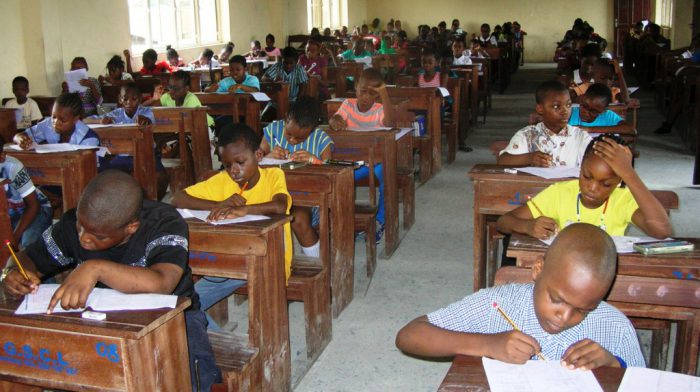
The former Executive Secretary of UBEC, Hamid Bobboyi, during a 2024 workshop with the Private Sector Advisory Group, said that out of 694,078 teachers required, only 499,202 were available, thus leaving a deficit of 194,876 teachers in our basic schools across the country. To save the schools from total closure, Parents Teachers Association (PTA) in most host communities now resort to hiring and paying teachers. In some cases, classes One and Two are merged for a teacher to handle. Many of the pupils try to learn sitting on the bare floor, while the teachers themselves have no writing tables. These absurdities are not acceptable, amid thousands of jobless NCE holders and graduates across the country.
According to a stakeholder, “Right now, the problem of primary and post-primary education in Nigeria is not restructuring, it is the provision of a better learning environment, laboratories, infrastructure, and qualified teachers, among others.”
The minister needs to be told in simple terms that the 6-3-3-4 system, in itself, did not fail. Only the government did with its inadequate financing and implementation of the system. With the absence of technical equipment, workshops, electricity, and trained teachers/other personnel required for its implementation, it could be argued that the system never really took off.
A policy somersault like this was why History was removed as a subject from the school curriculum, until recently when the public clamour for its return became impossible to ignore. Also, the government almost fell into a considerable blunder with last week’s increase of WASC and NECO registration fees to ₦50,000, without consultations. Political expediency must have informed its quick retraction of the decision, at least for now.
All matters educational are apparently too sensitive to be left in the hands of politicians alone. Government should desist from policies that have not been properly thought through, which have the capacity to set the country back in a major way, particularly in terms of powering its future. In order to attain the desired outcomes, education requires serious, sustained investments, not cosmetic restructuring.