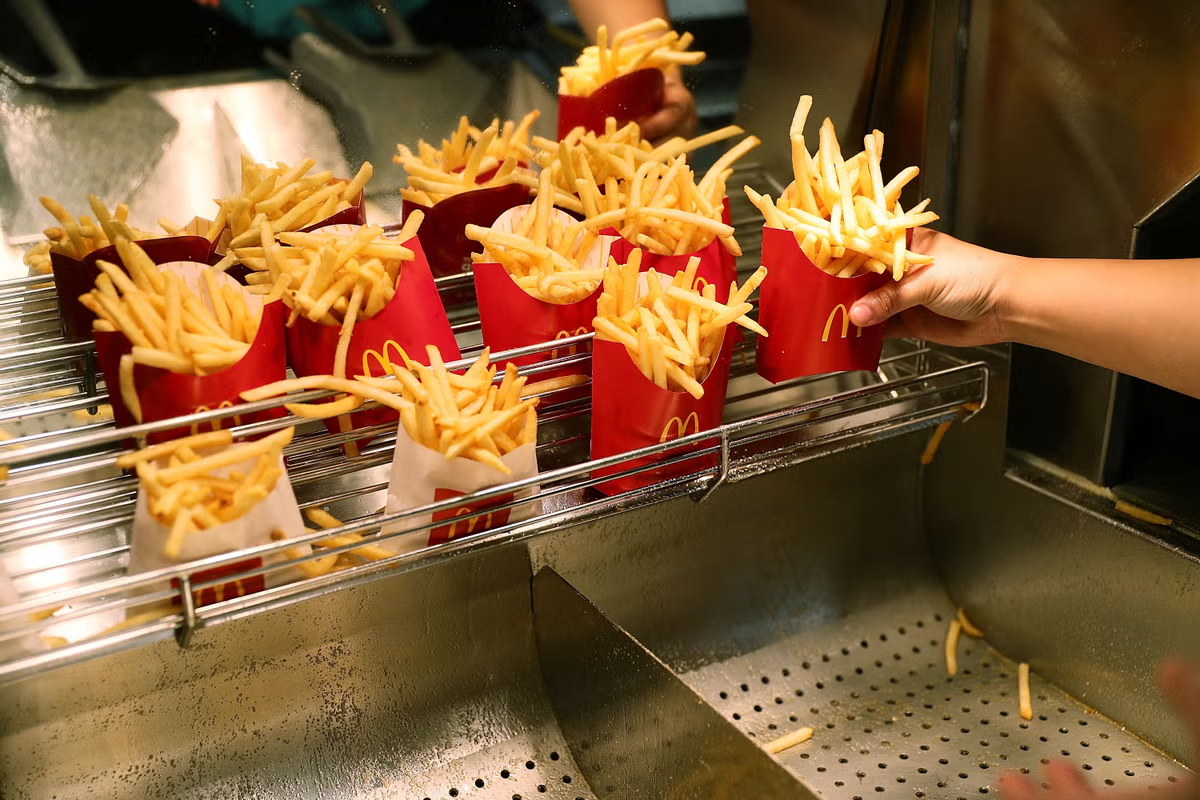
A New York City woman is suing McDonald’s after allegedly sustaining “serious and severe personal injuries and burns to [her] mouth and tongue, as a result of being served extremely hot fries,” according to a civil complaint obtained by The Independent.
In it, Catherine Luongo blames the March 5 incident, which occurred at a McDonald’s restaurant across the street from Manhattan’s Bryant Park, on the employees who “fail[ed] to provide [her] with a safe order of fries.”
Her purported physical trauma was “due solely… [to] the carelessness, recklessness and negligence” of the unnamed workers who prepared the fries in question, which the complaint describes as “overheated and not safe for human consumption.”
Luongo should never have been “permitt[ed] and allow[ed]” to “be served and consume extremely hot and overheated fries,” the complaint states. It contends that Luongo was not given ample warning of “the dangers to be encountered” when tucking into the fries, and that “the aforesaid occurrence was due solely by reason of the negligence of the Defendants,” and “through no fault or lack of care” on Luongo’s part.
On top of Luongo’s alleged mouth and tongue injuries, she also endured “a severe shock to the nervous system,” “suffered great physical pain and mental anguish,” and “was confined to bed and home and caused to abstain from usual duties and activities,” according to the complaint, which was filed July 21 in New York State Supreme Court.
It says Luongo was “forced to seek medical aid and attention,” which she had to pay for herself, and claims her fry-related health issues “may be permanent and lasting.” The complaint does not provide further details of Luongo’s alleged injuries.
McDonald’s did not respond to a request for comment.
In 2013, the chain was hauled into court by a Massachusetts mom who sued after her 3-year-old daughter suffered first- and second-degree burns on her thighs from an order of “unreasonably and dangerously hot” fries.
“As a direct and proximate cause of the unreasonably and dangerously hot French Fries, M.C. is now disfigured and scarred,” the lawsuit claimed. “M.C. is undergoing surgery due to the disfigurement and scarring.”
That same year, a Florida woman was awarded $800,000 after her 4-year-old daughter received second-degree burns from a “dangerously hot” Chicken McNugget that fell from its packaging and became wedged between the child’s leg and her seat belt. Philana Holmes used her iPhone to record the girl’s screams, which were played in court.
Lawyers for McDonald’s unsuccessfully argued that the McNugget had to be heated to a certain temperature to stave off the possibility of salmonella poisoning, and, as PBS reported at the time, that the nuggets “were not meant to be pressed between a seat belt and human flesh for more than two minutes.”
A similar suit, this one filed in 2009, involved an order of “dangerously hot” Dunkin’ Donuts hash browns and a Boston-area toddler, who they said received “serious and permanent burn injuries” when the hot potatoes fell from his mouth onto his neck. Before Robin MacLeod gave her son the hash brown, she checked it and found it “lukewarm,” the family’s complaint said.
However, the hash brown had been heated “unevenly,” according to the filing, which claimed the inside of the item was so hot, it was “unsafe for public consumption.”
Beyond the fast-food realm, a Philadelphia man sued Frontier Airlines in 2024 after sustaining third-degree burns and being “left with disfiguring scars on his genitals and thighs” after a flight attendant allegedly spilled hot tea on his lap.
As The Independent first reported, Sean Miller’s complaint detailed the “highly unsightly and embarrassing discoloration,” along with “significantly decreased sensation,” “post-traumatic stress disorder,” and “lack of self-esteem,” plus at least one herniated disc he suffered while writhing in distress.
Upon landing, the 56-year-old was rushed to an area burn center for specialized treatment “due to the severity” of his injuries.
Such lawsuits, including Luongo’s, bring to mind the well-known and widely misunderstood case of 79-year-old Stella Liebeck, who was maligned for bringing a “frivolous” lawsuit over a blisteringly hot cup of McDonald’s coffee, but which turned out to be anything but trivial.
Liebeck suffered horrific third-degree burns across six percent of her body and led to permanent tissue damage after the cup’s superheated contents spilled on her, causing what her physician called one of the worst scalding cases he had ever seen. The New Mexico resident spent a week in the hospital, three weeks recovering at home, and was then hospitalized again to undergo painful debridement and skin grafts.
Liebeck offered to settle for the costs of her medical treatment, about $20,000, and only sued when McDonald’s, which had in fact gotten hundreds of burn complaints before this one, refused to cooperate.
A jury awarded Liebeck $2.7 million in punitive damages for her injuries, which a judge later reduced to $480,000, for what he deemed “willful, wanton, reckless” and “callous” conduct on the part of McDonald’s.
Food service establishments have argued that a reasonable adult is aware that certain foods and beverages are hot, and that a potential burn is an “open and obvious” risk they knowingly assume. At the same time, if a product is so hot that normal use could land someone in the hospital, the seller is required to provide an explicit warning to all.
Luongo’s suit says she “has been damaged in a sum which exceeds the jurisdictional limits of all lower Courts,” and is seeking money damages to be determined at trial