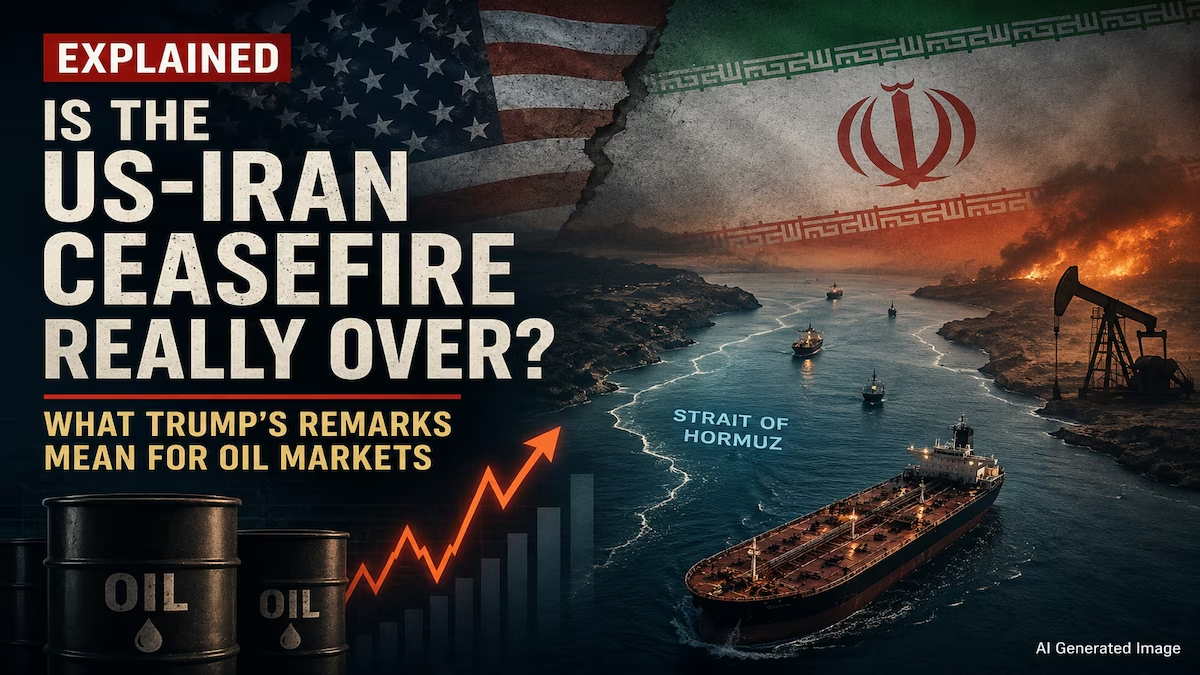
The statement came after a fresh exchange of military strikes between Washington and Tehran, attacks on vessels near the Strait of Hormuz, and renewed US sanctions on Iranian oil exports. Yet Trump’s comments do not necessarily signal the complete collapse of diplomacy.
Experts say the ceasefire was always a fragile arrangement rather than a comprehensive peace agreement. While recent developments have placed it under severe strain, back-channel negotiations are likely to continue even as military pressure intensifies.
Why did Trump say the ceasefire is ‘over’?
The latest escalation followed US allegations that Iran attacked three commercial vessels near the Strait of Hormuz, including a Qatari-flagged LNG tanker. Iran has neither confirmed nor denied the accusations.
Washington responded with strikes on more than 80 Iranian targets, including air defence systems, command centres and vessels linked to the Iranian Revolutionary Guards. It also revoked a temporary sanctions waiver that had allowed Iran to resume limited oil exports under the ceasefire arrangement.
Speaking on the sidelines of the NATO Summit, Trump accused Iran’s leadership of acting in bad faith and said he no longer wished to negotiate. At the same time, he indicated that US negotiators remained free to continue talks.
That mixed messaging suggests Washington is trying to maximise pressure on Tehran without completely shutting the door on diplomacy. Former Indian Ambassador to the US Meera Shankar says Trump’s public rhetoric and negotiating strategy are often deliberately contradictory, allowing him to keep both military and diplomatic options available.
Was the ceasefire always fragile?
Analysts say the MoU was never intended to resolve the deeper disputes between the two countries. Instead, it served as a temporary mechanism to halt immediate hostilities while leaving several contentious issues unresolved.
Questions surrounding sanctions, Iran’s nuclear programme and the management of shipping through the Strait of Hormuz were either postponed or left deliberately ambiguous.
According to Shankar, those unresolved issues made the agreement vulnerable from the outset. One of the biggest uncertainties was whether commercial vessels would continue coordinating their passage through the Strait with Iran and what role Tehran would retain in overseeing maritime traffic.
With fresh military action and renewed sanctions, many of those unanswered questions have resurfaced, exposing the limitations of the ceasefire framework.
Why is the Strait of Hormuz central to the conflict?
Although Iran’s nuclear programme dominates much of the political debate, experts say the Strait of Hormuz has become the conflict’s most strategically important battleground.
The narrow waterway carries roughly one-fifth of global oil trade, making it one of the world’s most critical energy chokepoints. Any disruption immediately raises concerns about global energy supplies and oil prices.
Iran also regards the Strait as one of its strongest sources of geopolitical leverage. Geopolitical researcher Vivek Kelkar argues that Tehran is unlikely to relinquish influence over the waterway because doing so would significantly weaken its negotiating position.
The way commercial vessels navigate the Strait has therefore become increasingly important. If shipping continues along routes acceptable to Iran, tensions may remain manageable. However, attempts to bypass Iranian oversight could increase the risk of further confrontations.
Shankar believes the Strait could eventually become part of a broader diplomatic settlement, with Iran potentially seeking greater international recognition of its role in maritime security in exchange for concessions on other contentious issues, including its nuclear programme.
Why could Qatar become the key mediator?
Despite the latest escalation, analysts do not expect diplomatic efforts to end altogether. Instead, negotiations are likely to move increasingly through regional intermediaries rather than direct engagement between Washington and Tehran.
Deep Pal, Director of Geopolitics at Koan Advisory Group, believes immediate diplomatic efforts will focus less on sanctions relief or the nuclear issue and more on preventing the conflict from expanding and ensuring safe passage through the Gulf.
Qatar is expected to play a particularly important role. The Gulf nation has previously acted as a trusted intermediary between the United States and Iran, maintains close security ties with Washington, and shares the world’s largest natural gas field with Iran.
Its ability to communicate with both governments places it in a strong position to facilitate back-channel negotiations as tensions continue.
Why neither side may want a prolonged conflict
Despite the exchange of military strikes, experts believe both Washington and Tehran have compelling reasons to avoid a prolonged war.
According to Shankar, the United States has already expended significant military resources during the conflict, while Iran continues to face severe economic pressure and military losses.
Domestic politics also create incentives for restraint. Higher oil prices could become politically damaging for Trump ahead of the US midterm elections, while Iran’s economy remains constrained by sanctions.
These factors make intermittent military exchanges more likely than a sustained regional war, while preserving incentives for continued diplomatic engagement.
What does this mean for oil prices?
Oil markets have reacted primarily to the growing risk of supply disruption rather than to actual shortages.
Pal says investors are increasingly factoring geopolitical risk into crude prices, particularly given the concentration of global energy exports passing through the Strait of Hormuz.
However, the longer-term outlook for oil prices will depend on more than developments in Iran alone.
Kelkar notes that Chinese demand, European consumption, Saudi Arabia’s production and pricing strategy, and the pace of global economic growth are likely to have a greater influence on crude prices over the coming months.
In other words, geopolitical tensions may trigger sharp short-term spikes, but sustained movements in oil prices will continue to depend on broader global supply and demand dynamics.
Is the ceasefire really over?
Not entirely.
The ceasefire framework has undoubtedly suffered a major setback. Fresh military strikes, renewed sanctions and increasingly hostile rhetoric have significantly weakened confidence in the arrangement.
However, the underlying conditions for diplomacy have not disappeared. Trump’s own remarks leave room for negotiations to continue, Qatar remains well placed to facilitate dialogue, and both Washington and Tehran have strong incentives to prevent the conflict from escalating into a full-scale regional war.
For oil markets, though, uncertainty itself is enough to keep prices elevated. Even if negotiations eventually regain momentum, traders are now assigning a higher probability to recurring disruptions in one of the world’s most strategically important energy corridors—the Strait of Hormuz.