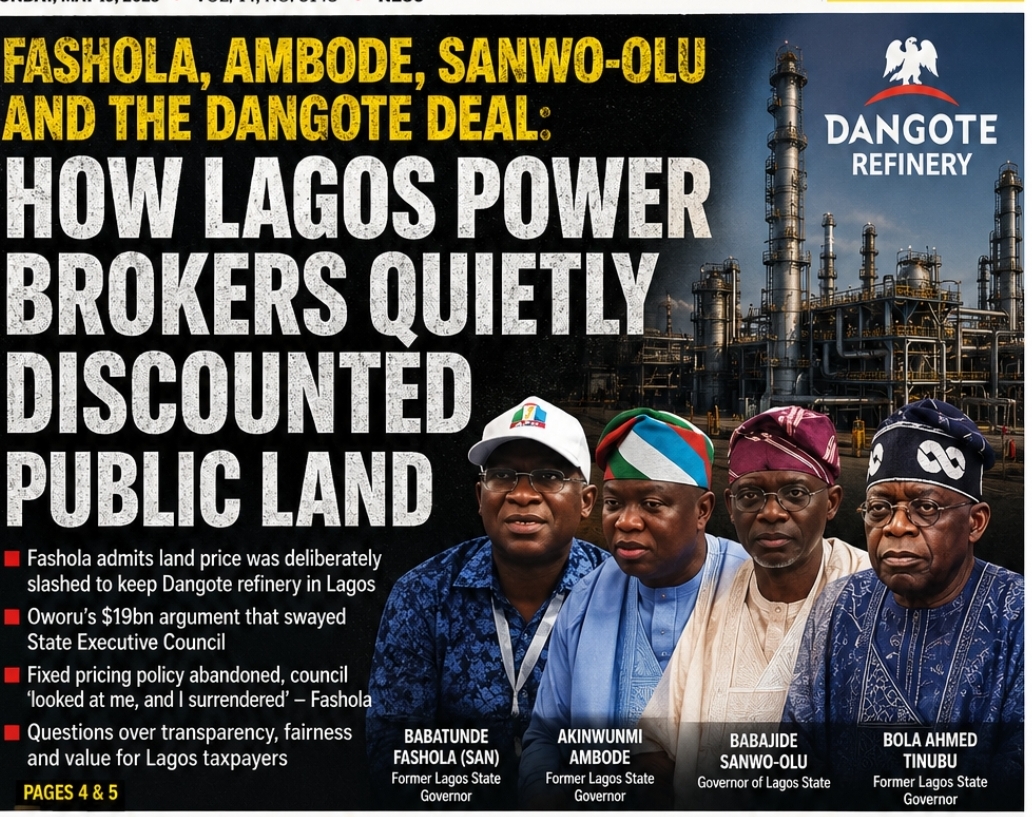
Former Lagos State Governor, Babatunde Fashola (SAN), may have intended to tell a story about visionary leadership, but what he revealed instead is a troubling portrait of how a handful of powerful officials bent public policy to accommodate one of Africa’s richest men.
Fashola’s admission that Lagos deliberately reduced the price of prime land to secure the Dangote Refinery project opens the door to deeper scrutiny not just of his administration, but of the political machinery that has governed Lagos for years.
At the center of that decision was Fashola himself, alongside his then Commissioner for Commerce and Industry, Olusola Oworu, whose argument tipped the scale in favour of granting a massive concession to the Dangote Group. Her position that a $19 billion investment justified sacrificing immediate land value became the official logic used to override an existing fixed pricing policy.
But that decision did not exist in isolation.
The Lekki Free Zone, where the refinery now sits, has long been shaped by a network of political and economic interests tied to successive administrations. From Fashola to his successor, Akinwunmi Ambode, and now Governor Babajide Sanwo-Olu, the same ecosystem has overseen land allocation, infrastructure development, and regulatory decisions in the corridor often with limited public transparency.
Under Ambode, critical groundwork for the refinery and surrounding infrastructure accelerated, including road networks and investor facing incentives. Under Sanwo-Olu, the project has continued to enjoy state backing, even as questions linger over environmental impact, flooding concerns, and the broader cost to host communities.
Hovering above all of this is the enduring political influence of Bola Ahmed Tinubu, the former governor widely regarded as the architect of Lagos’ political structure. While not directly named in the deal, Tinubu’s long-standing grip on the state’s economic and political direction raises unavoidable questions about how major concessions of this magnitude are conceived and approved.
And then there is Aliko Dangote himself — the beneficiary of a deal that effectively saw Lagos bend its own rules to meet his terms. While Dangote’s refinery is undeniably a landmark industrial achievement, its origins reflect a familiar Nigerian pattern: when elite business interests collide with public policy, it is often the policy that gives way.
Fashola’s remark “the whole council then looked at me, and I surrendered” is perhaps the most revealing of all. It suggests not a rigorous, transparent process, but a moment where internal resistance, if any existed, was quickly subdued in favour of a predetermined outcome.
What remains unclear is whether institutions such as the Lagos State Executive Council, the Ministry of Commerce and Industry, and the Lekki Free Zone authorities conducted independent valuations, opened the process to competitive bids, or subjected the concession to public scrutiny.
For a state that prides itself as Nigeria’s commercial nerve center, the lack of clarity is striking.
Fashola framed the story as an example of merit over gender, crediting Oworu’s intervention as decisive. But beyond the gender argument lies a more pressing issue: accountability among those entrusted with managing public assets.
Ambode and Sanwo-Olu may not have negotiated the original land discount, but their administrations have inherited and sustained the outcomes of that decision without publicly revisiting its terms or implications.
Today, the Dangote Refinery stands as a symbol of industrial ambition. Yet it also stands as a case study in how Nigeria’s most consequential economic decisions are often made behind closed doors, among a tight circle of political and corporate elites.
The refinery will shape Nigeria’s energy future. But the deal that brought it to life raises a harder question: who truly benefits when government power, political continuity, and private wealth align so seamlessly?
Until those questions are answered, Fashola’s revelation is not a triumph of leadership it is an invitation to scrutiny.