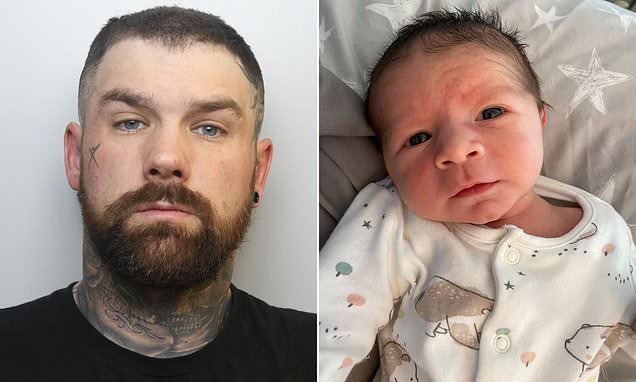
(Atticus Bartlett And Father. Photo by Dail Mail)
A father has been sentenced to life imprisonment, with a minimum term of 18 years, for killing his infant son.
Tony Bartlett, 39, was convicted on Friday of murdering his four-week-old son, Atticus Bartlett, in July 2022.
The baby collapsed at the family home in Chard, Somerset, on July 16, 2022, after Bartlett shook him violently in a moment of rage when he failed to get the infant to feed.
Atticus died five days later from severe internal injuries. Bartlett was said to have been heavily intoxicated at the time of the attack.
Bartlett, from Axminster, Devon, was sentenced at Bristol Crown Court.
The court heard that he and his then-partner, Evelyn Ballentyne, Atticus’s mother, had spent the evening of the child’s death at a pub and comedy club.
While Ms Ballentyne’s mother and stepfather, Rachel and Andrew Donovan, looked after the baby at the family’s home on Darcis Row, Chard.
Over the course of the evening, Bartlett consumed eight and a half pints of lager before returning home, where he was left alone with Atticus for a few minutes to feed him in the living room.
During that time, he shook the baby violently, inflicting severe damage to his brain and spinal cord, before dozing off.
When Ms Ballentyne came back downstairs after briefly going up, she found Atticus lying face down across Bartlett’s lap, limp and unresponsive.
The baby suffered catastrophic brain damage and never regained consciousness or the ability to breathe unaided.
Paramedics took him first to Musgrove Park Hospital and later transferred him to Bristol Royal Hospital for Children, where he was pronounced dead just before midnight on July 23, 2022.
Sentencing Bartlett, a former postman, Mr Justice Cavanagh said he had been very drunk when he attacked Atticus and stated he had no doubt the tragedy would not have occurred had Bartlett not been so heavily intoxicated.
The judge explained that Bartlett had been bottle-feeding Atticus, who was bringing the milk back up, and that in his drunken state, the baby’s difficulty feeding provoked a sudden surge of anger in him.
He said Bartlett vented that anger on his infant son, shaking him violently and gripping him tightly around the ribcage for a matter of seconds, intending in that brief moment to cause him serious harm, before his anger subsided just as quickly and he fell asleep.
During the trial, prosecutor Charles Row KC said Bartlett had been drunk and frustrated when he attacked the newborn.
He told the court that when Ms Ballentyne returned downstairs after leaving Atticus in Bartlett’s sole care, she found him lying face down across Bartlett’s lap and said he wasn’t breathing, noting that Bartlett appeared to be asleep with his eyes closed.
Bartlett then turned Atticus over, and the baby let out two gasps before appearing floppy and lifeless.
Experts told the court that Atticus’s injuries were consistent with vigorous shaking, and that his rib fractures resulted from being gripped and squeezed during the assault.
In her victim personal statement, Ms Ballentyne said she had been left with severe anxiety following her son’s death.
She said she would never know the person Atticus might have become, would never see him reach life’s milestones, start school, or grow up to have his own family.
She questioned who else plans a baby’s funeral or visits a chapel of rest, recalling that she had to wait over eleven hours for Atticus to die, calling it a horrendous ordeal that left her afraid to go out and afraid to stay in.
She added that she takes no joy in anything now because she has a dead son, describing the experience as constantly mentally and emotionally draining.
Ms Ballentyne’s mother, Mrs Donovan, told the court she often wondered what Atticus would look like now and what toys he might have enjoyed.
She said she just wished for one more day with him, expressing gratitude that she had been able to care for him on his final night, when he was loved and cuddled, and said she hoped he never understood what happened to him.
Representing Bartlett, Nigel Power KC argued that his client had previously been a good and caring parent, stressing that this was not a case involving intent to kill or premeditation.
Mr Justice Cavanagh acknowledged that Bartlett had been a loving parent with no prior history of violence toward Atticus, though he was known to have a fiery temper.
The judge said Atticus should have had a long and happy life ahead of him, but that his life was cut short before it truly began.
He stated he was certain Bartlett had not intended to kill Atticus, but had intended to cause him really serious harm.
He identified the extreme youth and vulnerability of the victim, along with the severe breach of trust involved, as the most significant aggravating factors, noting that no one is more vulnerable and dependent on others than a blameless one-month-old baby who could not even stand on his own.
He added that as Atticus’s father, Bartlett was one of the two people the child should have been able to rely on most for love and protection, and that Bartlett had known all along he alone was responsible for the injuries, likely feeling immediate regret, though not enough to admit what he had done or show remorse for it.
Detective Sergeant Sarah Bowden of Avon and Somerset Police’s major crime investigation team said Bartlett had been alone with Atticus when the fatal injuries occurred, and that medical evidence gathered during the investigation confirmed he was solely responsible, despite his claims of innocence.
She described the case as devastating, involving a very young baby who lost his life as a direct result of a cruel act by the man meant to protect and care for him.
She said Atticus’s death had deeply affected everyone who loved him, and extended sympathy to his family for enduring a long and complex investigation followed by a trial, commending them for the dignity and courage they showed throughout.
She also thanked everyone who provided evidence and support during the investigation to establish the facts surrounding Atticus’s death.