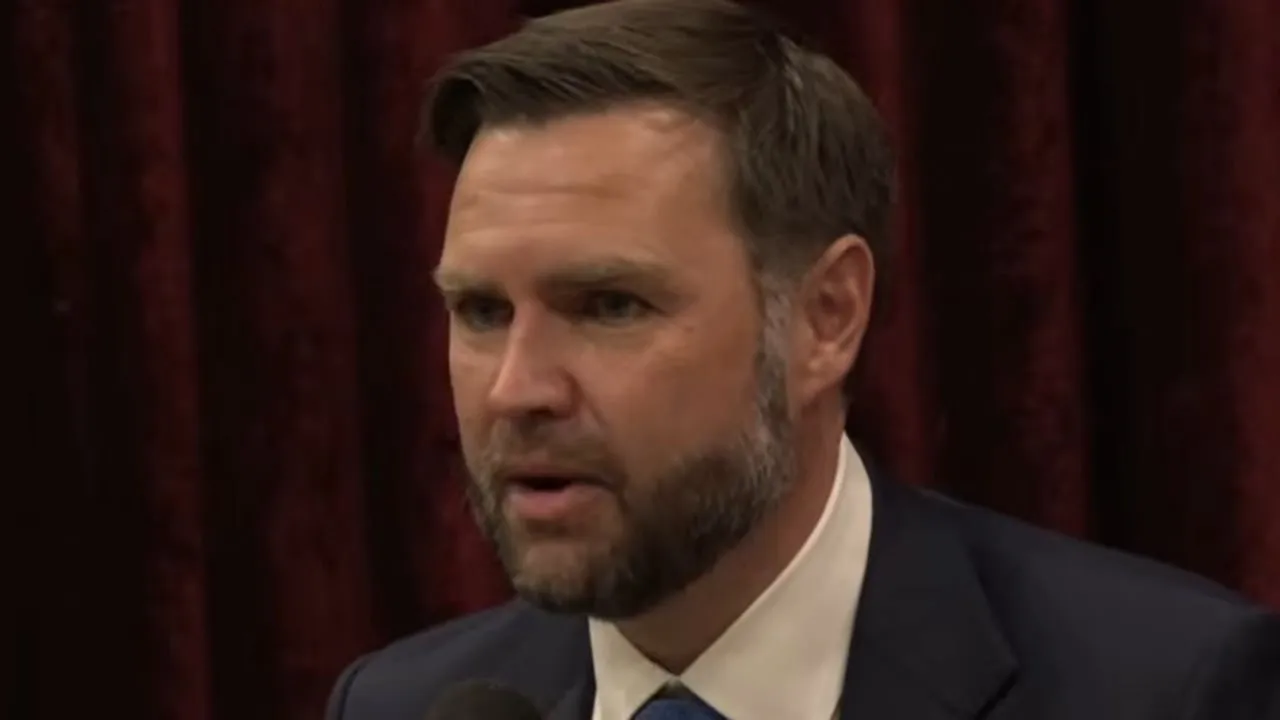
US Vice President JD Vance downplayed Israel’s alleged political influence on US policies in the Iran war while talking to Joe Rogan on the latter’s podcast, broadcast on Wednesday.
“There’s a lot of talk about how much the Israeli government is influencing American politics. There are certainly certain people within the Israeli government who hate the deal. And we see exact evidence,” Vance said.
He also referenced a story published on Tuesday in Time magazine, which commented on how Trump’s former election campaign manager, Brad Parscale, was linked with an Israeli government-funded campaign paying conservative influencers to push their audiences towards denouncing the ceasefire between the US and Iran.
“I definitely think you have seen this very discreet, extremely well-funded campaign to try to derail the negotiation and try to derail the deal,” Vance told Rogan.
The Time article is “worth reading because it lists a bunch of people who have quite literally been paid by a former Trump campaign person who was himself paid by certain elements within the Israeli government. And those people are attacking me viciously for quite literally trying to accomplish the negotiation objective that the president set for the country,” he added.
‘They’re attacking me obsessively’
Rogan asked how these people are attacking Vance, to which the vice president said that “It’s social media posts… leaking to reporters. They’re attacking me obsessively, saying that we should not be negotiating with Iran. We should just keep the military campaign going indefinitely.”
“That is their explicit position,” he said. “People have come after me and say that I’m influenced by Qatar, that I’m influenced by foreign governments, that, you know, I take my marching orders from Tucker Carlson. And there’s just so much bullshit out there when what I’m actually trying to do is accomplish what the president of the United States told me to accomplish, which is a settlement of this that accomplishes our objectives.”
These objectives included Iran not having a nuclear weapon, and achieving the “free flow of oil and gas,” Vance noted.
“I should be clear, I don’t actually mind that – let’s say certain elements of the Israeli government want to criticize the deal or have disagreements about the deal. I don’t even mind an effort to try to influence foreign governments to try to influence the United States all the time. You know, Israel does it, other countries do it. It’s just sort of the nature of the beast,” he said.
“What bothers me is actually when American leadership allows that influence to affect their judgment and to affect what they are advocating for. That’s what really bothers me. People are always going to try to influence the United States of America, whether they’re allies of ours or whether they’re enemies of ours,” he added.
“When I open up the pages of Time magazine, and I see that there’s a literal foreign influence campaign being funded to tank the very deal that I was pursuing, and many of the people who were receiving that money were actually attacking me in completely dishonest ways. You know, my response to that is, well, go to hell. I’m going to do what I have to do for the American people. I represent Americans first, and that’s the way that I’ve tried to do this job.” Vance said.
‘I have a ton of respect for the Jewish religion’
The vice president also defended his position towards Israel and allegations of antisemitic and anti-Zionist views.
“The crazy thing is, people don’t realize this, I’m actually…like the reasonable moderate,” Vance said, when placing himself within what he called the “massive pro-Israel, anti-Israel debate in the US.”
“I think that’s what so many people don’t realize is I’ve been accused of being an antisemite… some people say that I’ve insulted the Jewish religion, which is insane,” he said.
“I have a ton of respect for the Jewish religion… I’ve never heard a good compelling argument for why I’m an antisemite even though I’ve been accused of being an antisemitic by many people,” he added.
“My attitude towards this is Israel is an ally like France or the UK. We are going to have disagreements with them; we are going to have agreements with them. There are areas where we’re going to have similar interests and areas where our interests are going to diverge,” he said.
‘The concern is that they’re spying on American politicians’
Vance and Rogan also discussed the level to which Israel allegedly attempts to influence US politics.
“I think some are better at it than others. I think Israel is definitely more effective at it than most. But I wouldn’t say they’re the only effective country trying to influence American politics by any means,” Vance said.
“It’s more than that. The concern is that they’re spying on American politicians – that there are concerns about funding, influence, concerns about whether or not politicians are aligned with Israel or whether they’re aligned with the US first,” Rogan said.
“I definitely get those concerns,” Vance replied, “but my sense is that the way that all foreign influence works in the United States is people try to manipulate American public opinion, and then from manipulating public opinion they try to get the outcomes that they want.”
“But I know beyond a shadow of a doubt that there have been people within the Israeli government who are trying to, like, actually shift us away from that policy because they want to continue the military campaign. And by the way, like there are people within their government that I love, I have good relationships with. I hope, and I don’t think that they’re part of this. I mean, you know, the ambassador of Israel to the United States, I think, is actually a really good guy. Obviously, he cares about Israel first. I care about America first. But there are some people within their system, we know beyond a shadow of a doubt, who are manipulating and trying to change American public opinion to keep the war going on indefinitely. Again, not towards any objective, but just indefinitely,” Vance added.
Vance also downplayed the allegations that Israel, or any other country, could have influenced or “blackmailed” US President Donald Trump into striking Iran, stating that he was in the room for those decisions, and that Trump made the decision to strike on his own.
He also downplayed reports that the US is giving Iran $300b., saying that these are simply the lifting of sanctions, allowing Gulf States, such as Saudi Arabia and the UAE, to resume trading with, and investing in, Iran.