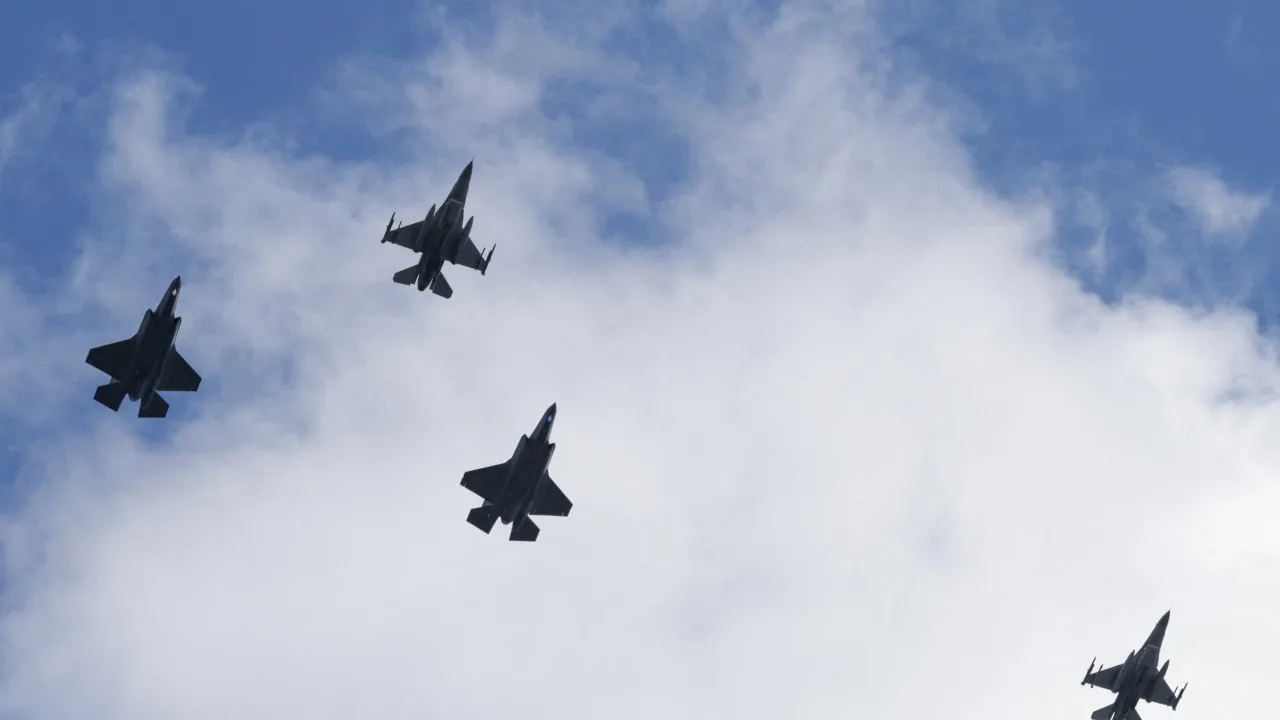
Greece has voiced its strongest public concerns yet over the possibility that the Trump administration could pave the way for Turkey’s return to the F-35 fighter jet program, warning that advanced American weapons should not be used against fellow NATO allies.
Greek Defense Minister Nikos Dendias, speaking Thursday at the 30th Economist Roundtable, said Greece “would not welcome” Turkey receiving either F-35 fighter jets or engines for its next-generation Turkish “Kaan” combat aircraft.
At the same time, Dendias emphasized that the decision ultimately rests with Washington.
“We are simply asking one question,” he said. “Is this truly in the interest of the United States? That is for the US government and the American people to decide.”
Dendias said any transfer of advanced military platforms within NATO should include restrictions preventing their use against another member of the alliance.
“NATO, and particularly stability in the Eastern Mediterranean, is of fundamental importance to the United States,” he said. “Providing such a platform without the condition that it cannot be used against another allied state raises the question of whether that truly serves American interests.”
He added that it should be “a basic principle” that military platforms sold between NATO members are never used against fellow allies.
F-35 should only be sold if guarantee given not to use it against allies
Earlier Thursday, a senior Greek diplomatic source said weapons sold by one ally to another “cannot be used against a fellow ally,” underscoring Athens’s concern that a future Turkish F-35 fleet could alter the military balance in the Eastern Mediterranean.
Greece is expected to receive its first F-35s in 2028.
The official stressed that while Greece cannot dictate the defense procurement decisions of other countries, it has both the right and the obligation to present its security concerns to Washington. Those concerns are sharpened by Turkey’s longstanding “casus belli” declaration over the possible extension of Greek territorial waters in the Aegean Sea.
Although Greece has no ability to impose conditions on a US arms sale, the official said Athens has raised the issue “through every available diplomatic channel.”
Erdogan dismisses Greece, Israel’s worries
Speaking Wednesday, Erdogan dismissed objections from Greece and Israel to a potential F-35 sale, saying there was “no place” for such opposition.
“Greek Prime Minister Kyriakos Mitsotakis should not have made the mistake of opposing Turkey’s purchase of the aircraft,” Erdogan said. “We have the right to acquire aircraft and defensive equipment, and we are holding talks on this matter.”
On Thursday, Israeli Prime Minister Benjamin Netanyahu appeared to allude to Turkey during a speech, though he did not mention it by name.
“The war has not yet ended,” the Israeli prime minister said. “Alongside the old challenges, new challenges are emerging. We are paying close attention to them and are prepared for every scenario. Preserving Israel’s air superiority is a fundamental pillar of our national security.”
Despite renewed optimism in Ankara following discussions between Trump and Erdogan, Greek officials said Turkey remains far from rejoining the F-35 program.
According to the senior Greek diplomatic source, Turkey has yet to secure any tangible breakthrough because the legal and political pathway remains highly restrictive.
The source pointed to the requirement that Ankara first prove it no longer possesses the Russian-made S-400 air defense system before any process to restore its eligibility for the F-35 could begin. Even then, officials noted, changes to US legislation, including provisions of the National Defense Authorization Act, would likely be required.
Turkey was removed from the multinational F-35 program in 2019 after taking delivery of the Russian S-400 system. Washington argued at the time that operating both systems simultaneously could compromise sensitive F-35 technology.