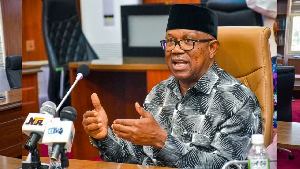
The Chairman of the Independent National Electoral Commission, Joash Amupitan, has called for INEC to be funded directly from the Federation Account, saying the current budgetary process weakens the Commission’s financial independence and affects its operational efficiency.
Amupitan made the call in Abuja on Thursday at the public presentation of Shadows: Protest Essays on Africa’s Most Consequential Country (1999–2023), a two-volume book authored by Eniola Bello, Managing Director of ThisDay Newspaper.
The INEC Chairman said although the Constitution places the Commission on first-line charge, the existing funding arrangement does not give it the level of financial autonomy required to conduct free, fair and credible elections.
According to him, INEC’s continued dependence on the annual appropriation process and the Federal Government’s envelope budgeting system makes it difficult for the electoral body to operate independently and efficiently.
“Experience over the years has shown that as long as INEC is still subject to the normal envelope system and the processes of appropriation, having to go to the National Assembly, it is very difficult to operate in such a situation without wasting your time,” Amupitan said.
He argued that INEC’s constitutional responsibilities go beyond conducting presidential and National Assembly elections, noting that the Commission also conducts governorship and state assembly elections, registers and regulates political parties, and maintains the national register of voters used for elections across all levels.
Amupitan said despite these broad responsibilities, the financial burden of running the Commission is still placed on the Federal Government because INEC’s funding is drawn from the Consolidated Revenue Fund.
He said governorship and state assembly elections cost INEC more to conduct than presidential and National Assembly elections, making the current funding structure unsustainable.
“It is for this reason we feel that although the Constitution tried to place INEC on the first-line charge, it is not strong enough,” he said.
“INEC should come as part of the Federation Account so that we can have seamless operations and what we call operational efficiency.”
His comments come amid continuing debate over electoral reforms following the signing of the Electoral Act 2026 (Amendment) Bill into law by President Bola Tinubu in February.
The amendment followed months of legislative debate and review by the National Assembly, with Tinubu at the time commending lawmakers for what he described as efforts to strengthen democratic stability and national development.
In April, the House of Representatives further amended the Electoral Act 2026 by designating the Court of Appeal as the final arbiter in pre-election disputes involving state houses of assembly, the National Assembly and governorship contests.
Earlier in July, the Court of Appeal in Abuja also voided sections 77(5), (6), (7), and 84(2) of the Electoral Act 2026, holding that the provisions were inconsistent with the 1999 Constitution. The court ruled that a subsidiary law cannot disqualify a person already deemed qualified by the Constitution.
Amupitan also called for further amendments to the Electoral Act to strengthen INEC’s oversight powers over political parties.
He said the Commission should be empowered to play a more active role in ensuring that political parties comply with their own constitutions, the Nigerian Constitution and the Electoral Act.
According to him, stronger regulatory powers for INEC could help reduce the volume of pre-election litigation that often burdens the courts and disrupts the electoral process.
He disclosed that the Commission is considering a mediation mechanism to resolve internal political party disputes within three months as an alternative to prolonged court battles.
Amupitan further proposed that all disputes relating to political parties should be concluded at least one year before a general election to prevent last-minute legal crises from affecting the electoral timetable.
The post “INEC Chairman Seeks Direct Funding From Federation Account” — Says Governorship, Assembly Elections Cost More Than Presidential Polls appeared first on TheNigeriaLawyer.