The prosecution alleges that the facility was used to produce 2,419.48 kilogrammes of methamphetamine valued at more than N480 billion.
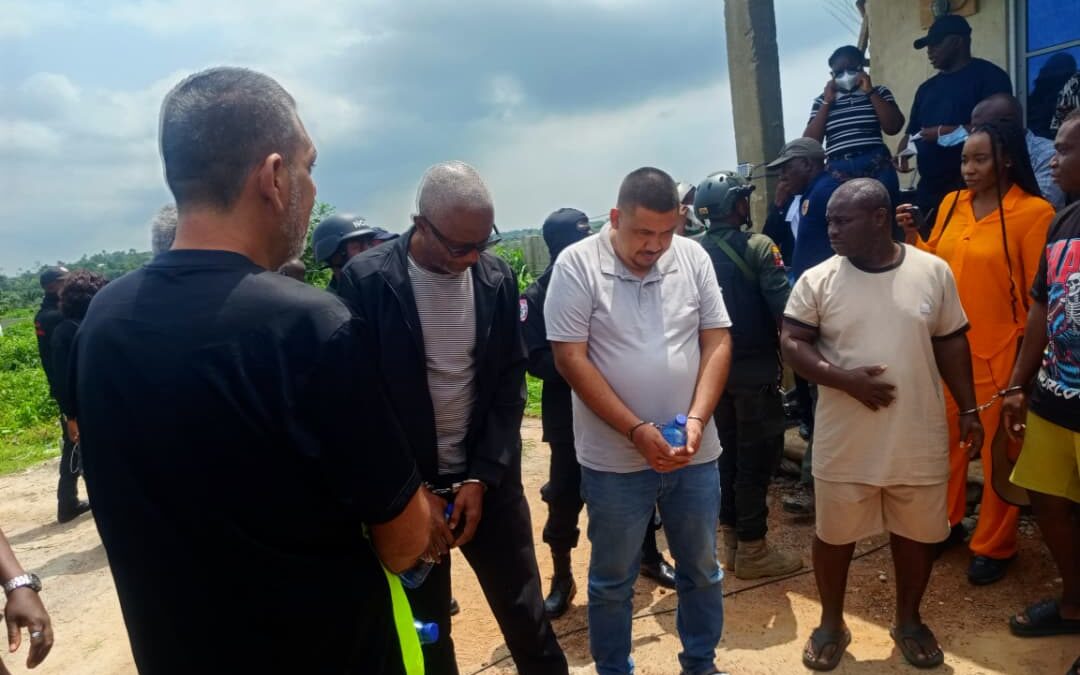
Justice Musa Kakaki of the Federal High Court in Lagos on Wednesday inspected a clandestine laboratory in Iloti community, Ogun State, where the National Drug Law Enforcement Agency (NDLEA) alleged that 10 defendants facing illicit drug charges produced and stored large quantities of methamphetamine.
The inspection formed part of the ongoing trial of three Mexican nationals and seven Nigerians accused of operating the laboratory.
The defendants, who were brought from the Lagos Correctional Centre, include Carlos Meza Torrero, Nemecio Martinez Felix and Jesus López Valles.
Others are Anochili Innocent, Nwankwo Sunday Christian, Egwuonwu Uchenna Victor, Igwe Abuchi Remijus, Ifeanyichukwu Chibuike Joshua, Omonughwa Kingsley Orike and Nwobum Emeka Christopher.
On the premises, E. Buhari, a prosecution lawyer, called Ajilema Anebi, the first prosecution witness and an expert in clandestine laboratories, to continue his testimony.
Mr Anebi had earlier testified before Mr Kakaki on 16 July about the substances and equipment allegedly recovered from the facility where some of the defendants were arrested.
He told the court that the substances recovered from the facility were used in the production and storage of large quantities of methamphetamine allegedly intended for export outside Nigeria.
Continuing his evidence on Wednesday, the witness explained that the identification of the substances was based on an analysis conducted by him and members of his team.
He also said the list of chemicals and equipment referred to in his evidence had already been tendered and admitted in evidence.
During cross-examination, however, defence lawyer Benson Ndakara asked Mr Anebi to physically identify the items at the premises and explain their uses to the court.
Mr Ndakara argued that the witness should show the items to the court rather than simply refer to exhibits that had previously been tendered.
The request prompted an objection from Adekunle Adebajo, the head of the NDLEA prosecution team, who took over from Mr Buhari. He argued that the witness had already answered the question that the list of items found during the agency’s operation was in the court documents already tendered.
The defence lawyer insisted that the physical identification of the items at the site was necessary to enable the witness to properly explain their uses and relevance to the case.
Mr Kakaki subsequently allowed the request.
Mr Anebi then led the judge and Mr Ndakara around the premises, identifying various chemicals, machines and bags found at the alleged laboratory.
As they moved around the facility, the witness explained the alleged relevance of the items to the production process.
He also testified about the substances and processes allegedly used at the facility, including the use of alcohol and hydrochloric acid.
The inspection to the laboratory, the scene where the cause of action in the case took place, the locus in quo, ended with the court adjourning further hearing in the case until Friday.
Speaking to journalists on the sidelines of the inspection, Mr Adebajo revealed that the exercise enabled the court to see the evidence listed in the prosecution’s documents at the location where it was allegedly recovered.
He stated that the prosecution had applied for the inspection to resolve issues arising from the defence’s case.
 “The court is here to clarify the application. So whatever we are going to do is concerning the specific defence of what the court will rule on Friday,” Mr Adebajo said.
He explained that some of the exhibits had already been admitted in evidence, while the prosecution would seek to tender the remaining items on Friday.
“Some of the exhibits have been admitted, not all, because the environment is not too conducive. So the court had to adjourn to Friday,” he stated.
“On Friday, some of the exhibits will be admitted. We made an attempt to tender them today, but due to the environment, we were not able to do that.”
Also speaking with journalists, NDLEA spokesperson Femi Babafemi described the inspection as a significant development in the agency’s efforts to combat drug trafficking and production.
Mr Babafemi noted that the scale of the alleged operation had implications beyond Nigeria because of the potential public health and security consequences of industrial-scale drug production.
“It is indeed a landmark for the agency in our drug control efforts because of what was recovered here,” he said.
“It helps to curb a lot of public health issues and security challenges, not only in Nigeria but also in the subregion and other jurisdictions outside the country, because of the potency of the drugs produced at an industrial scale in this facility.”
He stressed that the NDLEA was concerned about attempts by international drug cartels to establish major production hubs in Nigeria, particularly in the South-west.
According to him, the cartels appeared to be moving their operations away from urban centres and into forests, creating additional challenges for law enforcement agencies.