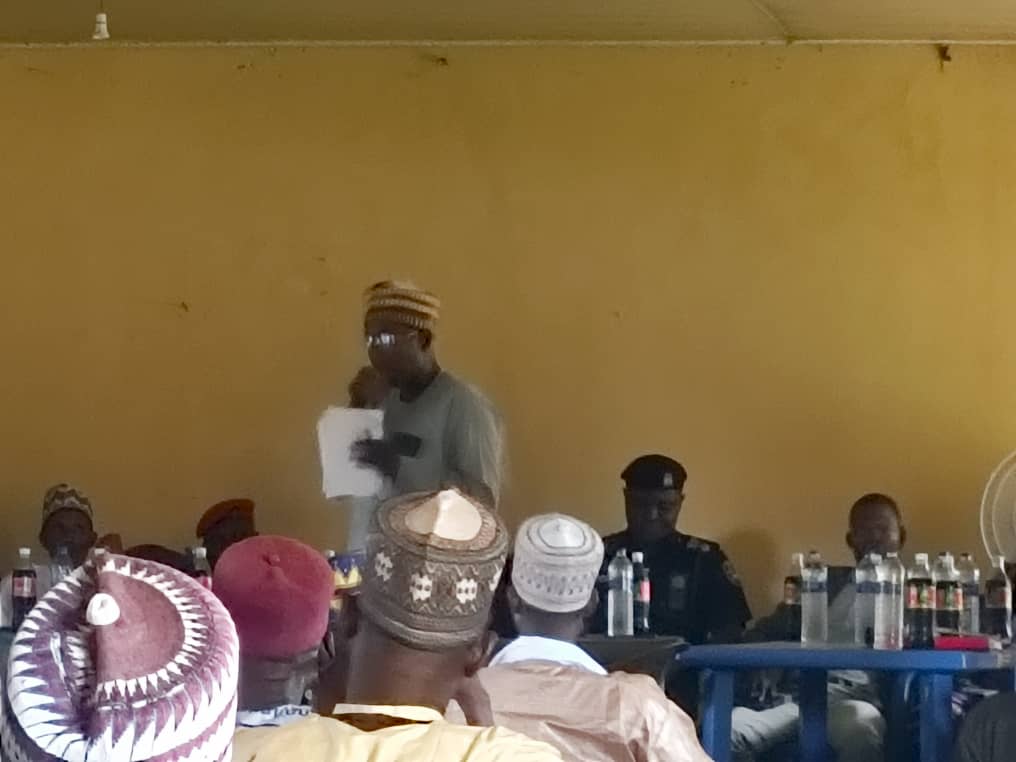
Leaders of Fulani communities, security agencies, farmers, traditional institutions and government representatives in Oyo State have called for stronger collaboration to tackle kidnapping, farmer-herder clashes and other security threats, warning against the ethnic profiling of Fulani people over crimes committed by individuals.
The resolution was reached at a stakeholders’ peace and security meeting convened by the leadership of the Miyetti Allah Cattle Breeders Association of Nigeria (MACBAN) in Oyo State and hosted by the Oyo West Local Government.
The meeting attracted representatives of the Nigeria Police Force, Department of State Services, Nigeria Security and Civil Defence Corps, Amotekun Corps, traditional institutions, farmers’ associations and Fulani leaders from Oyo State and across the South-West.
Speaking at the meeting, the Oyo State Chairman of MACBAN and convener, Alhaji Ibrahim Jiji, said the gathering was organised to address growing security concerns and strengthen peaceful coexistence between Fulani communities and their host communities.
He said while the Oyo State Government had demonstrated commitment to maintaining peace, residents also had a responsibility to support security efforts through cooperation and timely intelligence sharing.
Jiji lamented what he described as the growing tendency to associate kidnapping and other criminal activities with the entire Fulani ethnic group, insisting that law-abiding Fulani should not be judged by the actions of criminals.
“We are not criminals. We are not kidnappers. If we have a Fulani who is a criminal, we will not hide him. Likewise, if there is a criminal among our host Yoruba communities, they should not hide him. That is how we can ensure peace,” he said.
He also expressed concern over the activities of suspected foreign cattle rearers allegedly operating in some communities, urging government and security agencies to identify and deal with such elements.
According to him, Fulani leaders are willing to provide intelligence on suspicious persons and criminal activities to security agencies.
Jiji also appealed to government to address grazing-related challenges, saying access to designated grazing areas remained important for livestock owners while urging authorities to ensure Fulani citizens enjoyed equal economic opportunities.
Also speaking, the representative of the Oyo State Farmers Council, Alhaji Oladeji Emmanuel, said farmers and herders were not enemies but partners whose livelihoods depended on one another.
He described most disputes between both groups as economic disagreements arising from competition over land and livestock rather than ethnic hostility.
“Farmers and Fulani are not enemies. The issues between them are economic,” Emmanuel said.
He urged traditional rulers and local government authorities to respond promptly to complaints from both farmers and herders, while warning that some individuals deliberately exploit communal tensions for personal gain.
On his part, the National President of MACBAN, Alhaji Baba Othman Ngelzarma, represented by A.B. Danmasani, commended the peaceful relationship between Fulani communities and their hosts in Oyo State.
He urged affluent Fulani members to support vulnerable members of their communities and called on traditional rulers and community leaders to continue working with security agencies in sustaining peace.
Representing the Oyo West Local Government Chairman, Ambassador Muyideen Adeyemi stressed the need to involve traditional rulers more actively in conflict resolution, noting that monarchs remained influential in rural communities.
He advised MACBAN leaders across the state to maintain closer relationships with local government chairmen to strengthen grassroots peacebuilding initiatives.
The police also used the meeting to caution against collective blame.
Representing the Commissioner of Police, the Divisional Police Officer of Afijio, CSP Mojid Lawal, said investigations had shown that criminality cut across ethnic groups, warning residents against stereotyping Fulani people.