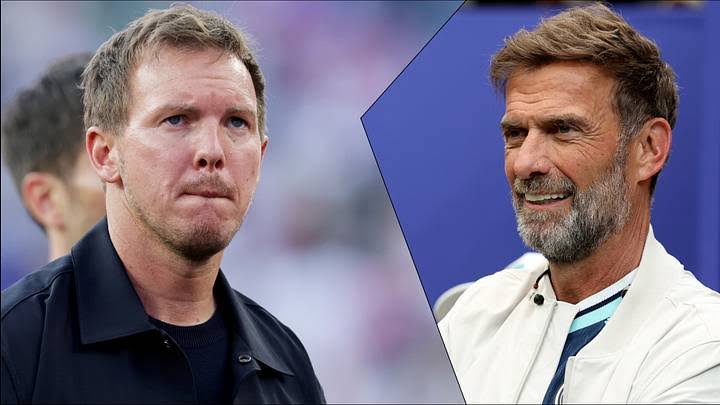
German football governing body, (DFB) on Friday, 24 July, 2026 appointed Jürgen Klopp as national team coach replacing Julian Nagelsmann, who tendered his resignation in early July following the team’s exit at the 2026 World Cup.
Nagelsmann exit was expected after a disappointing round of 32 defeat at the hands of Paraguay, Germany’s third consecutive early World Cup exit since winning the tournament in 2014.
DFB gave Kloop, former Liverpool manager given the task of rebuilding the struggling European giants.
With Klopp’s appointment, his contract will see him through to the 2030 World Cup co-hosted by Spain, Portugal and Morocco, as well as the three centenary matches planned for that year in South America.
Before his new appointment, 59-year-old Klop admitted publicly his desire to succeed his predecessor, Nagelsmann.
As the German FA’s preferred candidate, Klopp’s willingness to take the job accelerated Nagelsmann’s departure.
“It’s a great honour for me to be sitting here today. This is ideally the high point of my career, of my life, my professional life. I will give it everything I have,” Klopp told a press conference called by the DFB to announce his appointment in Frankfurt.
However, he warned the assembled reporters that “if you tomorrow you start saying: ‘He’s crap’, then I’m off”.
According to DFB President, Bernd Neuendorf, Klopp’s contract would start on August 15 and run until summer 2030.
Since 2025, Klopp has been under contract until 2029 with Austrian energy drink maker Red Bull as “Head of Global Soccer”, where he oversees the football clubs affiliated with the company, such as RB Leipzig, Red Bull Salzburg and the New York Red Bulls.
Neuendorf thanked Red Bull for their willingness to end the contract early as Klopp would need his “full concentration” for the new job.
The DFB did not have to pay a fee but will instead make a donation of a million euros ($1.1 million) to Red Bull’s Wings for Life charity foundation, which supports research into spinal cord injuries.
Having repeatedly said his time in the dugout was over, Klopp returns with the mammoth task of returning the struggling Germans to the top of the international game.
Germany have won four World Cups — the equal most of any European team — and three European Championships, one behind record holders Spain, but have struggled in recent years.
The team was exited at the just concluded this summer’s World Cup after losing to Paraguay on penalties in the round of 32.
It was the third successive World Cup failure for the Germans since winning their fourth title in 2014.