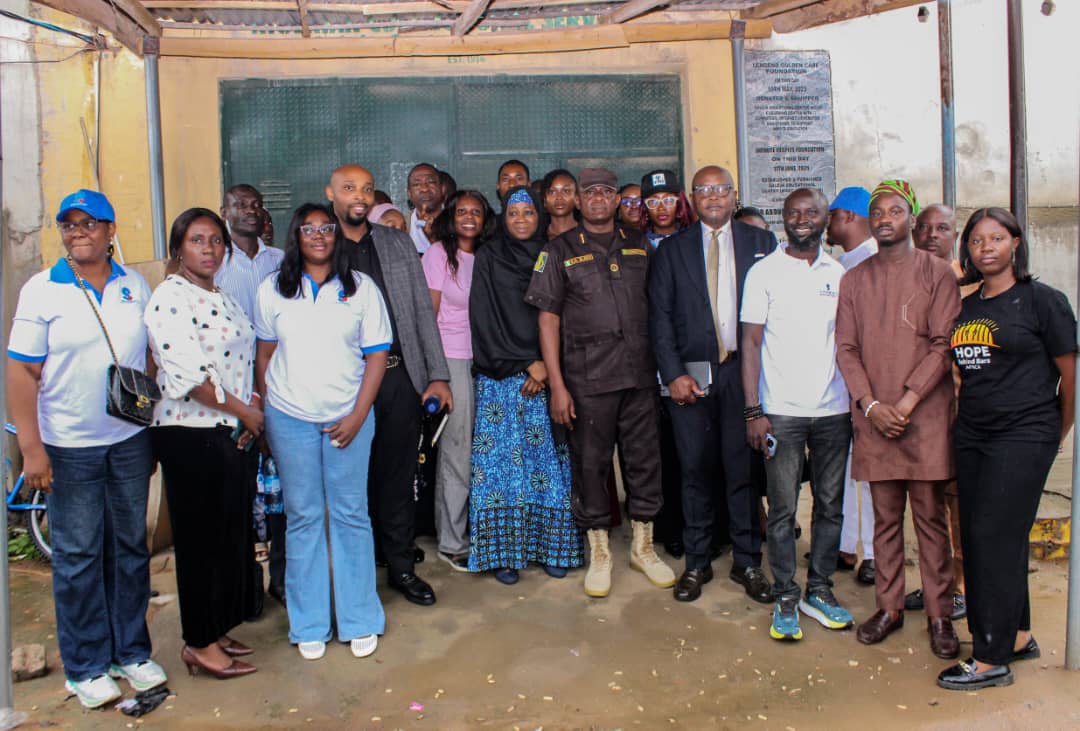
The National Human Rights Commission (NHRC), in partnership with Hope Behind Bars Africa and other stakeholders, has facilitated the release of 11 indigent inmates from the Suleja Medium Security Custodial Centre in Niger State as part of activities commemorating the 2026 Nelson Mandela Day.
The intervention, which involved the payment of fines ranging between N800,000 and N900,000, also included the donation of essential hygiene materials to inmates and sensitisation of correctional officers on international standards guiding the treatment of persons deprived of liberty.
The initiative, according to the organisers, was aimed at promoting the ideals of the late South African leader, Nelson Mandela, whose life remains a global symbol of the fight for justice, equality, dignity and human rights.
Speaking at the event, the Executive Secretary of the NHRC, Dr Tony Ojukwu, SAN, said Mandela Day was an opportunity to remind society that justice, dignity and compassion must extend to everyone, including persons in custodial facilities.
Represented by his Special Assistant and Head of the Commission’s Monitoring Department, Dr Benedict Agu, Ojukwu said the United Nations General Assembly’s decision in 2015 to expand the focus of Mandela Day was to draw attention to humane conditions of imprisonment, recognition of prisoners as continuing members of society and the crucial role of correctional officers as providers of an important social service.
He said the adoption of the United Nations Standard Minimum Rules for the Treatment of Prisoners as the Nelson Mandela Rules remained a fitting tribute to a man who spent 27 years behind bars in pursuit of freedom and justice.
“Today’s commemoration is not about the calendar but about the principles Mandela stood for. For us, it is not just a memorial but a reaffirmation of a life lived for the human person, for the values of human dignity and for the principles of freedom,” Ojukwu stated.
He noted that the theme of Mandela Day 2026, “It’s Still in Our Hands to Combat Poverty and Inequity,” strongly aligns with the realities encountered by the Commission in its human rights work.
According to him, poverty remains one of the underlying factors contributing to crime and prolonged detention, particularly among inmates unable to pay court-imposed fines.
“Most crimes that bring people into custody are often rooted in poverty, and when you look at the fines that continue to keep low-risk inmates behind bars, you can see how poverty and inequity sustain overcrowding in our correctional facilities,” he said.
Ojukwu stressed that the theme must challenge governments, institutions and citizens to address inequality through reforms in policies, laws and practical interventions.
He explained that the Commission had moved beyond monitoring detention facilities and making recommendations by actively supporting vulnerable inmates through payment of fines, welfare assistance and programmes designed to encourage rehabilitation and reintegration.
“For people of means, it is an invitation to join hands in supporting these efforts, so that custodial centres are not overwhelmed and society can benefit from the values and contributions of rehabilitated inmates because they still have something to offer,” he said.
Recalling the Commission’s Mandela Day intervention in 2025, Ojukwu said the NHRC facilitated the release of four indigent inmates at the Suleja facility, donated essential welfare materials and sensitised correctional officers on the Mandela Rules and Bangkok Rules.
He added that the Commission was continuing in that direction by supporting the release of more low-risk inmates, stressing that those in custody remained members of society deserving opportunities to rebuild their lives.
“By these actions we are simply saying that those in custody remain part of our society and deserve opportunities to rebuild their lives. Custody must be a turning point, leading to correction and ultimately reintegration,” he said.
Also speaking, the Executive Director of Hope Behind Bars Africa, Pauline Oloreomi, said justice should not be perceived only as punishment but as a pathway towards reform, rehabilitation and restoration.
Oloreomi highlighted the need to pay greater attention to the specific challenges faced by women in custodial centres, including access to healthcare, protection of dignity during searches and increased adoption of non-custodial measures for pregnant women and nursing mothers.
While acknowledging that legal frameworks exist to protect female inmates, she noted that implementation remained a major challenge and called for stronger collaboration among stakeholders to improve conditions in correctional facilities.
The Programme Supervisor of Hope Behind Bars Africa, Hassan Nurudeen, said the organisation’s work focuses on access to justice, human rights protection, education and rehabilitation as part of efforts to reduce repeat offending.