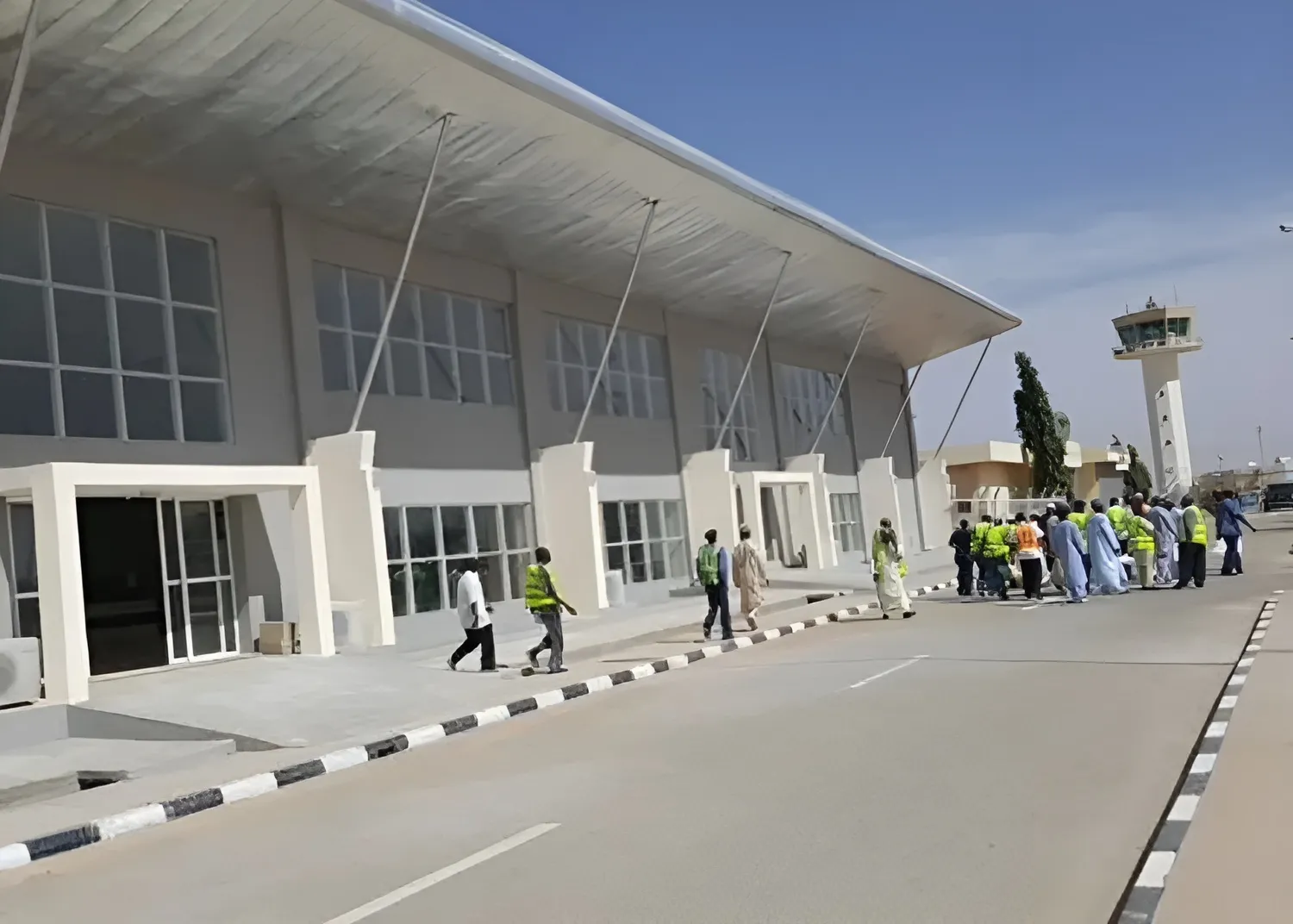
A PREMIUM TIMES investigation reconstructs the official Hajj registration and screening process after the arrest of seven returning pilgrims suspected to be terrorists at Katsina airport.
The atmosphere inside the international arrivals terminal at the Umaru Musa Yar’Adua International Airport in Katsina was one of celebration. Families stood behind security barriers waiting to embrace relatives returning from Saudi Arabia after completing the 2026 Hajj pilgrimage. Airport officials moved methodically through familiar administrative routines, and returning pilgrims wheeled their luggage toward the main arrival hall after presenting their travel documents for standard border clearance.
Then, without warning to the waiting crowd, the routine changed.
As passengers stepped forward one after another for immigration clearance, border control officers quietly isolated seven men from the rest of the arriving passengers. There was no public commotion, no shouting, and no dramatic confrontation inside the terminal. The men were discreetly separated from the other pilgrims, escorted out of public view under heavy security detail, and placed in immediate custody.
Within hours, the seven detainees were moved out of the airport under armed escort and subsequently flown to Abuja, where they were handed over to the State Security Service (SSS).
Days later, the Minister of Interior, Olubunmi Tunji-Ojo, made a public announcement that transformed the quiet airport operation into a subject of intense national debate. The minister stated that security agencies had intercepted seven suspected commanders of Boko Haram and ISWAP who had returned from the Hajj through the Katsina airport.
Nigeria faces several types of terrorism from groups like ISWAP, Boko Haram, and bandits. Several groups of bandits operate in Katsina, where thousands of people have been killed or kidnapped in recent years.
The government presented the arrests as evidence of Nigeria’s expanding digital border management capabilities, highlighting technical advancements in biometric identity verification and real-time intelligence coordination among security agencies.
As of the time of publishing this story, neither the federal government nor the SSS has publicly released the identities of the seven suspects or announced any criminal charges against them.
While the minister’s announcement generated major headlines across the country, it also left behind a series of fundamental questions. The most critical question raised by the operation is not how the men were apprehended upon their return, but how they managed to leave Nigeria in the first place.
Unlike some transnational criminals who utilise forged travel documents, stolen identities, or clandestine border crossings, immigration officials familiar with the operation confirmed to PREMIUM TIMES that the seven suspects travelled using valid Nigerian international passports issued in their own legal names and identities.
The seven men completed all official Hajj travel procedures before leaving Nigeria. This paradox raises difficult accountability questions extending far beyond the immediate fate of the seven suspects: What specific security screening protocols exist before an intending pilgrim is cleared to leave Nigeria? Which institutions bear the statutory responsibility for identifying registration applicants who are already on national security watchlists? Did the intelligence identifying these suspects emerge only while they were overseas, or were crucial opportunities to intercept them missed before they boarded their outbound flight? Most fundamentally, where does administrative accountability reside among the overlapping state and federal institutions that coordinate one of Nigeria’s largest annual international migrations?
Over several days of field reporting, PREMIUM TIMES interviewed security personnel familiar with the airport operation, spoke with anonymous policy and intelligence sources, questioned civil society leaders, and visited the headquarters of the Katsina State Pilgrims Welfare Board. PREMIUM TIMES also reviewed official government statements, examined the administrative mechanics of the annual Hajj workflow, and sought clarifications from every primary institution involved.
What emerged was a fragmented institutional picture. Federal authorities describe the operation as a successful intelligence-led border interdiction enabled by integrated digital systems, while civil society groups argue it exposed weaknesses in pre-departure vetting. Several of the institutions responsible for processing intending pilgrims either declined to explain their screening procedures or failed to answer key questions.
Rather than determining the guilt or innocence of the suspects, this investigation examines how those institutional responsibilities intersect and where accountability for pre-departure screening ultimately lies.
To evaluate how the seven suspects departed the country, it is first necessary to reconstruct the structured administrative process that an ordinary citizen must follow to perform the annual pilgrimage under Nigeria’s official framework.
Travelling for Hajj is not a simple commercial transaction; for the vast majority of Nigerian Muslims, it is a months-long, highly regulated bureaucratic process involving shared responsibilities among state governments, federal agencies, and Saudi Arabian authorities.
The operational chain begins at the grassroots level under the direct control of state agencies, such as the Katsina State Pilgrims Welfare Board, where designated Hajj officials receive applications and guide prospective pilgrims through the registration process. Following seasonal consultations with Saudi Arabian authorities, the National Hajj Commission of Nigeria (NAHCON) sets and announces the official annual Hajj fare, which covers airfare, accommodation in Mecca and Medina, meals, local transport, and associated logistics.
Prospective pilgrims must deposit this approved fare, which has risen sharply in recent years to between seven and eight million Naira due to macroeconomic inflation and exchange rate fluctuations, directly into the state board’s designated bank accounts.
Once financial obligations are satisfied, the applicant proceeds to the documentation stage. Interviews with Hajj stakeholders and border control officials indicate that the international passport has become the centralised identity document underpinning the entire modern registration workflow. Unlike in previous decades, when multiple separate supporting identity documents and physical clearance forms were collected manually by local boards, the vast majority of an applicant’s personal information, including biometric data and National Identification Numbers (NIN), is now embedded directly within the passport itself following enrollment by the Nigeria Immigration Service (NIS).
Once local documentation closes, the state pilgrims welfare board compiles the names of qualified applicants from across its local government areas into a comprehensive statewide register. This unified list is transmitted to NAHCON headquarters in Abuja for national coordination.
NAHCON subsequently uploads the pilgrims’ data into Saudi Arabia’s electronic Hajj portal, through which the Saudi Ministry of Hajj and Umrah issues the mandatory entry visas electronically. Only after the electronic visas are approved are the pilgrims assigned to outbound flights, and final passenger manifests are generated for each state delegation, indicating exactly who is cleared to board each charter aircraft.
According to immigration officials who spoke to PREMIUM TIMES anonymously, the NIS’s statutory responsibilities change significantly as the process moves from passport issuance to airport departure clearance. It was learned that the primary daily mandate of officers stationed at the international departure terminals is to enforce immigration laws governing valid exit and entry, establish identity, and verify the physical integrity of travel documents.
Therefore, according to the officers interviewed, immigration officers primarily verify identity and travel documents and rely on intelligence alerts or watchlists supplied through the wider national security system when determining whether a traveller should be intercepted.
An immigration officer stationed in the region explained that their core role at the departure gate is passenger clearance. The source stated that when a traveller presents a passport, biometric verification and document checks are conducted to confirm that the passport is genuine and that the bearer standing before the officer is the legitimate holder of the document.
The official emphasised that routine immigration clearance remains an identity check, whereas the specialised tracking of terrorism suspects or the management of active criminal intelligence falls within the distinct purview of specialised intelligence agencies.
Federal pilgrimage authorities further clarify this division of responsibilities. Contacted by PREMIUM TIMES regarding the boundaries of federal oversight, NAHCON spokesperson Fatima Usara clarified that NAHCON is not statutorily positioned to conduct background checks or profile individual travellers.
Mrs Usara stated that NAHCON does not conduct screening operations, clarifying that such mandates fall squarely on individual state units. According to her, state pilgrims’ welfare boards function as direct operators, handling grouping and overseeing pilgrim manifests, while NAHCON acts strictly as a manager and regulator, tasked with establishing administrative standards, issuing policy statements, and monitoring implementation.
Regarding national security protocols, Mrs Usara added that while NAHCON maintains security agencies as affiliates to assist the matrix, the primary curation of manifests remains decentralised at the state operational level.
This dynamic exposes a critical operational divide. While border immigration personnel at the airport verify identity at the point of international travel and federal regulators monitor compliance with standards, the active vetting of individual backgrounds rests with the state-level frameworks that initially compile the lists. Many states, however, lack the capacity for such vetting, as Nigeria currently operates a unitary security system in which virtually all security agencies are owned and controlled by the federal government.
To understand how the seven suspects passed through these early administrative stages, PREMIUM TIMES visited the Katsina headquarters of the State Pilgrims Welfare Board to obtain an official explanation of the administrative safeguards and background checks built into the pilgrim recruitment process. The board declined to provide details of the process.