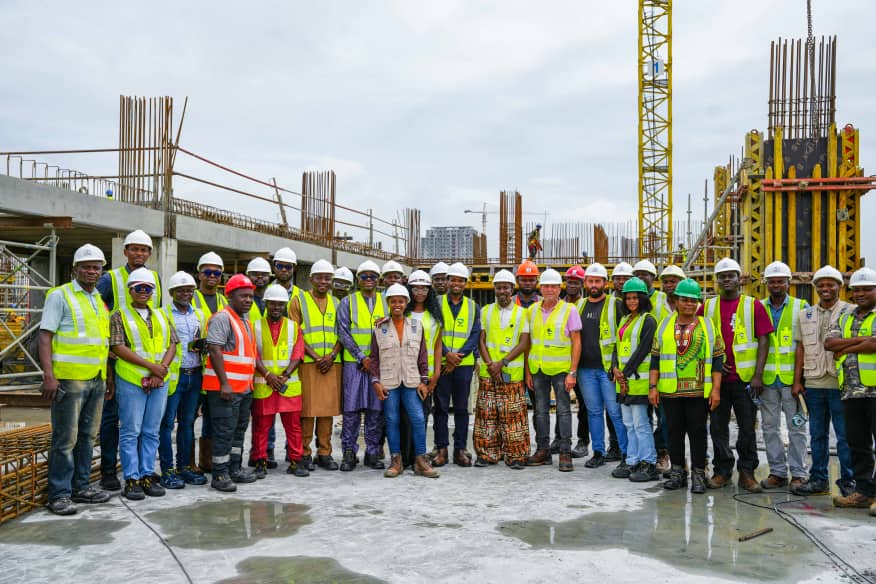
A delegation of the Nigerian Society of Engineers, NSE, Trans Amadi Branch, on Friday, 3rd July, 2026, visited the Louisville Project in Eko Atlantic City, Lagos, for an industrial safety engagement focused on strengthening safety practices in engineering and construction operations.
The engagement, themed “Advancing Safety in Engineering Operations,” brought together representatives of the NSE, the Nigerian Institution of Safety Engineers, NISafetyE, and members of the Louisville project team for discussions and a site inspection.
The delegation was led by Engr. Dr. Jonathan Francis, FNSE, Chairman of the NSE Trans Amadi Branch. Other members included Engr. Oluseun Faluyi, FNSE, FNISafety, FNIMechE, Immediate Past National Chairman of NISafetyE; Engr. Alani Saheed, MNSE, Chairman of the Lagos Chapter of NISafetyE; Engr. Chetachi Enyiegbulam, MNSE, Financial Secretary of the NSE Trans Amadi Branch, and other members of the Society.
During the engagement, the delegation received an overview of safety management practices at the Louisville Project and held discussions with the project team on safety planning, compliance, risk management and the role of continuous vigilance in sustaining strong safety performance.
Francis commended the project’s safety performance while stressing the need to guard against complacency and maintain consistent attention to operational risks.
Faluyi also emphasised the human importance of workplace safety, noting that beyond project schedules and construction targets, the objective of every safety system is to ensure that workers return home safely after each working day.
Representatives of the Louisville project team explained that safety considerations are incorporated from the design and planning stages of the development and carried through construction execution.
Following the discussions, the delegation toured the active construction site, where members observed ongoing operations, interactions between project and safety personnel, the use of personal protective equipment and other safety procedures being implemented across the project.
During the visit, a member of the delegation observed that some aspects of the safety culture being implemented on the project were comparable with practices commonly associated with the oil and gas industry.
The engagement concluded with the presentation of helmet chin straps by the Nigerian Society of Engineers to the Louisville project team as part of efforts to support compliance with personal protective equipment requirements on site.
The Louisville Project had earlier crossed 500,000 working hours without a lost-time injury, while construction activities continue across the development.
The visit formed part of ongoing efforts to promote knowledge sharing, professional engagement and improved safety practices across engineering and construction operations.