“The Federal Reserve’s commitment to price stability and maximum employment is unwavering. As is our resolve to pursue our mandate with rigor,” Warsh said in a statement.
“I am honoured that the best minds from a range of disciplines have agreed to work with us to sharpen our performance as an institution. The goal is straightforward: to ensure the Fed is best positioned to achieve our objectives in this consequential time.”
Each task force is co-led by outside experts drawn from academia, business and central banking, and will be supported by Fed staff. The Fed said the panels will “operate independently, with a mandate to follow the evidence, provide candid feedback, and produce rigorous findings” for the Federal Open Market Committee (FOMC).
The Fed has not set a formal deadline, but Warsh has said he expects the task forces to complete their work by the end of the year.
Balance Sheet Policy: Raghuram Rajan
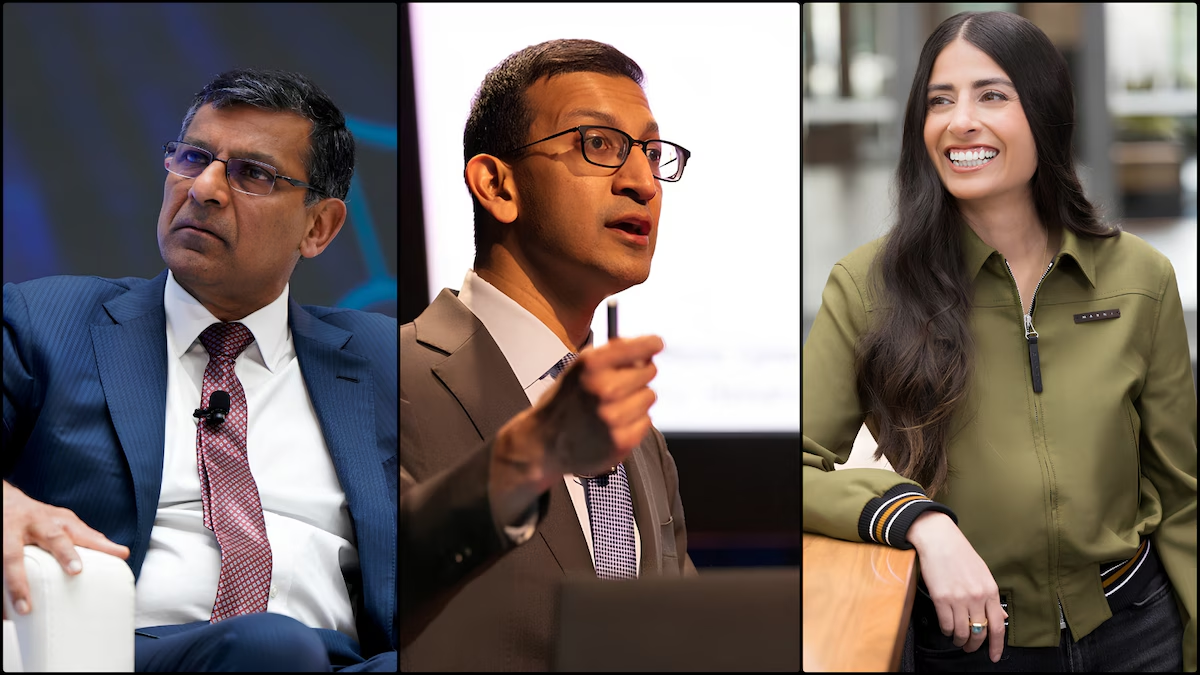
Raghuram Rajan, professor of finance at the University of Chicago Booth School of Business, is one of three leaders of the Balance Sheet Policy task force. He was governor of the Reserve Bank of India from 2013 to 2016, a period in which he helped guide India through the “taper tantrum,” strengthened the banking system, and helped set up India’s inflation-targeting framework.
The task force will examine the costs, benefits and institutional implications of the Fed’s current balance sheet policy. Rajan will work alongside Harvard economist Karen Dynan and Jeremy Stein, a Harvard economist and former Fed governor. Warsh has been a long-standing critic of the size of the Fed’s balance sheet and wants to cut its roughly $6.7 trillion in holdings.
Data: Raj Chetty
Raj Chetty, an economics professor at Harvard University, will co-lead the Data task force, which aims to improve the quality and timeliness of real-economy signals used in Fed policy decisions. Chetty is known for using large administrative and real-time data sets to study economic mobility, inequality and labour markets across the US.
He will work with Doug McMillon, former president and CEO of Walmart, and Kevin Murphy, an economics professor at the University of Chicago.
Productivity and Jobs: Asha Sharma
Asha Sharma, executive vice president and CEO of Microsoft’s Xbox division, will serve on the Productivity and Jobs task force, which will assess how new general-purpose technologies, including artificial intelligence, are affecting productivity, employment and wages, to inform the Fed’s policy judgments.
She will be joined by Marc Andreessen, co-founder and general partner at Andreessen Horowitz, and Charles I. Jones, an economics professor at Stanford University currently on leave at Anthropic. Andreessen was separately named to the US Defence Policy Board in late June, a civilian advisory panel for the Pentagon.
Communications
The Communications task force will review how the Fed conveys its policy deliberations and decisions amid uncertainty. Its leaders are Peter R. Fisher, professor of practice at the University of Washington’s Foster School of Business; Arminio Fraga, founder and chairman of Gávea Investimentos and former president of Brazil’s central bank; and Mervyn King, former governor of the Bank of England. Some names, including King’s, had already been reported before Thursday’s announcement.
Warsh has already begun changing how the Fed communicates, with officials giving less forward guidance and focusing more on their “reaction function” — the conditions under which they will adjust interest rates. The Fed’s post-meeting statement in June was shorter than earlier ones.
Inflation Frameworks
The Inflation Frameworks task force will revisit how the Fed understands and responds to the drivers of inflation. Its leaders are Greg Mankiw, a Harvard economics professor and former chairman of the White House Council of Economic Advisers; Thomas Sargent, an economics professor at New York University and Nobel laureate; and William White, a Canadian economist and senior fellow at the CD Howe Institute who previously advised the Bank for International Settlements. White had warned about loose monetary policy ahead of the 2008 global financial crisis.
Why it matters
Warsh has been Fed chair for less than two months. Unlike earlier Fed reviews, which relied mainly on internal discussion, these task forces will operate independently and draw on outside expertise.
Their findings will only be recommendations, but they could still shape how the Fed handles interest rates, inflation, financial stability and new technologies in the years ahead.