Segun James
Lagos State Governor, Mr. Babajide Sanwo-Olu, was alarmed, Wednesday, at the level of destruction caused by flood waters in the Ibeju-Lekki corridor of the state.
The Governor who took an unscheduled inspected of the flood-hit communities across the Lekki corridor, attributing the flooding to a combination of climate-induced heavy rainfall and human activities that obstruct natural waterways.
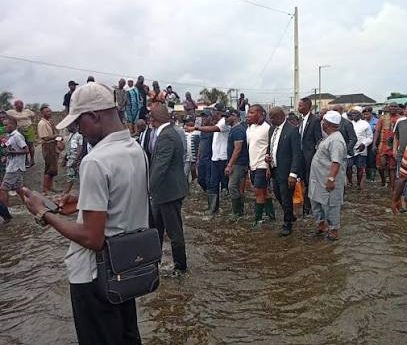
The governor toured Ogombo in Sangotedo, Chevron Drive and Ajiran in Eti-Osa Local Government Area, as well as Gbetu-Olorunkemi Road in Awoyaya, Ibeju-Lekki Local Government Area, to assess the impact of the flooding and ongoing drainage management efforts by the state government, said the inspection was necessary to obtain first-hand information on the challenges facing residents and identify both immediate and long-term solutions.
Accompanied by Deputy Governor Dr. Obafemi Hamzat, Secretary to the State Government, Mrs. Abimbola Salu-Hundeyin, commissioners and other members of the State Executive Council, Sanwo-Olu inspected major drainage channels, tributaries and waterways affected by the heavy rains recorded in recent weeks.
Addressing journalists while standing in floodwaters at Awoyaya, the Governor explained that the affected communities are located along Lagos’ natural drainage corridors and stressed the importance of preserving waterways and tributaries that channel stormwater into the lagoons.
“What we are being very intentional about is ensuring that water flows through its natural channels because Lagos is surrounded by water and several tributaries,” Sanwo-Olu said.
Sanwo-Olu noted that while the volume of rainfall experienced across Lagos in the last three to four weeks was unusually high, human activities had worsened flooding in several locations.
“In all of the places we visited today, there is a natural occurrence and there is also a human factor. Over the years, developments have come to meet natural bodies of water. In some places, people without approvals have restricted the flow of these waterways,” he said.
According to him, many of the tributaries and wetlands inspected during the tour have existed for decades and historically served as channels through which water flowed naturally into the Lagos Lagoon.
He said encroachment, indiscriminate development and blocked drainage systems had significantly reduced the capacity of some channels, increasing the vulnerability of surrounding communities during periods of intense rainfall.
Sanwo-Olu disclosed that the state government would intensify dredging, excavation and drainage expansion projects to improve water flow and reduce flooding risks.
“We need to come regularly to excavate and clear these channels so there will be free flow of water. Once the waterways are maintained, the water will eventually find their way into the lagoon,” he said.
The Governor described the recent flooding as partly a consequence of climate change, noting that many countries around the world were experiencing extreme weather conditions.
“The volume of water recorded in the last three to four weeks is largely due to natural causes. Climate change is real, and we are seeing heavier rainfall across the world. We cannot stop the rain, but we can continue to improve our infrastructure to manage it,” he stated.
Using a simple household analogy, Sanwo-Olu explained how blocked drains contribute to flooding.
“If your kitchen sink is blocked with waste, water will not flow freely. The same thing happens when our drainage channels are filled with refuse or other materials. It is our responsibility to remove those obstructions,” he said.
The governor stressed that environmental management requires collective responsibility and called on residents to support government efforts by keeping drainage channels free of refuse and complying with environmental regulations.
“We all have a role to play. The media has a responsibility to educate the public, citizens must act responsibly, and government has the responsibility to provide the necessary infrastructure. It is only when we all play our part that we can achieve better results,” he added.
Sanwo-Olu also sympathised with residents whose homes and property were damaged by the flooding, assuring them that government would assess affected communities and provide support where necessary.
“We want to commiserate with families that have suffered losses. We will visit other affected communities and see what kind of relief we can provide. Our relief centres are already receiving people, and we will continue to support those in need,” he said.
The governor warned that the rainy season was far from over and urged residents living in flood-prone areas to pay attention to weather advisories and relocate to safer and higher ground where necessary.
He assured residents that the Ministry of the Environment and Water Resources and other relevant agencies would continue monitoring vulnerable communities and implementing measures aimed at reducing the impact of flooding across the state.
Also speaking during the inspection, the Majority Leader of the Lagos State House of Assembly and member representing Eti-Osa Constituency I, Chief Noheem Adams, commended the governor for personally visiting the affected communities.
Adams said residents had been worried by the flooding experienced in communities such as Ajiran, Monastery Road, Ologolo, Alpha Beach, Ogombo and Lekki Gardens, adding that the governor’s visit had reassured residents that government was committed to finding lasting solutions.
“We thank the Governor of Lagos State for listening to the cries of the people of Eti-Osa and for personally coming to assess the flooding situation. The governor did not just receive reports; he came here himself and even stepped into the floodwaters. That shows he is a leader who genuinely cares about the welfare of the people,” Adams said.
The lawmaker expressed confidence that the inspection would lead to both immediate and long-term interventions to address flooding in the area.
According to him, residents are also being sensitised on the need to avoid activities that contribute to flooding, particularly indiscriminate dumping of refuse into drainage channels and waterways.
“This flooding is not peculiar to Eti-Osa alone. Many parts of Lagos have experienced similar challenges due to the heavy rains. We are continuously engaging residents through local government and community structures, encouraging them to keep drainage channels free of waste and comply with environmental regulations,” he said.
Adams further urged residents living in vulnerable areas to heed government advisories and relocate temporarily to safer locations where necessary, noting that the rainy season was still ongoing.