“The moment you have a federation, you have legislative lists given to different levels of government. It goes without saying that every level of government is authorised to police.”
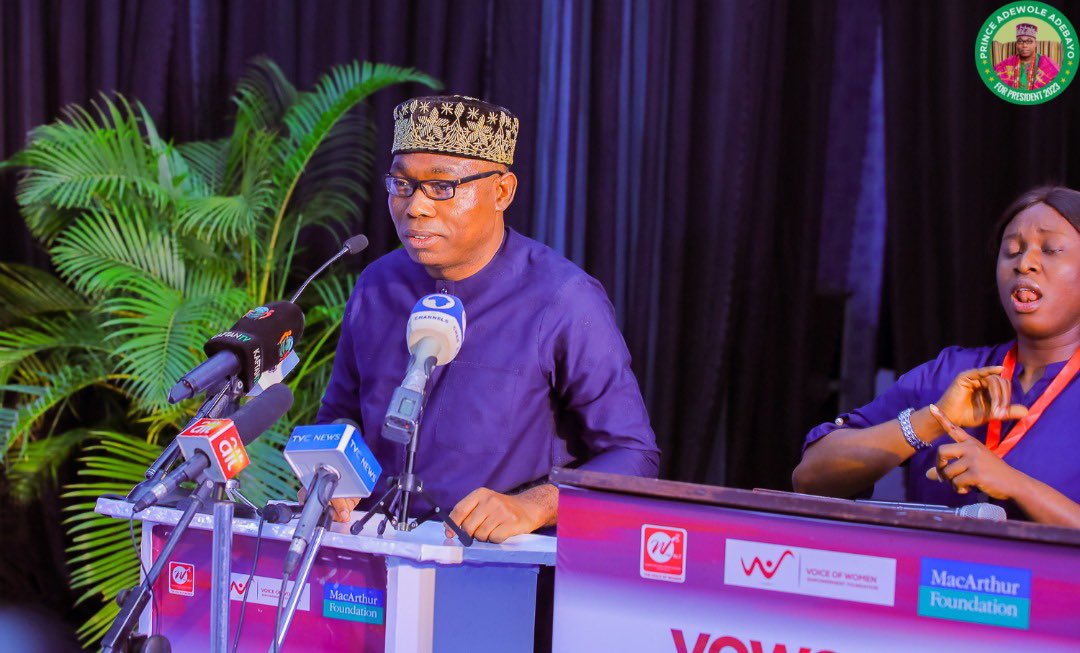
The presidential candidate of the Social Democratic Party (SDP), Adewole Adebayo, has backed the proposed establishment of state police, arguing that concerns over possible abuse by governors should not be used to oppose the reform.
Mr Adebayo made the remarks on Friday during an interview on “Politics Today,” a programme on Channels Television.
“The moment you have a federation, you have legislative lists given to different levels of government. It goes without saying that every level of government is authorised to police,” he said.
Responding to concerns that governors could misuse state police for political purposes, the SDP chieftain argued that the same risk exists with the federal government.
“If you don’t trust the governors, why would you trust the president? There are histories of a president misusing the police. So why have we not abolished the presidency or the federal police?” he stated.
According to Mr Adebayo, a professor, policing is an inherent function of government, and every tier of government should be empowered to enforce laws within its constitutional jurisdiction.
He also suggested the creation of local government police to enforce sanitation regulations, market rules, traffic laws and other local by-laws.
“If you have a governor who is misbehaving, then you vote him out in the next election. How you abuse police, or you don’t abuse police, how you manage law enforcement, will be part of what you consider before deciding whether somebody is fit to be a governor,” he added.
On the proposal to deduct funding for state police directly from the Federation Account, Mr Adebayo said the arrangement would guarantee stable financing for an essential public institution without placing it under federal control.
He likened the proposal to the constitutional provisions for direct funding of state judiciaries, stating that such arrangements ensure funds meant for critical institutions are not diverted.
“It doesn’t mean that the federal government will control. What it means is that the money is spoken for,” he said.
The Senate passed the state police bill in June after more than two-thirds of senators voted in support during a manual voting process.
The House of Representatives, which had earlier passed its version of the bill, withdrew it on Tuesday and has commenced consideration of the Senate’s version.
After passage by both chambers, the bill will be transmitted to the 36 state Houses of Assembly. At least 24 state legislatures must approve it before it can be sent to the president for assent.
There have been several debates regarding the state police. Those who supported the bill have repeatedly said that state policing would bring security closer to the people, improve intelligence gathering and strengthen local responses to crime.
Section 17 of the bill, which deals with appointment, command, direction and tenure, provides that while the Inspector-General of Police shall head the Federal Police Service, the State Police Service shall be headed by a Commissioner of Police appointed by the governor of the state, subject to confirmation by the state’s House of Assembly.
Section 17(6) states that a state governor may give lawful written directives of a general policy nature to the Commissioner of Police of the state on matters relating to the maintenance of public safety and public order.
These sections literally empower governors to exercise significant influence over state policing institutions, while state houses of assembly would provide legislative oversight.
The bill also establishes a State Police Service Commission under Section 22, with powers to recruit personnel and to oversee promotions and discipline of officers within the state police structure.
The state government would also bear substantial responsibility for funding and administering the state police. Although the bill does not expressly state how governors would finance the police, the significant role assigned to state governments suggests that much of the funding would come from the states.
This arrangement effectively gives governors considerable influence over the appointment and supervision of commissioners of police in their respective states.
If implemented, the authority presently concentrated in Abuja would be shared with state governments. This redistribution of security powers could have profound electoral consequences.