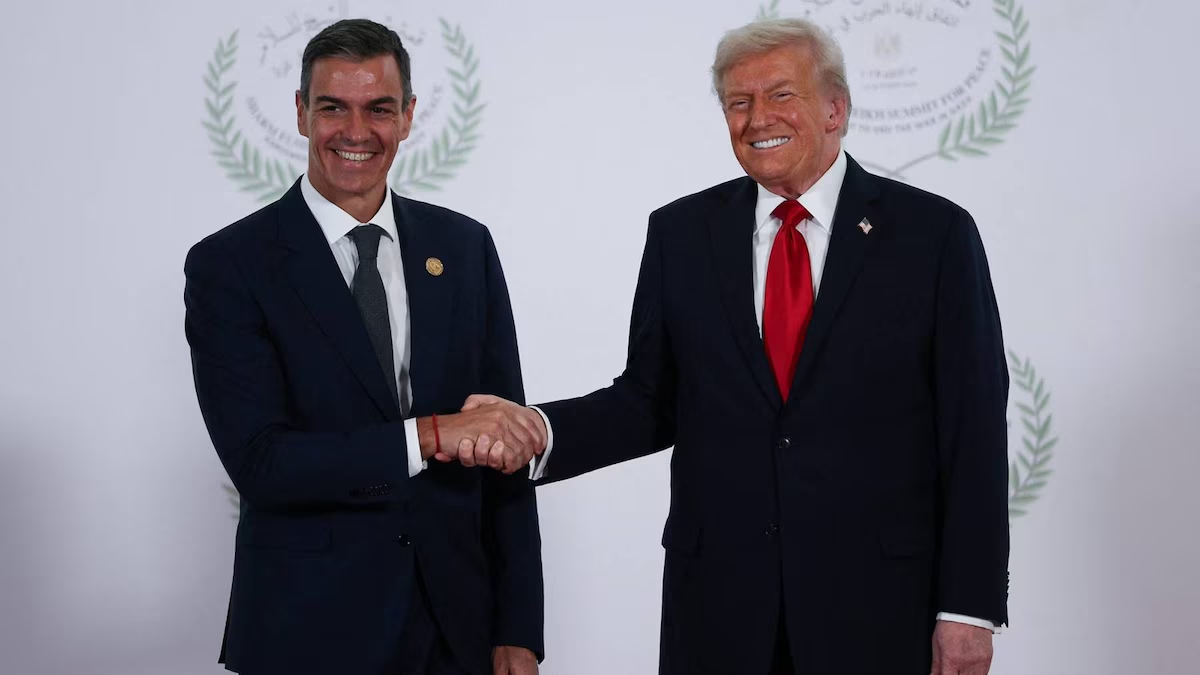
At a NATO summit in Ankara on Wednesday, Trump called Spain a “terrible partner” and ordered an immediate halt to all trade with the country after disputes over defence spending and the Iran war.
On his way back to the United States after the summit, he told reporters aboard Air Force One: “I did have issues, and I still do. But Spain, they came back all the way today. Spain was very generous today.”
Asked what Spain had done, he said: “They honoured a request for lots of payments, and if they didn’t, we wouldn’t have even talked to them.”
A spokesperson for Spanish Prime Minister Pedro Sanchez said this was understood to be a reference to Madrid complying with NATO’s former defence spending target of 2% of GDP.
At the summit, Sanchez highlighted that Spain would reach that goal this year after more than doubling nominal defence spending from 0.98% of GDP in 2017 to nearly €33 billion ($37.7 billion). He played down the rift and said he had a “very cordial” conversation with Trump during the summit.
But Trump has repeatedly criticised Spain for not agreeing to a new objective for NATO member states to spend 5% of GDP on defence by 2035. Spain’s left-wing government says it wants to respond to real threats rather than increasing spending for the sake of it, as that would imply cuts to social benefits.
It was not immediately clear what the softening of Trump’s rhetoric might mean for his threat to halt trade.
Asked about the next steps following Trump’s directive, a U.S. official in Washington told Reuters the relevant federal agencies would present Trump with a “menu” of Spanish products that may be embargoed.
Trade lawyers say Trump could invoke the International Emergency Economic Powers Act to impose a full or partial embargo on Spanish imports. Trump’s first administration imposed a 30% anti-dumping tariff on Spanish black olives in 2018.
OPPOSITION CRITICISM
According to the Spanish government’s agenda, Defence Minister Margarita Robles was set to meet with U.S. Ambassador Benjamin Leon later on Thursday for a “working meeting”, without providing further details.
Sources in the Spanish delegation to Ankara cited by El Mundo said Madrid likened the dispute to a staged fight lacking actual conflict and that Spanish officials had not detected any economic consequences or a decline in investment in Spain in recent years despite Trump’s criticisms.
Some figures in the main opposition People’s Party (PP) blamed Sanchez for the spat but said they stood with their country.
A senior PP official highlighted the interdependence between Spanish and U.S. firms, which meant “economic reality takes precedence over the grandiloquent statements (Trump) seeks to make in order to attack Spain”.
In the PP-run region of Aragon – where big U.S. tech firms including Amazon and Microsoft have invested billions of dollars in data centres – officials said it was business as usual.
Santiago Abascal – a Trump ally who leads far-right party Vox – said the tensions with Washington were “absolutely dramatic” and accused Sanchez of “destroying Spain’s credibility on the world stage”.