Despite billions budgeted for primary healthcare in Ogun State, many health centres remain neglected. In this investigation, DAUD OLATUNJI, exposes the stark gap between government spending and the realities confronting patients at the grassroots.
Across communities in Ogun State, patients continue to arrive at primary healthcare centres only to encounter broken equipment, unreliable electricity, and inadequate health workers.
While successive budgets earmarked billions of naira for primary healthcare infrastructure, an investigation by PLATFORM TIMES found that only a small portion of the approved funds was eventually released, raising concerns over the impact of poor budget implementation on healthcare delivery.
A PLATFORM TIMES investigation across four local governments in the state – Odeda,Ikenne,Imeko-Afon and Abeokuta-South – revealed a gap between government spending commitments and the state of primary healthcare facilities.
Nine primary healthcare centres were visited during this investigation. While conditions of the facilities varied, they all showed signs of a healthcare system under severe strain. In many facilities, critical infrastructure was either inadequate or deteriorating, medical equipment were lacking, staffing levels fell far below demand, and essential services were limited.
Budget records deepen concerns
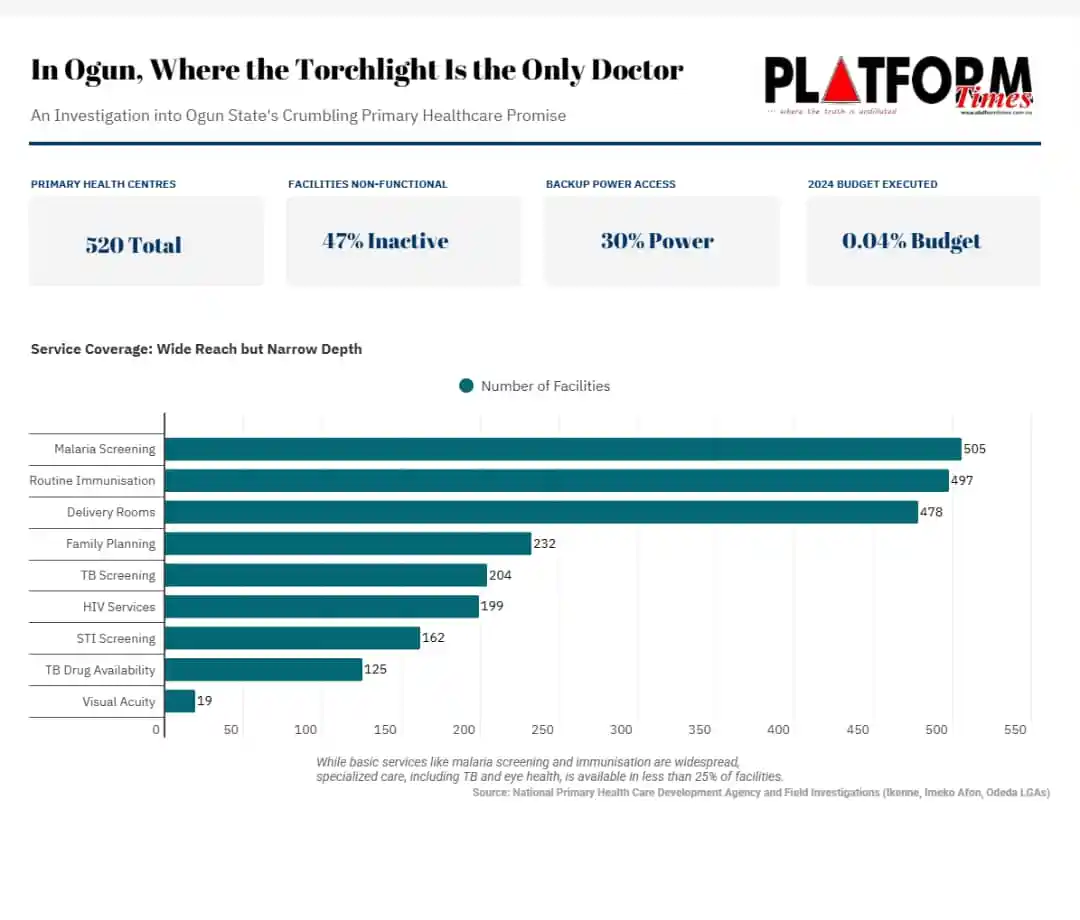
According to Ogun State’s 2024 Budget Implementation Report, the Ogun State Primary Healthcare Development Board spent just ₦3.96million of its ₦ 10.55 billion capital budget by the end of the fiscal year, representing approximately 0.04 per cent of the revised allocation.
The figure was cross- checked against the state’s approved budget document. In practical terms, for every ₦1,000 budgeted for constructing, equipping and maintaining primary healthcare facilities across the state, less than 50 kobo was spent.
The Network On Paper
While the government failed to release the funds meant for the primary health centres; the centres are in horrible condition. Data obtained from the National Primary HealthCare Development Agency dashboard paints a mixed picture of Ogun State’s primary healthcare system.
Of the state’s 520 primary healthcare facilities, only 47 percent are classified as functional. Infrastructure gaps remain widespread. Only 157 facilities have backup power, 117 provide staff accommodation, while just 57 have been renovated through government or development partner interventions.
The availability of essential health services is similarly uneven. Whilst 505 facilities provide malaria screening and 497 offer routine immunisation. Family planning is available in only 232 facilities, HIV services were in 199, tuberculosis screening in 204, sexually transmitted infection screening in 162, while TB treatment is available in just 125 facilities. Basic eye care services are the scarcest to fall, offered in only 19 facilities, less than four per cent of the state’s primary healthcare network.
ODEDA: Low Awareness, Lower Capacity