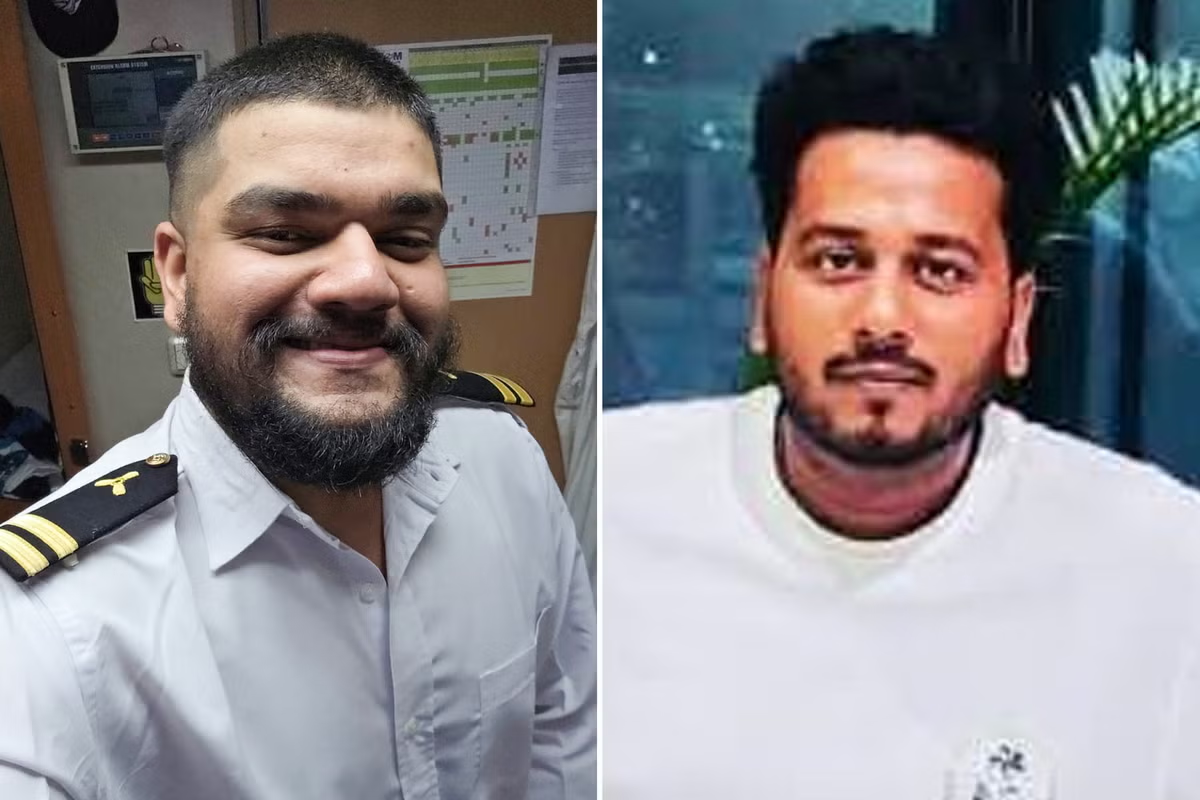
“Our ship has safely crossed,” Herambh Karmarkar wrote in a message to his family as his vessel left the Strait of Hormuz.
It was the last text that the 30-year-old marine engineer would ever send. Hours later, he was killed in an Iranian strike on his ship, the Cyprus-flagged GFS Galaxy,as it passed by the coast of Oman on Sunday.
For days he had been reported missing, but on Wednesday his family in India received the news they had been dreading.
“We received a condolence message from the company saying that Herambh is no more,” the seafarer’s father-in-law Vivek Tandon told The National.
“We are all in a bad state after receiving this news. Now we just want Herambh back to complete his last rites.”
US Central Command said that his ship, a Dubai-bound container vessel with 24 crew members on board, had been struck by an unidentified projectile while crossing the Strait of Hormuz. Since the beginning of the US-Israeli war on Iran in February, ships have faced frequent attacks as Tehran seeks to weaponise the route in a bid to disrupt oil supply and damage the global economy.
Herambh is not the only seafarer to die while crossing the strait. At least 16 others, mostly Indian nationals, have been killed since the war began.
Rohan Kumar, 31, was killed after two Emirati oil tankers, the Mombasa B and Al Bahiyah, came under attack on Tuesday. His brother Manesh Kumar told the Hindustan Times that Rohan had been “working tirelessly” at sea to support the family. “Those dreams are shattered now,” he said.
India has since barred its seafarers from working in Hormuz until further orders. Over 20,000 workers of all nationalities are based in the region with plans to evacuate at least 6,000 of them who are stranded, according to the International Maritime Organisation.
Those who are not killed or injured by Iranian attacks face horrific conditions on board and the situation has spiralled into a humanitarian catastrophe, trade unions told The Independent. For weeks and months at a time, workers have been left without food, fuel for amenities including air conditioning in sweltering summer temperatures, and medication.
Most of the seafarers are from the global South with families dependent on their sole income. But many have not been paid in months, unions say. Hidden behind headlines about stagnating economies, fuel shortages and oil prices is a devastating human cost.
“This is impunity. This is modern day slavery and systemic exploitation,” says Mohamed Arrachedi, the International Transport Workers’ Federation’s (ITF) network coordinator for the Arab world and Iran.
“Especially when you don’t give food and water, these are basic human rights.”
Since February, the ITF says that it has had over 3,000 requests for help from stranded seafarers. “That is not the number of individuals, which is far higher. Each call is from someone representing their crew, which can be five people or 20.”
Most of the requests are for unpaid wages and requests for repatriation, with 10 per cent relating to concerns about low provisions and fuel. Mr Arrachedi says that workers are terrified and nervous while they remain legally “abandoned” on the ships.
Under the Maritime Legal Convention 2006, crew members are considered legally abandoned when they are not provided with food, water, fuel and medical care, for at least two months.
But the convention is difficult to enforce with international waters becoming a legal no man’s land. Ship crew can be of several nationalities on a ship that is dubiously marked with the flag of a nation that is not tied to the destination or shipping company, which are based in multiple other countries. It makes it a lengthy process to attribute responsibility, and finding a resolution can take months.
In the meantime, Mr Arrachedi says that seafarers are desperate.
“One of the guys told me that if there is no solution to this, he will take his own life. And it’s not the only one that we’ve received since the war started, because human beings have limitations.”
Others have serious medical conditions such as high blood pressure and have been left without medication for months. One needs to go to the doctor for a potential prostate problem because he is passing blood in his urine, says Mr Arrachedi.
Responses from shipping companies are mixed. Some require workers to pay for their own flight repatriation tickets, which can cost over $1,000. For a seafarer earning around $200 a month, the costs are eye-watering and prohibitive.
Mr Arrachedi shares the case of one man who requested repatriation and has been taken off work by the employer and confined to his cabin.
The ITF and others are working on collective bargaining strategies to allow workers the agency to refuse to pass through the strait. But thousands of non-unionised workers remain unprotected with insecure employment contracts and no knowledge of their rights. There are approximately 15,000 vessels that are not unionised and remain exposed.
Unions also demand compensation for workers whose lives have been at risk while working.
In a landmark case, three Thai nationals who were aboard the ship Mayuree Naree, which was hit by a projectile north of Oman on 11 March, are suing the vessel’s operator over labour rights violations and unfair dismissal. Three people were killed and the remaining 20 rescued.