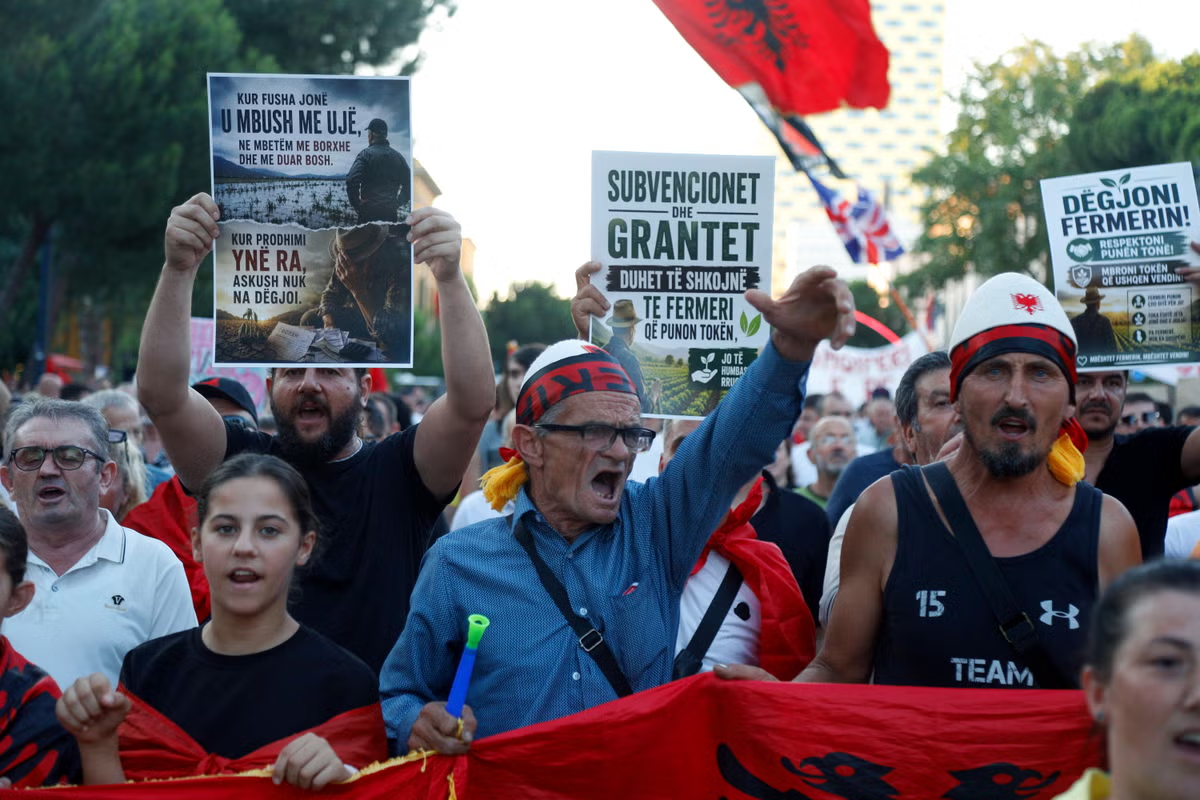
Many of the protestors marching through the streets of Tirana last night had been demonstrating for 46 consecutive days. For over six weeks, every night they meet in Skanderbeg Square in the centre of the Albanian capital and march to the office of Prime Minister Edi Rama where speeches are made demanding a change of government, before the crowd peacefully, yet determinedly, walks through the streets of the city calling for Shqipëri e re (a new Albania).
It’s tiring, often very hot, and there’s a sense of frustration among protestors that Albania’s leaders are refusing to listen to their demands – along with the fear that the world’s media are losing interest as the days wear on.
So to hear a global superstar like Dua Lipa throw her support behind their cause is being welcomed by activists.
Speaking on her Service95 Book Club podcast, the singer said she found it inspiring to see how much people really care by taking to the streets every night.
She added: “What I actually find concerning is the principle that the government could just change the law to remove the environmental protection without any kind of public consultation.”
Writing in CNA, an Albania news publication that carries the slogan “no censorship”, human rights activist Besim Ndregjoni is emphatic in his praise for Dua Lipa, describing her as “a worthy defender of freedom” with “national vision” and “cultural foresight”.
He adds: “Thank you Dua Lipa for the contribution you make to the freedom of Albanians who are hostages of Edi Rama’s communism. The cream of Albanian intellectuals, academics and professors, who impart knowledge in the universities of the democratic world, have joined the new Albania!”
Aleksandër Trajçe, executive director of theProtection and Preservation of Natural Environment in Albania (PPNEA), describes Dua Lipa’s comments as “a breath of fresh air”.
He says: “Her voice reaches millions, and for many young Albanians she is a role model. Seeing someone of her stature speak openly about the lack of transparency surrounding this project has given people fresh hope and determination. She has chosen to stand on the side of nature, transparency and the public interest, and I believe history will remember that.”
Ger Emeri is editor-in-chief of Amfora.al Media, a non-profit local news outlet based in the Albanian city of Durres. He says Dua Lipa’s comments would have been “undoubtedly uncomfortable” for Mr Rama, who has met the singer several times to promote his own image and Albania’s international profile.
He adds: “The protests have already surpassed every previous record for sustained civic mobilisation in Albania. Despite their creativity and peaceful nature, protesters face daily attacks, ridicule and attempts to delegitimise them by Prime Minister Rama, members of the Socialist Party and senior public officials.
“The fact that one of the protest movement’s central concerns – the lack of transparency and the removal of protected status from environmentally sensitive areas without meaningful public consultation – was highlighted during Dua Lipa’s conversation gives greater visibility to the movement and helps ensure that citizens’ concerns are heard internationally.”
Activist Bora Mema, a member of the the left-wing political party Levizja Bashke (Together Movement), agrees that the fact that Dua Lipa is speaking out against the government after politicians like Mr Rama and Tirana mayor Erion Veliaj (currently in prison on pre-trial detention for charges of corruption and money laundering) previously used her to promote the country is a positive development for the movement.
Others have been more restrained in their response. Like many activists, Grigor Malo has been waiting for Dua Lipa, who has Kosovo Albanian parents and speaks warmly about her heritage, to comment on the protests for the past few weeks.
He says: “I don’t want to be harsh to her, and her support is more than welcome, but the comments came a little too late.”
Mr Malo points out that Dua Lipa has been quick to condemn actions in Palestine, but it has taken her six weeks to comment on the events in Albania.
The nightly protests in Tirana were sparked by Ivanka Trump and Jared Kushner’s plans to build luxury resorts on protected lands on the Zvernec Peninsula and Sazan Island on the Adriatic coast, but have since swelled into anti–government protests demanding the resignation of Mr Rama and an end to corruption. Dubbed the “flamingo revolution” after the pink wading birds that live in the protected areas under threat, the demonstrations have brought tens of thousands of Albanians onto the streets since the end of May.
A highly contentious Kanye West concert that took place in Tirana last Saturday July 11 has added to activists’ frustrations, with protestors criticising the government for welcoming a singer who is banned in other European countries for his neo-Nazi and anti-semitic outbursts, and releasing an emergency €4m to save the concert when not enough tickets were sold.
In a Facebook post, Mr Rama defended the spend as an “investment” that would provide “global marketing” for Albania.
Artan Kacani is also cautious in his praise for Dua Lipa, pointing out that when the singer travels to the Albanian coast she stays in luxury properties. Dua Lipa has posted photos believed to be from Kep Merli, an exclusive, ultra-luxe resort in Ksamil in the southwest of the country.
Like most activists who spoke to The Independent, Mr Kacani believes that tourism is a good thing for Albania and they actively welcome international visitors, but urges tourists to think carefully about where they choose to stay and spend their money.
Mr Kacani, an urban planner from Durres, cautions that luxury resorts are being built at the expense of smaller family-run hotels and restaurants, which have been cleared to make way for the larger developments.
But rather than being “too late”, Mr Emiri suggests that Dua Lipa’s comments actually come at a critical time for the protests.
“I believe her intervention comes at an important moment,” he says. “The Albanian government has intensified efforts to discredit individual protesters and undermine the movement. Statements like Dua Lipa’s reinforce that the protesters’ core concerns – particularly the changes to protected area boundaries without meaningful public consultation and against the recommendations of environmental experts – are legitimate and grounded in fact.”