Weeks after the end of a historic term, Supreme Court Justices Elena Kagan and Amy Coney Barrett will make a rare appearance before Congress on Tuesday at 10 a.m. ET. The justices could face wide-ranging questions as the high court seeks millions of dollars to beef up security amid a rise in threats to the judiciary.
Down the street, U.S. President Donald Trump will welcome new Iraqi Prime Minister Ali al-Zaidi to the White House after strongly backing the political novice’s bid for office. Iraq has been under pressure to disarm Iran-backed militias that attacked U.S. bases and diplomatic facilities after the U.S. and Israel instigated the Iran war.
The U.S. launched more strikes on Iran early Tuesday, hours after Trump vowed to reinstate an American blockade of Iranian ports and charge ships 20% of their cargo for safe passage through the Strait of Hormuz. Iran responded with more attacks on Middle East allies, leaving the ceasefire deal in tatters and under the threat of all-out war. The U.S. military said it will resume its naval blockade on Tuesday at 4 p.m. ET.
The Latest:
Trump to welcome Iraq’s new prime minister to the White House
Al-Zaidi has been under pressure to disarm a network of Iran-backed militias operating in the country, some of which launched attacks on U.S. bases and diplomatic facilities after the U.S. and Israel launched their war against Iran.
Trump is scheduled to greet the Iraqi leader Zaidi at 11 a.m., followed by an Oval Office meeting.
Renad Mansour, director of the Iraq Initiative at the Chatham House think tank, expects that “the U.S. will put significant pressure on al-Zaidi” to move ahead with disarmament “and Zaidi will respond by saying, ‘But I need support — intelligence support, technical support, armed support.’”
“There is a scenario in which, if the Iraqi government starts going after these groups, they will also go after the government,” Mansour said. “And this is a scenario that I think that the Iraqi government is apprehensive about.”
‘Dangerous.’ ‘Brazen.’ ‘Unprecedented.’ ‘Uncharted territory’
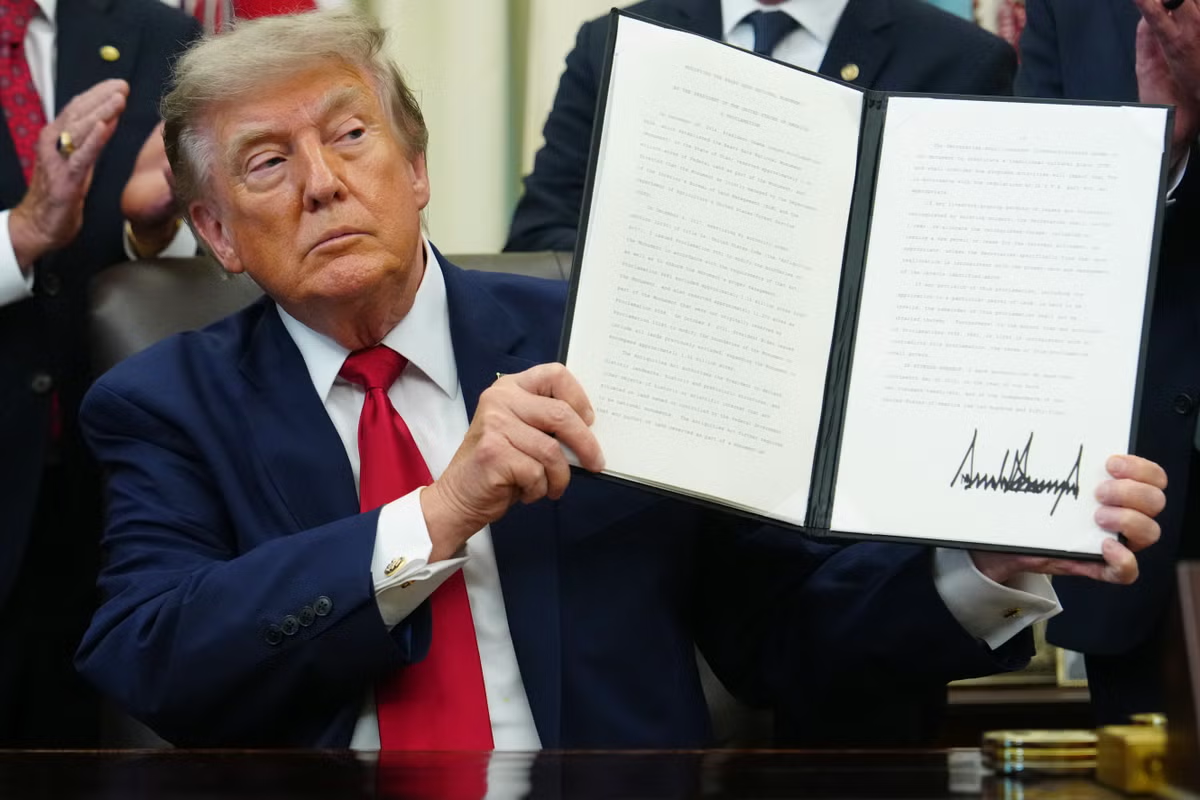
Reaction has been swift and severe to the issue of subpoenas to five New York Times journalists who reported on security questions involving Trump’s new Qatari-gifted Air Force One.
“The subpoenas are an extraordinary escalation in President Trump’s efforts to threaten and intimidate independent news organizations and have a chilling effect on the work of journalists across the country,” said Jodie Ginsberg, CEO of the Committee to Protect Journalists.
The White House Correspondents Association holds its rescheduled dinner celebrating the First Amendment in less than two weeks, with Trump planning to attend. The first was scuttled when a shooter opened fire in what prosecutors say was an attempt to kill the president.
“The WHCA condemns any act of intimidation against journalists, including attempts to pressure them into revealing sources,” said a statement from the group’s president, Weijia Jiang.
▶ Read more
What does the Supreme Court want from Congress?
Security is central to the court’s budget request of $228 million — roughly 10% more than the last fiscal year.
Nearly $15 million of that would go to expanding personal protection for justices, with six more agents for each.
Another $2 million would fund more Supreme Court police officers and an off-site residential security post to speed emergency responses.
The U.S. Marshals Service reported 564 threats to the hundreds of federal judges around the country during the last fiscal year, and justices have not been immune: Barrett’s security detail had to defuse a fake 911 call at her house, and her sister was the victim of a bomb threat. A would-be assassin was arrested near the home of Justice Brett Kavanaugh.
Chief Justice John Roberts has condemned the threats, saying it’s “dangerous, and it’s got to stop.”
June inflation report shows complicated outlook for Trump on economy
The White House will have reasons to rejoice in the June release of the consumer price index, as prices fell 0.4% on a monthly basis in large part because of tumbling oil prices tied to the now deteriorated ceasefire with Iran.
But prices still rose 3.5% over the past 12 months, well above the Federal Reserve’s inflation target of 2%.
And the monthly decline could be short-lived, with oil prices jumping again as fighting intensifies in the Middle East.